

Some Patterns of the Distribution of Bottom Fauna in the Indian Ocean
471
II. Trophic Structure
The bottom population of the ocean may be divided into three groups according to
their food habits: detritus-feeders (feeding on detritus from bottom sediments), sestonfeeders (feeding on particulate matter suspended in the bottom water layer) and carnivores
(feeding on living or dead bodies). Thus the basic food of bottom animals consists of
detritus, and the source of detritus is the organic matter produced in the surface layer
of the ocean, which reaches the sea floor after undergoing considerable transformation.
In all the more or less productive regions of the ocean feeding conditions at all depths
are favorable for the existence of all 3 trophic groups of bottom invertebrates.
Conversely, in the least productive regions, usually remote from the shore and lying
within tropical latitudes, feeding conditions are most adverse. Here in the impoverished
benthic communities detritus-feeding invertebrates are either absent or insignificant.
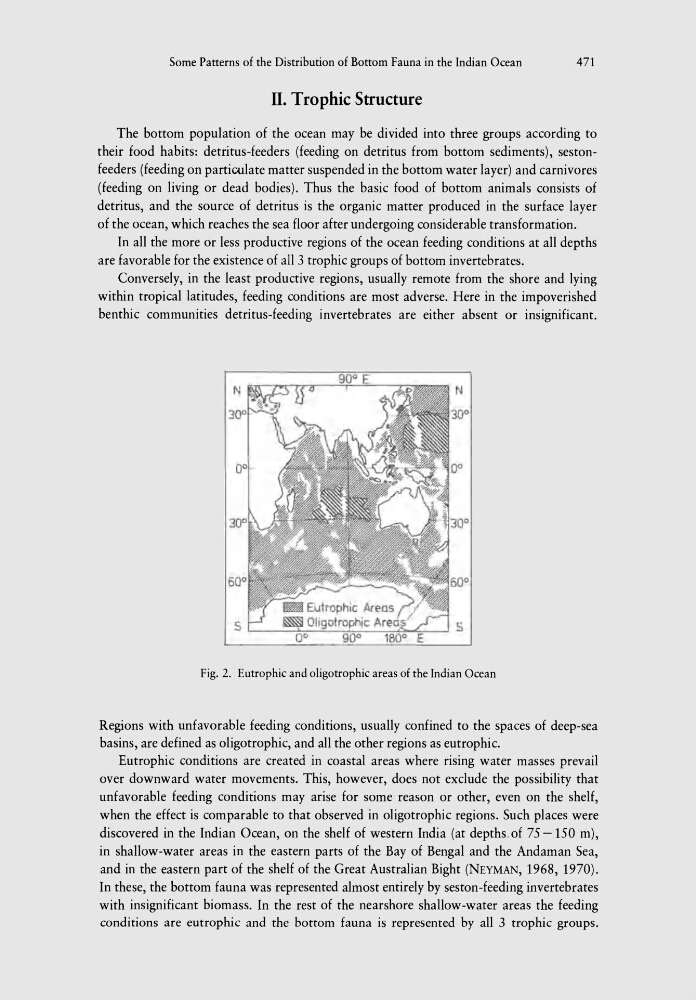
Fig. 2. Eutrophic and oligotrophic areas of the Indian Ocean
Regions with unfavorable feeding conditions, usually confined to the spaces of deep-sea
basins, are defined as oligotrophic, and all the other regions as eutrophic.
Eutrophic conditions are created in coastal areas where rising water masses prevail
over downward water movements. This, however, does not exclude the possibility that
unfavorable feeding conditions may arise for some reason or other, even on the shelf,
when the effect is comparable to that observed in oligotrophic regions. Such places were
discovered in the Indian Ocean, on the shelf of western India (at depths. of 75 -150 m),
in shallow-water areas in the eastern parts of the Bay of Bengal and the Andaman Sea,
and in the eastern part of the shelf of the Great Australian Bight (NEYMAN, 1968, 1970).
In these, the bottom fauna was represented almost entirely by seston-feeding invertebrates
with insignificant biomass. In the rest of the nearshore shallow-water areas the feeding
conditions are eutrophic and the bottom fauna is represented by all 3 trophic groups.
471
II. Trophic Structure
The bottom population of the ocean may be divided into three groups according to
their food habits: detritus-feeders (feeding on detritus from bottom sediments), sestonfeeders (feeding on particulate matter suspended in the bottom water layer) and carnivores
(feeding on living or dead bodies). Thus the basic food of bottom animals consists of
detritus, and the source of detritus is the organic matter produced in the surface layer
of the ocean, which reaches the sea floor after undergoing considerable transformation.
In all the more or less productive regions of the ocean feeding conditions at all depths
are favorable for the existence of all 3 trophic groups of bottom invertebrates.
Conversely, in the least productive regions, usually remote from the shore and lying
within tropical latitudes, feeding conditions are most adverse. Here in the impoverished
benthic communities detritus-feeding invertebrates are either absent or insignificant.
Fig. 2. Eutrophic and oligotrophic areas of the Indian Ocean
Regions with unfavorable feeding conditions, usually confined to the spaces of deep-sea
basins, are defined as oligotrophic, and all the other regions as eutrophic.
Eutrophic conditions are created in coastal areas where rising water masses prevail
over downward water movements. This, however, does not exclude the possibility that
unfavorable feeding conditions may arise for some reason or other, even on the shelf,
when the effect is comparable to that observed in oligotrophic regions. Such places were
discovered in the Indian Ocean, on the shelf of western India (at depths. of 75 -150 m),
in shallow-water areas in the eastern parts of the Bay of Bengal and the Andaman Sea,
and in the eastern part of the shelf of the Great Australian Bight (NEYMAN, 1968, 1970).
In these, the bottom fauna was represented almost entirely by seston-feeding invertebrates
with insignificant biomass. In the rest of the nearshore shallow-water areas the feeding
conditions are eutrophic and the bottom fauna is represented by all 3 trophic groups.