

Kinds and Abnndance of Fish Larvae in the Arabian Sea and the Persian Gulf
417
ocean between Mombasa and Cochin, the ratio for number of species caught at night
to number of species caught by day was 1 for RT hauls. The HLN fished always somewhat
deeper than the RT, so the less prolific day catches with the HLN were not likely to have
occurred because mostlarvae stayed much deeper during the day. If this were so, the opposite
effect should have resulted. However, many fish larvae species do show a near-surface
distribution at night (HARTMANN, 1970; NELLEN and HEMPEL; 1970; NELLEN, 1972)
and, as vertically towed nets whenever they do not follow a very straight vertical line
tend to drag at the surface before lifting out of the water, the HLN may have filtered
a higher volume of surface water compared to other depths. Such an effect may have
increased the chance of catching more species at night.
During an oblique RT haul roughly 10 times more water was filtered than during a
vertical HLN standard haul. Thus an RT haul probably integrates the number of fish
II)
Q)
·u
Q)
a.
II)
'0
d
z
Q)
01
~
Q)
>
<{
Red Sea -
Gull of Aden
Ea ~t Afr i ca
D HLN 0 -100m day
HlN 0 -100m night
-
RT day
em RT night
0
HLN O->100m day
-
HLN 0- > 100m night
open Ocean
Indian Westeoost
G.of Oman
Ironion Gulf
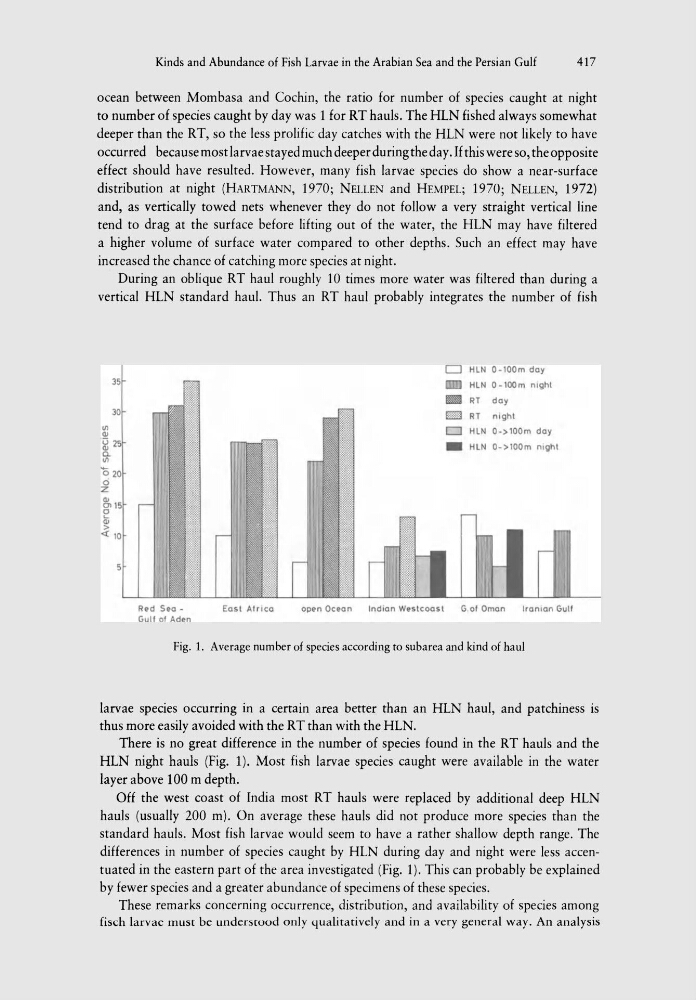
Fig. 1. Average number of species according to subarea and kind of haul
larvae species occurring in a certain area better than an HLN haul, and patchiness is
thus more easily avoided with the RT than with the HLN.
There is no great difference in the number of species found in the RT hauls and the
HLN night hauls (Fig. 1). Most fish larvae species caught were available in the water
layer above 100 m depth.
Off the west coast of India most RT hauls were replaced by additional deep HLN
hauls (usually 200 m). On average these hauls did not produce more species than the
standard hauls. Most fish larvae would seem to have a rather shallow depth range. The
differences in number of species caught by HLN during day and night were less accentuated in the eastern part of the area investigated (Fig. 1). This can probably be explained
by fewer species and a greater abundance of specimens of these species.
These remarks concerning occurrence, distribution, and availability of species among
fisch larvae must be understood only qualitatively and in a very general way. An analysis
417
ocean between Mombasa and Cochin, the ratio for number of species caught at night
to number of species caught by day was 1 for RT hauls. The HLN fished always somewhat
deeper than the RT, so the less prolific day catches with the HLN were not likely to have
occurred because mostlarvae stayed much deeper during the day. If this were so, the opposite
effect should have resulted. However, many fish larvae species do show a near-surface
distribution at night (HARTMANN, 1970; NELLEN and HEMPEL; 1970; NELLEN, 1972)
and, as vertically towed nets whenever they do not follow a very straight vertical line
tend to drag at the surface before lifting out of the water, the HLN may have filtered
a higher volume of surface water compared to other depths. Such an effect may have
increased the chance of catching more species at night.
During an oblique RT haul roughly 10 times more water was filtered than during a
vertical HLN standard haul. Thus an RT haul probably integrates the number of fish
II)
Q)
·u
Q)
a.
II)
'0
d
z
Q)
01
~
Q)
>
<{
Red Sea -
Gull of Aden
Ea ~t Afr i ca
D HLN 0 -100m day
HlN 0 -100m night
-
RT day
em RT night
0
HLN O->100m day
-
HLN 0- > 100m night
open Ocean
Indian Westeoost
G.of Oman
Ironion Gulf
Fig. 1. Average number of species according to subarea and kind of haul
larvae species occurring in a certain area better than an HLN haul, and patchiness is
thus more easily avoided with the RT than with the HLN.
There is no great difference in the number of species found in the RT hauls and the
HLN night hauls (Fig. 1). Most fish larvae species caught were available in the water
layer above 100 m depth.
Off the west coast of India most RT hauls were replaced by additional deep HLN
hauls (usually 200 m). On average these hauls did not produce more species than the
standard hauls. Most fish larvae would seem to have a rather shallow depth range. The
differences in number of species caught by HLN during day and night were less accentuated in the eastern part of the area investigated (Fig. 1). This can probably be explained
by fewer species and a greater abundance of specimens of these species.
These remarks concerning occurrence, distribution, and availability of species among
fisch larvae must be understood only qualitatively and in a very general way. An analysis