

4.15
Distribution and Ecology of Pterotrachea coronata
(FORSKAL)
P. N. ARAVINDAKSHAN
The genus Pterotrachea comprises 4 species, Pt. coronata being the largest. This
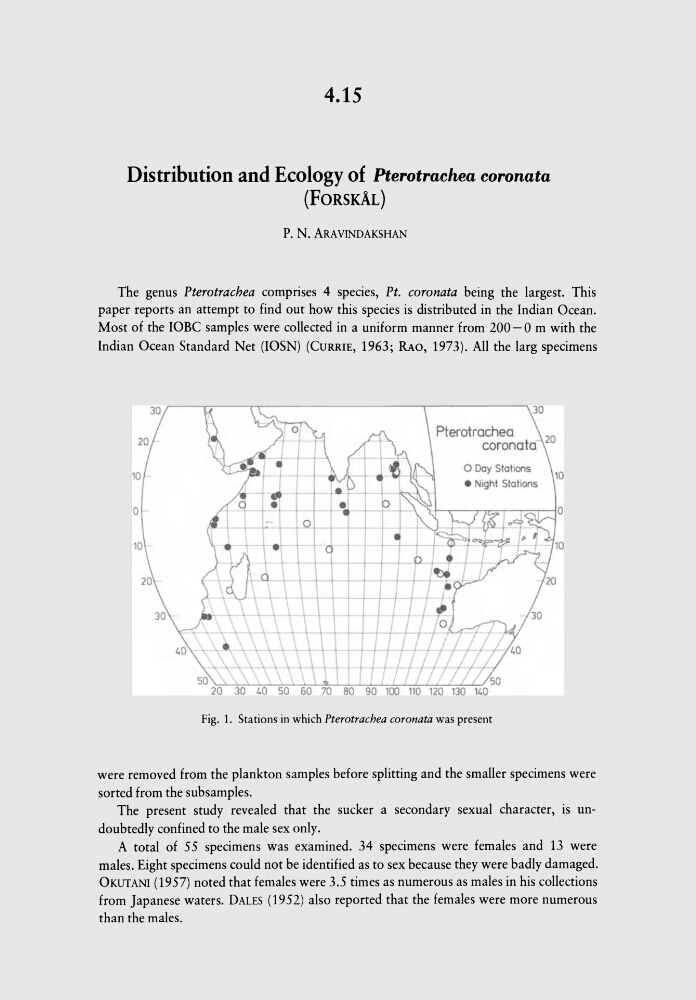
paper reports an attempt to find out how this species is distributed in the Indian Ocean.
Most of the IOBC samples were collected in a uniform manner from 200 - 0 m with the
Indian Ocean Standard Net (IOSN) (CURRIE, 1963; RAo, 1973). All the larg specimens
Fig. 1. Stations in which Pterotrachea coronata was present
were removed from the plankton samples before splitting and the smaller specimens were
sorted from the subsamples.
The present study revealed that the sucker a secondary sexual character, is undoubtedly confined to the male sex only.
A total of 55 specimens was examined. 34 specimens were females and 13 were
males. Eight specimens could not be identified as to sex because they were badly damaged.
OKUTANI (1957) noted that females were 3.5 times as numerous as males in his collections
from Japanese waters. DALES (1952) also reported that the females were more numerous
than the males.
Distribution and Ecology of Pterotrachea coronata
(FORSKAL)
P. N. ARAVINDAKSHAN
The genus Pterotrachea comprises 4 species, Pt. coronata being the largest. This
paper reports an attempt to find out how this species is distributed in the Indian Ocean.
Most of the IOBC samples were collected in a uniform manner from 200 - 0 m with the
Indian Ocean Standard Net (IOSN) (CURRIE, 1963; RAo, 1973). All the larg specimens
Fig. 1. Stations in which Pterotrachea coronata was present
were removed from the plankton samples before splitting and the smaller specimens were
sorted from the subsamples.
The present study revealed that the sucker a secondary sexual character, is undoubtedly confined to the male sex only.
A total of 55 specimens was examined. 34 specimens were females and 13 were
males. Eight specimens could not be identified as to sex because they were badly damaged.
OKUTANI (1957) noted that females were 3.5 times as numerous as males in his collections
from Japanese waters. DALES (1952) also reported that the females were more numerous
than the males.