

346
A. FLEMINGER and K. HULSEMANN:
h
@
~
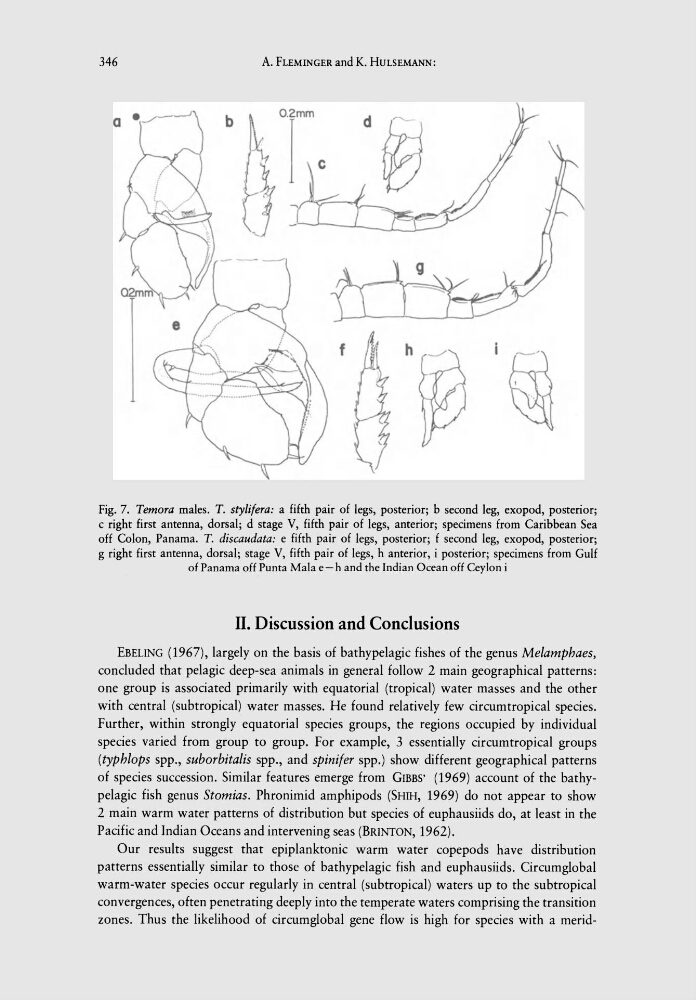
Fig. 7. Temora males. T. stylifera: a fifth pair of legs, posterior; b second leg, exopod, posterior;
c right first antenna, dorsal; d stage Y, fifth pair of legs, anterior; specimens from Caribbean Sea
off Colon, Panama. T. discaudata: e fifth pair of legs, posterior; f second leg, exopod, posterior;
g right first antenna, dorsal; stage Y, fifth pair of legs, h anterior, i posterior; specimens from Gulf
of Panama off Punta Mala e - h and the Indian Ocean off Ceylon i
II. Discussion and Conclusions
EBELING (1967), largely on the basis of bathypelagic fishes of the genus Melamphaes,
concluded that pelagic deep-sea animals in general follow 2 main geographical patterns:
one group is associated primarily with equatorial (tropical) water masses and the other
with central (subtropical) water masses. He found relatively few circumtropical species.
Further, within strongly equatorial species groups, the regions occupied by individual
species varied from group to group. For example, 3 essentially circum tropical groups
(typhlops spp., suborbitalis spp., and spinifer spp.) show different geographical patterns
of species succession. Similar features emerge from GIBBS' (1969) account of the bathypelagic fish genus Stomias. Phronimid amphipods (SHIH, 1969) do not appear to show
2 main warm water patterns of distribution but species of euphausiids do, at least in the
Pacific and Indian Oceans and intervening seas (BRINTON, 1962).
Our results suggest that epiplanktonic warm water copepods have distribution
patterns essentially similar to those of bathypelagic fish and euphausiids. Circumglobal
warm-water species occur regularly in central (subtropical) waters up to the subtropical
convergences, often penetrating deeply into the temperate waters comprising the transition
zones. Thus the likelihood of circumglobal gene flow is high for species with a merid-
A. FLEMINGER and K. HULSEMANN:
h
@
~
Fig. 7. Temora males. T. stylifera: a fifth pair of legs, posterior; b second leg, exopod, posterior;
c right first antenna, dorsal; d stage Y, fifth pair of legs, anterior; specimens from Caribbean Sea
off Colon, Panama. T. discaudata: e fifth pair of legs, posterior; f second leg, exopod, posterior;
g right first antenna, dorsal; stage Y, fifth pair of legs, h anterior, i posterior; specimens from Gulf
of Panama off Punta Mala e - h and the Indian Ocean off Ceylon i
II. Discussion and Conclusions
EBELING (1967), largely on the basis of bathypelagic fishes of the genus Melamphaes,
concluded that pelagic deep-sea animals in general follow 2 main geographical patterns:
one group is associated primarily with equatorial (tropical) water masses and the other
with central (subtropical) water masses. He found relatively few circumtropical species.
Further, within strongly equatorial species groups, the regions occupied by individual
species varied from group to group. For example, 3 essentially circum tropical groups
(typhlops spp., suborbitalis spp., and spinifer spp.) show different geographical patterns
of species succession. Similar features emerge from GIBBS' (1969) account of the bathypelagic fish genus Stomias. Phronimid amphipods (SHIH, 1969) do not appear to show
2 main warm water patterns of distribution but species of euphausiids do, at least in the
Pacific and Indian Oceans and intervening seas (BRINTON, 1962).
Our results suggest that epiplanktonic warm water copepods have distribution
patterns essentially similar to those of bathypelagic fish and euphausiids. Circumglobal
warm-water species occur regularly in central (subtropical) waters up to the subtropical
convergences, often penetrating deeply into the temperate waters comprising the transition
zones. Thus the likelihood of circumglobal gene flow is high for species with a merid-