

292
T. BALACHANDRAN: Meroplanktonic Stages of Anthozoa in the Indian Ocean
Of the hauls having more than 20 larvae, 43 night hauls (1725 larvae) averaged 40 per
haul, and 28 day hauls (1133 larvae) averaged 40 per haul. This probably shows some
diurnal effect. The hauls made at 2000 to 2100 h, 0100 to 0600 h, 0800 to 1200 h,
1500 to 1800 h, and 2200 to 2300 h had fairly good catches, probably indicating an
absence of hourly effect on larval catch. While one haul at 2100 h had 190 larvae, one
haul at 0900 had 112, indicating patchiness. There was no relation of catch to plankton
biomass.
III. Effect of Structure of Water Column on Bathymetric
Distribution of Larvae
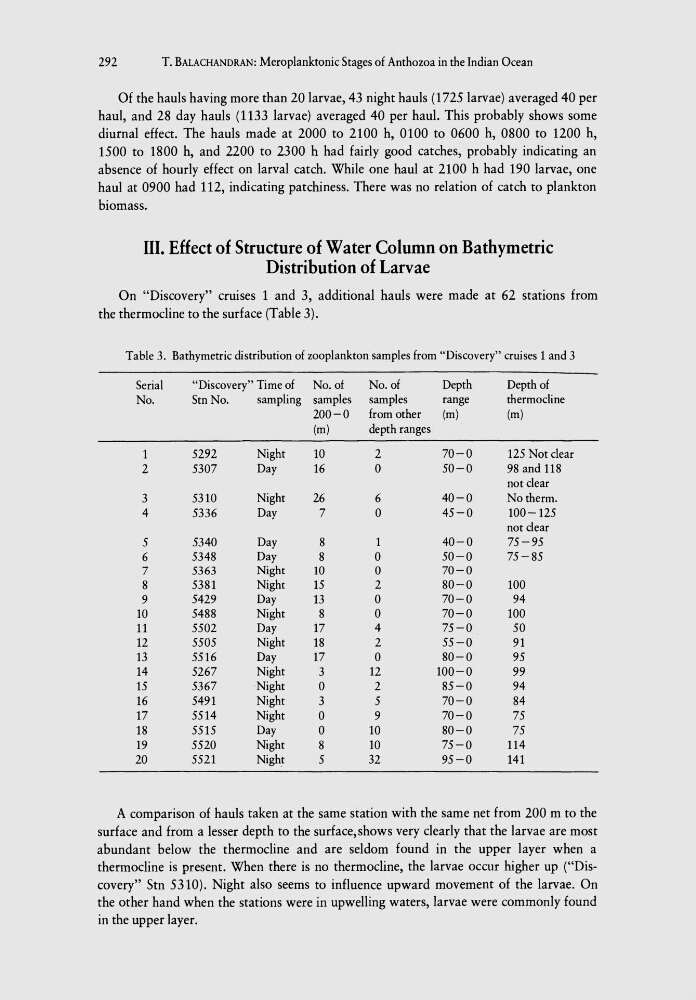
On "Discovery" cruises 1 and 3, additional hauls were made at 62 stations from
the thermocline to the surface (Table 3).
Table 3. Bathymetric distribution of zooplankton samples from "Discovery" cruises 1 and 3
Serial
"Discovery" Time of No. of
No. of
Depth
Depth of
No.
Stn No.
sampling samples samples
range
thermocline
200-0
from other
(m)
(m)
(m)
depth ranges
1
5292
Night
10
2
70-0
125 Not clear
2
5307
Day
16
0
50-0
98 and 118
not clear
3
5310
Night
26
6
40-0
Notherm.
4
5336
Day
7
0
45-0
100-125
not clear
5
5340
Day
8
1
40-0
75-95
6
5348
Day
8
0
50-0
75-85
7
5363
Night
10
0
70-0
8
5381
Night
15
2
80-0
100
9
5429
Day
13
0
70-0
94
10
5488
Night
8
0
70-0
100
11
5502
Day
17
4
75-0
50
12
5505
Night
18
2
55-0
91
13
5516
Day
17
0
80-0
95
14
5267
Night
3
12
100-0
99
15
5367
Night
0
2
85-0
94
16
5491
Night
3
5
70-0
84
17
5514
Night
0
9
70-0
75
18
5515
Day
0
10
80-0
75
19
5520
Night
8
10
75-0
114
20
5521
Night
5
32
95-0
141
A comparison of hauls taken at the same station with the same net from 200 m to the
surface and from a lesser depth to the surface,shows very clearly that the larvae are most
abundant below the thermocline and are seldom found in the upper layer when a
thermocline is present. When there is no thermocline, the larvae occur higher up ("Discovery" Stn 5310). Night also seems to influence upward movement of the larvae. On
the other hand when the stations were in upwelling waters, larvae were commonly found
in the upper layer.
T. BALACHANDRAN: Meroplanktonic Stages of Anthozoa in the Indian Ocean
Of the hauls having more than 20 larvae, 43 night hauls (1725 larvae) averaged 40 per
haul, and 28 day hauls (1133 larvae) averaged 40 per haul. This probably shows some
diurnal effect. The hauls made at 2000 to 2100 h, 0100 to 0600 h, 0800 to 1200 h,
1500 to 1800 h, and 2200 to 2300 h had fairly good catches, probably indicating an
absence of hourly effect on larval catch. While one haul at 2100 h had 190 larvae, one
haul at 0900 had 112, indicating patchiness. There was no relation of catch to plankton
biomass.
III. Effect of Structure of Water Column on Bathymetric
Distribution of Larvae
On "Discovery" cruises 1 and 3, additional hauls were made at 62 stations from
the thermocline to the surface (Table 3).
Table 3. Bathymetric distribution of zooplankton samples from "Discovery" cruises 1 and 3
Serial
"Discovery" Time of No. of
No. of
Depth
Depth of
No.
Stn No.
sampling samples samples
range
thermocline
200-0
from other
(m)
(m)
(m)
depth ranges
1
5292
Night
10
2
70-0
125 Not clear
2
5307
Day
16
0
50-0
98 and 118
not clear
3
5310
Night
26
6
40-0
Notherm.
4
5336
Day
7
0
45-0
100-125
not clear
5
5340
Day
8
1
40-0
75-95
6
5348
Day
8
0
50-0
75-85
7
5363
Night
10
0
70-0
8
5381
Night
15
2
80-0
100
9
5429
Day
13
0
70-0
94
10
5488
Night
8
0
70-0
100
11
5502
Day
17
4
75-0
50
12
5505
Night
18
2
55-0
91
13
5516
Day
17
0
80-0
95
14
5267
Night
3
12
100-0
99
15
5367
Night
0
2
85-0
94
16
5491
Night
3
5
70-0
84
17
5514
Night
0
9
70-0
75
18
5515
Day
0
10
80-0
75
19
5520
Night
8
10
75-0
114
20
5521
Night
5
32
95-0
141
A comparison of hauls taken at the same station with the same net from 200 m to the
surface and from a lesser depth to the surface,shows very clearly that the larvae are most
abundant below the thermocline and are seldom found in the upper layer when a
thermocline is present. When there is no thermocline, the larvae occur higher up ("Discovery" Stn 5310). Night also seems to influence upward movement of the larvae. On
the other hand when the stations were in upwelling waters, larvae were commonly found
in the upper layer.