

290
T. BALACHANDRAN:
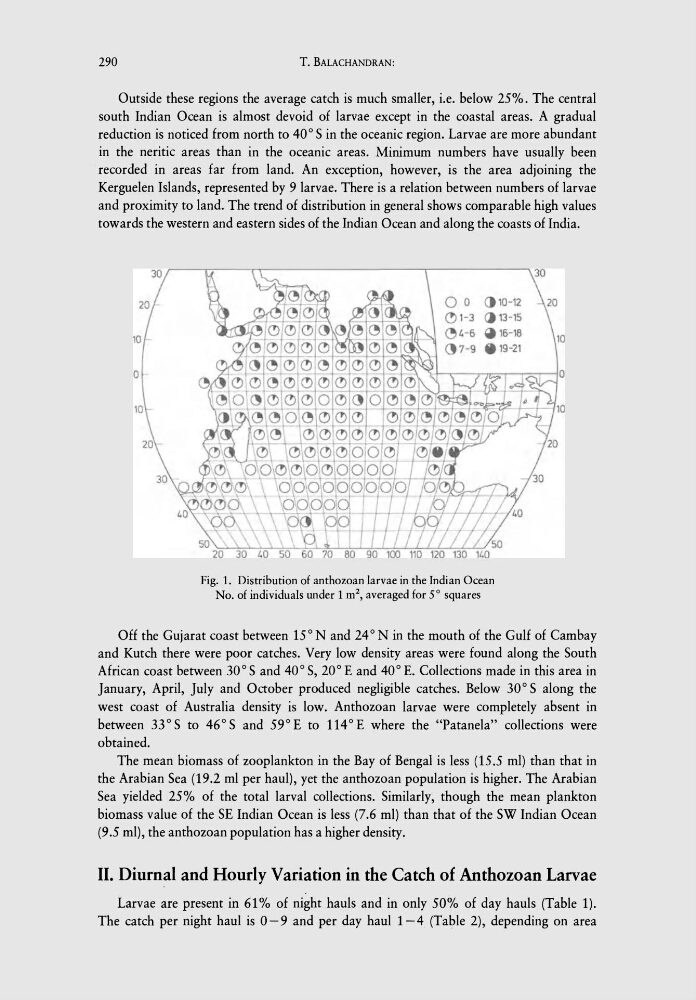
Outside these regions the average catch is much smaller, i.e. below 25%. The central
south Indian Ocean is almost devoid of larvae except in the coastal areas. A gradual
reduction is noticed from north to 40° S in the oceanic region. Larvae are more abundant
in the neritic areas than in the oceanic areas. Minimum numbers have usually been
recorded in areas far from land. An exception, however, is the area adjoining the
Kerguelen Islands, represented by 9 larvae. There is a relation between numbers of larvae
and proximity to land. The trend of distribution in general shows comparable high values
towards the western and eastern sides of the Indian Ocean and along the coasts of India.
o
Fig. 1. Distribution of anthozoan larvae in the Indian Ocean
No. of individuals under 1 m 2 , averaged for 5° squares
Off the Gujarat coast between 15 ° Nand 24 ° N in the mouth of the Gulf of Cambay
and Kutch there were poor catches. Very low density areas were found along the South
African coast between 30° Sand 40° S, 20° E and 40° E. Collections made in this area in
January, April, July and October produced negligible catches. Below 30° S along the
west coast of Australia density is low. Anthozoan larvae were completely absent in
between 33°S to 46°S and 59°E to 114°E where the "Patanela" collections were
obtained.
The mean biomass of zooplankton in the Bay of Bengal is less (15.5 ml) than that in
the Arabian Sea (19.2 ml per haul), yet the anthozoan population is higher. The Arabian
Sea yielded 25% of the total larval collections. Similarly, though the mean plankton
biomass value of the SE Indian Ocean is less (7.6 ml) than that of the SW Indian Ocean
(9.5 ml), the anthozoan population has a higher density.
II. Diurnal and Hourly Variation in the Catch of Anthozoan Larvae
Larvae are present in 61 % of night hauls and in only 50% of day hauls (Table 1).
The catch per night haul is 0-9 and per day haul 1-4 (Table 2), depending on area
T. BALACHANDRAN:
Outside these regions the average catch is much smaller, i.e. below 25%. The central
south Indian Ocean is almost devoid of larvae except in the coastal areas. A gradual
reduction is noticed from north to 40° S in the oceanic region. Larvae are more abundant
in the neritic areas than in the oceanic areas. Minimum numbers have usually been
recorded in areas far from land. An exception, however, is the area adjoining the
Kerguelen Islands, represented by 9 larvae. There is a relation between numbers of larvae
and proximity to land. The trend of distribution in general shows comparable high values
towards the western and eastern sides of the Indian Ocean and along the coasts of India.
o
Fig. 1. Distribution of anthozoan larvae in the Indian Ocean
No. of individuals under 1 m 2 , averaged for 5° squares
Off the Gujarat coast between 15 ° Nand 24 ° N in the mouth of the Gulf of Cambay
and Kutch there were poor catches. Very low density areas were found along the South
African coast between 30° Sand 40° S, 20° E and 40° E. Collections made in this area in
January, April, July and October produced negligible catches. Below 30° S along the
west coast of Australia density is low. Anthozoan larvae were completely absent in
between 33°S to 46°S and 59°E to 114°E where the "Patanela" collections were
obtained.
The mean biomass of zooplankton in the Bay of Bengal is less (15.5 ml) than that in
the Arabian Sea (19.2 ml per haul), yet the anthozoan population is higher. The Arabian
Sea yielded 25% of the total larval collections. Similarly, though the mean plankton
biomass value of the SE Indian Ocean is less (7.6 ml) than that of the SW Indian Ocean
(9.5 ml), the anthozoan population has a higher density.
II. Diurnal and Hourly Variation in the Catch of Anthozoan Larvae
Larvae are present in 61 % of night hauls and in only 50% of day hauls (Table 1).
The catch per night haul is 0-9 and per day haul 1-4 (Table 2), depending on area