

Distribution of Hydromedusae in the Indian Ocean
275
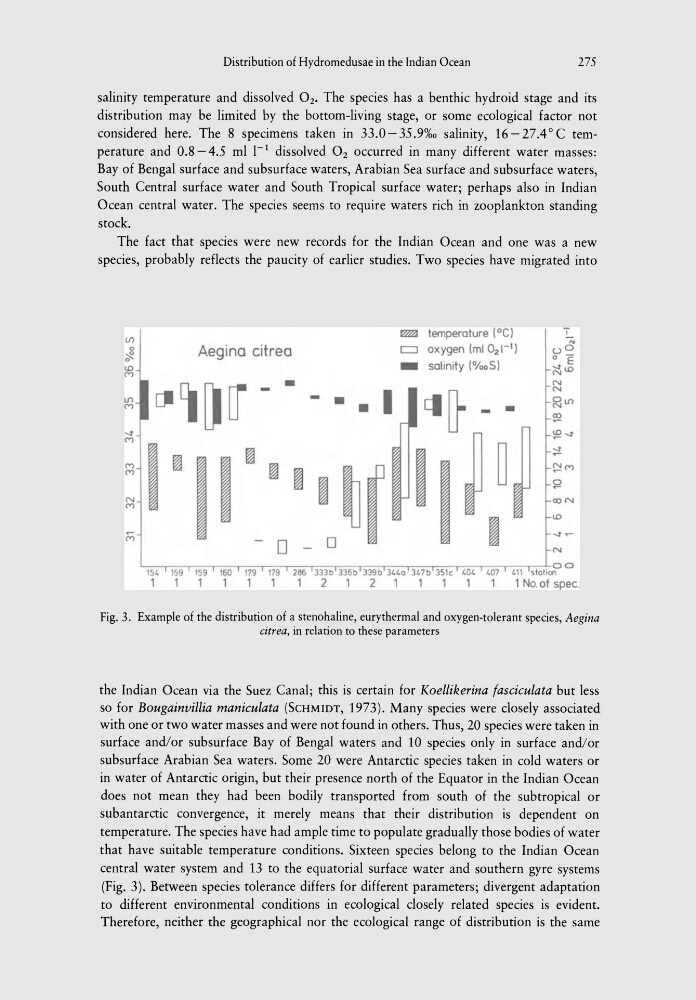
salinity temperature and dissolved O2, The species has a benthic hydroid stage and its
distribution may be limited by the bottom-living stage, or some ecological factor not
considered here. The 8 specimens taken in 33.0-35.9%0 salinity, 16-27.4°C temperature and 0.8 - 4.5 ml 1-1 dissolved O 2 occurred in many different water masses:
Bay of Bengal surface and subsurface waters, Arabian Sea surface and subsurface waters,
South Central surface water and South Tropical surface water; perhaps also in Indian
Ocean central water. The species seems to require waters rich in zooplankton standing
stock.
The fact that species were new records for the Indian Ocean and one was a new
species, probably reflects the paucity of earlier studies. Two species have migrated into
Aegina citrea
~ temperature lOCI
c::J oxygen (ml 02 1- 1 )
_
salinity {%oS]
•
7
u O
~E
N
N
~IO
~
CON
N
L'~S~,T7.'5~9~IS~9~t~ro~7.t7=9~1=~~2=~~3=3~3b~33~67br.3~~~bT3~,7'Q~3'~77br.3~St~cT7.,o~,or.'~07~~,,7t~s~tQ~tiOOOO
1
1
1
1
1
1
1
2
1
2
1
1
1
1
1
1
No. of spec.
Fig. 3. Example of the distribution of a stenohaline, eurythermal and oxygen-tolerant species, Aegina
eitrea, in relation to these parameters
the Indian Ocean via the Suez Canal; this is certain for Koellikerina fasciculata but less
so for Bougainvillia maniculata (SCHMIDT, 1973). Many species were closely associated
with one or two water masses and were not found in others. Thus, 20 species were taken in
surface and/ or subsurface Bay of Bengal waters and 10 species only in surface and/ or
subsurface Arabian Sea waters. Some 20 were Antarctic species taken in cold waters or
in water of Antarctic origin, but their presence north of the Equator in the Indian Ocean
does not mean they had been bodily transported from south of the subtropical or
subantarctic convergence, it merely means that their distribution is dependent on
temperature. The species have had ample time to populate gradually those bodies of water
that have suitable temperature conditions. Sixteen species belong to the Indian Ocean
central water system and 13 to the equatorial surface water and southern gyre systems
(Fig. 3). Between species tolerance differs for different parameters; divergent adaptation
to different environmental conditions in ecological closely related species is evident.
Therefore, neither the geographical nor the ecological range of distribution is the same
275
salinity temperature and dissolved O2, The species has a benthic hydroid stage and its
distribution may be limited by the bottom-living stage, or some ecological factor not
considered here. The 8 specimens taken in 33.0-35.9%0 salinity, 16-27.4°C temperature and 0.8 - 4.5 ml 1-1 dissolved O 2 occurred in many different water masses:
Bay of Bengal surface and subsurface waters, Arabian Sea surface and subsurface waters,
South Central surface water and South Tropical surface water; perhaps also in Indian
Ocean central water. The species seems to require waters rich in zooplankton standing
stock.
The fact that species were new records for the Indian Ocean and one was a new
species, probably reflects the paucity of earlier studies. Two species have migrated into
Aegina citrea
~ temperature lOCI
c::J oxygen (ml 02 1- 1 )
_
salinity {%oS]
•
7
u O
~E
N
N
~IO
~
CON
N
L'~S~,T7.'5~9~IS~9~t~ro~7.t7=9~1=~~2=~~3=3~3b~33~67br.3~~~bT3~,7'Q~3'~77br.3~St~cT7.,o~,or.'~07~~,,7t~s~tQ~tiOOOO
1
1
1
1
1
1
1
2
1
2
1
1
1
1
1
1
No. of spec.
Fig. 3. Example of the distribution of a stenohaline, eurythermal and oxygen-tolerant species, Aegina
eitrea, in relation to these parameters
the Indian Ocean via the Suez Canal; this is certain for Koellikerina fasciculata but less
so for Bougainvillia maniculata (SCHMIDT, 1973). Many species were closely associated
with one or two water masses and were not found in others. Thus, 20 species were taken in
surface and/ or subsurface Bay of Bengal waters and 10 species only in surface and/ or
subsurface Arabian Sea waters. Some 20 were Antarctic species taken in cold waters or
in water of Antarctic origin, but their presence north of the Equator in the Indian Ocean
does not mean they had been bodily transported from south of the subtropical or
subantarctic convergence, it merely means that their distribution is dependent on
temperature. The species have had ample time to populate gradually those bodies of water
that have suitable temperature conditions. Sixteen species belong to the Indian Ocean
central water system and 13 to the equatorial surface water and southern gyre systems
(Fig. 3). Between species tolerance differs for different parameters; divergent adaptation
to different environmental conditions in ecological closely related species is evident.
Therefore, neither the geographical nor the ecological range of distribution is the same