

4.2
The Distribution and Abundance of Zooplankton along
the Coast of Pakistan during Postmonsoon and Premonsoon Periods
S.M. HAQ, J. Au KHAN, and S. CHUGTAI
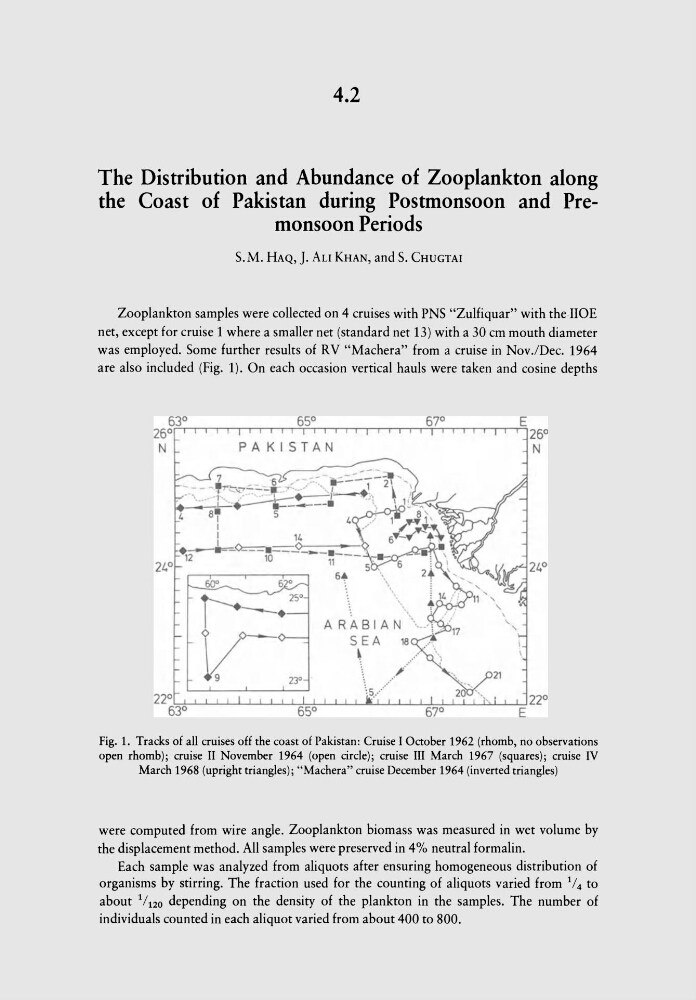
Zooplankton samples were collected on 4 cruises with PNS "Zulfiquar" with theIIOE
net, except for cruise 1 where a smaller net (standard net 13) with a 30 em mouth diameter
was employed. Some further results of RV "Machera" from a cruise in Nov.!Dec. 1964
are also included (Fig. 1). On each occasion vertical hauls were taken and cosine depths
E
PAKISTAN
Fig. 1. Tracks of all cruises off the coast of Pakistan: Cruise I October 1962 (rhomb, no observations
open rhomb); cruise II November 1964 (open circle); cruise III March 1967 (squares); cruise IV
March 1968 (upright triangles); "Machera" cruise December 1964 (inverted triangles)
were computed from wire angle. Zooplankton biomass was measured in wet volume by
the displacement method. All samples were preserved in 4% neutral formalin.
Each sample was analyzed from aliquots after ensuring homogeneous distribution of
organisms by stirring. The fraction used for the counting of aliquots varied from 1/4 to
about 1/120 depending on the density of the plankton in the samples. The number of
individuals counted in each aliquot varied from about 400 to 800.
The Distribution and Abundance of Zooplankton along
the Coast of Pakistan during Postmonsoon and Premonsoon Periods
S.M. HAQ, J. Au KHAN, and S. CHUGTAI
Zooplankton samples were collected on 4 cruises with PNS "Zulfiquar" with theIIOE
net, except for cruise 1 where a smaller net (standard net 13) with a 30 em mouth diameter
was employed. Some further results of RV "Machera" from a cruise in Nov.!Dec. 1964
are also included (Fig. 1). On each occasion vertical hauls were taken and cosine depths
E
PAKISTAN
Fig. 1. Tracks of all cruises off the coast of Pakistan: Cruise I October 1962 (rhomb, no observations
open rhomb); cruise II November 1964 (open circle); cruise III March 1967 (squares); cruise IV
March 1968 (upright triangles); "Machera" cruise December 1964 (inverted triangles)
were computed from wire angle. Zooplankton biomass was measured in wet volume by
the displacement method. All samples were preserved in 4% neutral formalin.
Each sample was analyzed from aliquots after ensuring homogeneous distribution of
organisms by stirring. The fraction used for the counting of aliquots varied from 1/4 to
about 1/120 depending on the density of the plankton in the samples. The number of
individuals counted in each aliquot varied from about 400 to 800.