

Agulhas Bank Plankton
201
Aug. 1965
Oct. 1965
. ,."1 .'
. . . ' . ' .' . )" .
. . ' . .
.fl' r··
LL lllLLllLLLLLLlLLL . tr\
.
LLlLLLL ~
@
CD
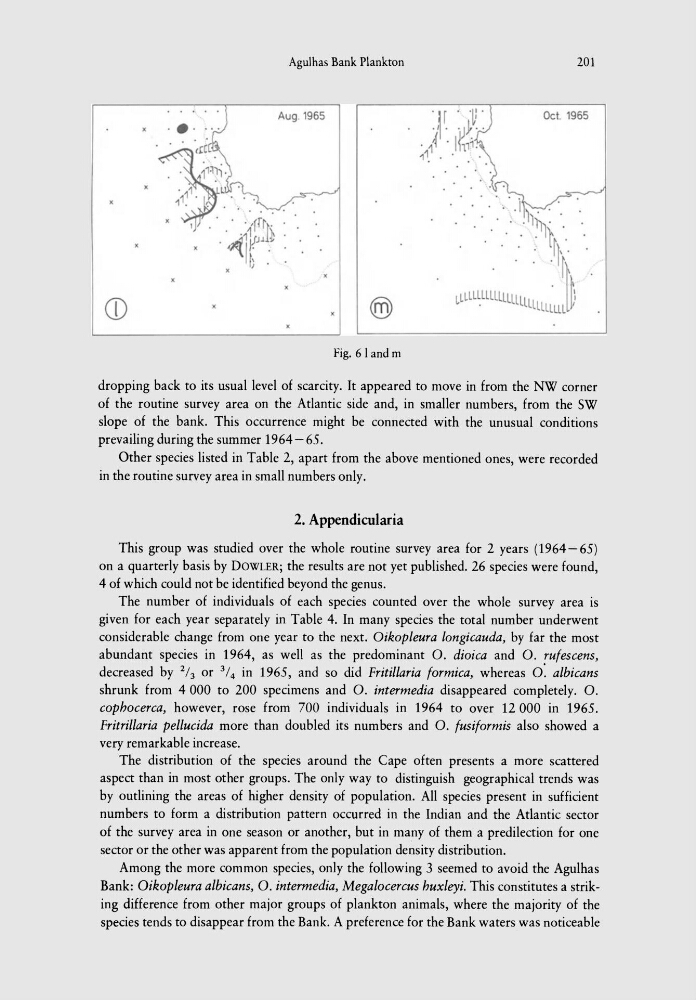
Fig. 61 and m
dropping back to its usual level of scarcity. It appeared to move in from the NW corner
of the routine survey area on the Atlantic side and, in smaller numbers, from the SW
slope of the bank. This occurrence might be connected with the unusual conditions
prevailing during the summer 1964 - 65.
Other species listed in Table 2, apart from the above mentioned ones, were recorded
in the routine survey area in small numbers only.
2. Appendicularia
This group was studied over the whole routine survey area for 2 years (1964 - 65)
on a quarterly basis by DOWLER; the results are not yet published. 26 species were found,
4 of which could not be identified beyond the genus .
The number of individuals of each species counted over the whole survey area is
given for each year separately in Table 4. In many species the total number underwent
considerable change from one year to the next. Oikopleura longicauda, by far the most
abundant species in 1964, as well as the predominant O. dioica and O. rufescens,
decreased by 2 / 3 or 3/4 in 1965, and so did Fritillaria formica, whereas 0: albicans
shrunk from 4000 to 200 specimens and O. intermedia disappeared completely. O.
cophocerca, however, rose from 700 individuals in 1964 to over 12 000 in 1965.
Fritrillaria pellucida more than doubled its numbers and O. fusiformis also showed a
very remarkable increase.
The distribution of the species around the Cape often presents a more scattered
aspect than in most other groups. The only way to distinguish geographical trends was
by outlining the areas of higher density of population. All species present in sufficient
numbers to form a distribution pattern occurred in the Indian and the Atlantic sector
of the survey area in one season or another, but in many of them a predilection for one
sector or the other was apparent from the population density distribution.
Among the more common species, only the following 3 seemed to avoid the Agulhas
Bank: Oikopleura albicans, O. intermedia, Megalocercus huxleyi. This constitutes a striking difference from other major groups of plankton animals, where the majority of the
species tends to disappear from the Bank. A preference for the Bank waters was noticeable
201
Aug. 1965
Oct. 1965
. ,."1 .'
. . . ' . ' .' . )" .
. . ' . .
.fl' r··
LL lllLLllLLLLLLlLLL . tr\
.
LLlLLLL ~
@
CD
Fig. 61 and m
dropping back to its usual level of scarcity. It appeared to move in from the NW corner
of the routine survey area on the Atlantic side and, in smaller numbers, from the SW
slope of the bank. This occurrence might be connected with the unusual conditions
prevailing during the summer 1964 - 65.
Other species listed in Table 2, apart from the above mentioned ones, were recorded
in the routine survey area in small numbers only.
2. Appendicularia
This group was studied over the whole routine survey area for 2 years (1964 - 65)
on a quarterly basis by DOWLER; the results are not yet published. 26 species were found,
4 of which could not be identified beyond the genus .
The number of individuals of each species counted over the whole survey area is
given for each year separately in Table 4. In many species the total number underwent
considerable change from one year to the next. Oikopleura longicauda, by far the most
abundant species in 1964, as well as the predominant O. dioica and O. rufescens,
decreased by 2 / 3 or 3/4 in 1965, and so did Fritillaria formica, whereas 0: albicans
shrunk from 4000 to 200 specimens and O. intermedia disappeared completely. O.
cophocerca, however, rose from 700 individuals in 1964 to over 12 000 in 1965.
Fritrillaria pellucida more than doubled its numbers and O. fusiformis also showed a
very remarkable increase.
The distribution of the species around the Cape often presents a more scattered
aspect than in most other groups. The only way to distinguish geographical trends was
by outlining the areas of higher density of population. All species present in sufficient
numbers to form a distribution pattern occurred in the Indian and the Atlantic sector
of the survey area in one season or another, but in many of them a predilection for one
sector or the other was apparent from the population density distribution.
Among the more common species, only the following 3 seemed to avoid the Agulhas
Bank: Oikopleura albicans, O. intermedia, Megalocercus huxleyi. This constitutes a striking difference from other major groups of plankton animals, where the majority of the
species tends to disappear from the Bank. A preference for the Bank waters was noticeable