

Agulhas Bank Plankton
193
upper 50 m, subject to wider seasonal fluctuations than the corresponding layer off the
west coast. The salinity fluctuates irregularly in both areas, values over the Bank being as a
rule markedly higher. During the 4 years represented in Fig. 3, both areas show a gradual
decrease in amplitude of the fluctuations of both temperature and salinity until December
1966, when a sharp and persistent drop occurred off the west coast, followed in May
107 ~----.---------.--------'r--------'--------~---------'--'
/\
Phytoplankton
,J
4
,
I"
, \ /\ - Agulhas Bank -- West Coast I
:
j \
: \
i\
/' ',.
:
,
I I 1
j ,
..... ',
I
,
I
I
' I
I
", \
"
I
" l\j!
V \
\
\ !
~
V
~,
\ , ,
10\ J A 0 0 F A J A 0 0 F A J A
80 1961
1962
1963
A J A 0
1964
A J 0
1965
A J
1966
o J A
1967
:t,
120
,
I
1 70
90
~60
~50
§ 40
g 30
" ~ 20
Qi
V)
Phytoplankton
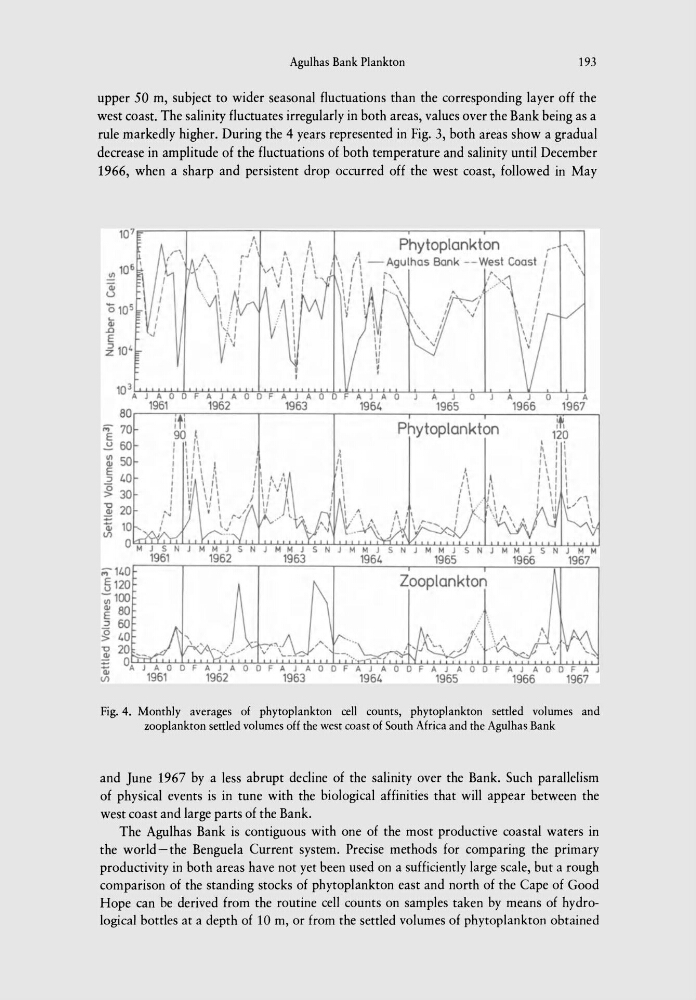
Fig. 4. Monthly averages of phytoplankton cell counts, phytoplankton settled volumes and
zooplankton settled volumes off the west coast of South Africa and the Agulhas Bank
and June 1967 by a less abrupt decline of the salinity over the Bank. Such parallelism
of physical events is in tune with the biological affinities that will appear between the
west coast and large parts of the Bank.
The Agulhas Bank is contiguous with one of the most productive coastal waters in
the world - the Benguela Current system. Precise methods for comparing the primary
productivity in both areas have not yet been used on a sufficiently large scale, but a rough
comparison of the standing stocks of phytoplankton east and north of the Cape of Good
Hope can be derived from the routine cell counts on samples taken by means of hydrological bottles at a depth of 10 m, or from the settled volumes of phytoplankton obtained
193
upper 50 m, subject to wider seasonal fluctuations than the corresponding layer off the
west coast. The salinity fluctuates irregularly in both areas, values over the Bank being as a
rule markedly higher. During the 4 years represented in Fig. 3, both areas show a gradual
decrease in amplitude of the fluctuations of both temperature and salinity until December
1966, when a sharp and persistent drop occurred off the west coast, followed in May
107 ~----.---------.--------'r--------'--------~---------'--'
/\
Phytoplankton
,J
4
,
I"
, \ /\ - Agulhas Bank -- West Coast I
:
j \
: \
i\
/' ',.
:
,
I I 1
j ,
..... ',
I
,
I
I
' I
I
", \
"
I
" l\j!
V \
\
\ !
~
V
~,
\ , ,
10\ J A 0 0 F A J A 0 0 F A J A
80 1961
1962
1963
A J A 0
1964
A J 0
1965
A J
1966
o J A
1967
:t,
120
,
I
1 70
90
~60
~50
§ 40
g 30
" ~ 20
Qi
V)
Phytoplankton
Fig. 4. Monthly averages of phytoplankton cell counts, phytoplankton settled volumes and
zooplankton settled volumes off the west coast of South Africa and the Agulhas Bank
and June 1967 by a less abrupt decline of the salinity over the Bank. Such parallelism
of physical events is in tune with the biological affinities that will appear between the
west coast and large parts of the Bank.
The Agulhas Bank is contiguous with one of the most productive coastal waters in
the world - the Benguela Current system. Precise methods for comparing the primary
productivity in both areas have not yet been used on a sufficiently large scale, but a rough
comparison of the standing stocks of phytoplankton east and north of the Cape of Good
Hope can be derived from the routine cell counts on samples taken by means of hydrological bottles at a depth of 10 m, or from the settled volumes of phytoplankton obtained