

2.8
Bacteriological Investigations in the Arabian Sea
G. RHEINHEIMER
Bacteriological investigations were carried out during the cruise of R V "Meteor"
in the Arabian Sea in March and April 1965. The distribution of bacteria was studied
in the northern Gulf of Oman and the Straits of Hormuz, as influenced by the currents
flowing out of the Persian Gulf.
Total counts were made by the plate-method on ZOBELL'S yeast extract-peptone agar
2216 E. Numbers of saprophytic bacteria ranged from 8-470 ml-t, the highest counts
being usually obtained along the thermocline at 20 to 30 m. The number of bacteria
along the Arabian coast significantly exceeded those along the Persian coast.
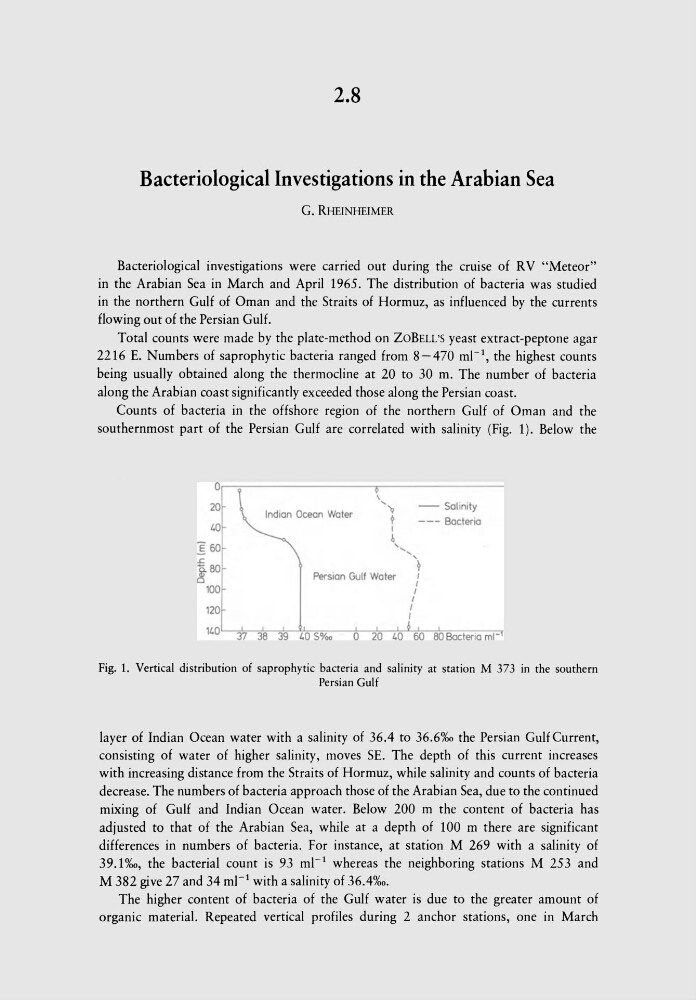
Counts of bacteria in the offshore region of the northern Gulf of Oman and the
southernmost part of the Persian Gulf are correlated with salinity (Fig. 1). Below the
Or-~--------------o--------------20
40
]60
.r::;
!80
100
120
\ ''9
-
Salinity
~
- - - Bacteria
Indian Oceon Water
I
b
' .... ,
'~
Persian Gulf Water
I
I
I
I
I
I
140L-->i37:,->;\38,...,3""9;-'4;';oO;-;S"'o/."oo --7. 0--.2-b0;--;4""0:-"-->6!r;0----;;80~Bac :-:7" ter ~i '=" a .... m 7.I-:cr
Fig. 1. Vertical distribution of saprophytic bacteria and salinity at station M 373 in the southern
Persian Gulf
layer of Indian Ocean water with a salinity of 36.4 to 36.6%0 the Persian Gulf Current,
consisting of water of higher salinity, moves SE. The depth of this current increases
with increasing distance from the Straits of Hormuz, while salinity and counts of bacteria
decrease. The numbers of bacteria approach those of the Arabian Sea, due to the continued
mixing of Gulf and Indian Ocean water. Below 200 m the content of bacteria has
adjusted to that of the Arabian Sea, while at a depth of 100 m there are significant
differences in numbers of bacteria. For instance, at station M 269 with a salinity of
39.10/00, the bacterial count is 93 ml- 1 whereas the neighboring stations M 253 and
M 382 give 27 and 34 ml- 1 with a salinity of 36.4%0.
The higher content of bacteria of the Gulf water is due to the greater amount of
organic material. Repeated vertical profiles during 2 anchor stations, one in March
Bacteriological Investigations in the Arabian Sea
G. RHEINHEIMER
Bacteriological investigations were carried out during the cruise of R V "Meteor"
in the Arabian Sea in March and April 1965. The distribution of bacteria was studied
in the northern Gulf of Oman and the Straits of Hormuz, as influenced by the currents
flowing out of the Persian Gulf.
Total counts were made by the plate-method on ZOBELL'S yeast extract-peptone agar
2216 E. Numbers of saprophytic bacteria ranged from 8-470 ml-t, the highest counts
being usually obtained along the thermocline at 20 to 30 m. The number of bacteria
along the Arabian coast significantly exceeded those along the Persian coast.
Counts of bacteria in the offshore region of the northern Gulf of Oman and the
southernmost part of the Persian Gulf are correlated with salinity (Fig. 1). Below the
Or-~--------------o--------------20
40
]60
.r::;
!80
100
120
\ ''9
-
Salinity
~
- - - Bacteria
Indian Oceon Water
I
b
' .... ,
'~
Persian Gulf Water
I
I
I
I
I
I
140L-->i37:,->;\38,...,3""9;-'4;';oO;-;S"'o/."oo --7. 0--.2-b0;--;4""0:-"-->6!r;0----;;80~Bac :-:7" ter ~i '=" a .... m 7.I-:cr
Fig. 1. Vertical distribution of saprophytic bacteria and salinity at station M 373 in the southern
Persian Gulf
layer of Indian Ocean water with a salinity of 36.4 to 36.6%0 the Persian Gulf Current,
consisting of water of higher salinity, moves SE. The depth of this current increases
with increasing distance from the Straits of Hormuz, while salinity and counts of bacteria
decrease. The numbers of bacteria approach those of the Arabian Sea, due to the continued
mixing of Gulf and Indian Ocean water. Below 200 m the content of bacteria has
adjusted to that of the Arabian Sea, while at a depth of 100 m there are significant
differences in numbers of bacteria. For instance, at station M 269 with a salinity of
39.10/00, the bacterial count is 93 ml- 1 whereas the neighboring stations M 253 and
M 382 give 27 and 34 ml- 1 with a salinity of 36.4%0.
The higher content of bacteria of the Gulf water is due to the greater amount of
organic material. Repeated vertical profiles during 2 anchor stations, one in March