

The Unique Situation in the Environment of the Indian Ocean
3
subpolar and polar seas, that water of low temperature reaches high density on the sea
surface and initiates a deep circulation. Therefore, the meridional circulation of the
Indian Ocean is similar to that occurring in an estuary: heavy water on the bottom spreads
to the head of the bay, light water in the upper layer to the mouth. Although only a
part of the Indian Ocean lies in the northern hemisphere, its own rudimentary meridional
St. No. 12" 125 126
121 128 129
130
131 222
223
22~
225
226
227 228
~
~~~~~~~~~~
500
500
1000
1000
1500
1500
2000
2000
3000
. SECTION}N
3000
"000
300
350
Okm
50
100
150
200
<0..0.5 0..0.5-0.5 0..5-10. lQ-> 4.o ml l- 1
80'
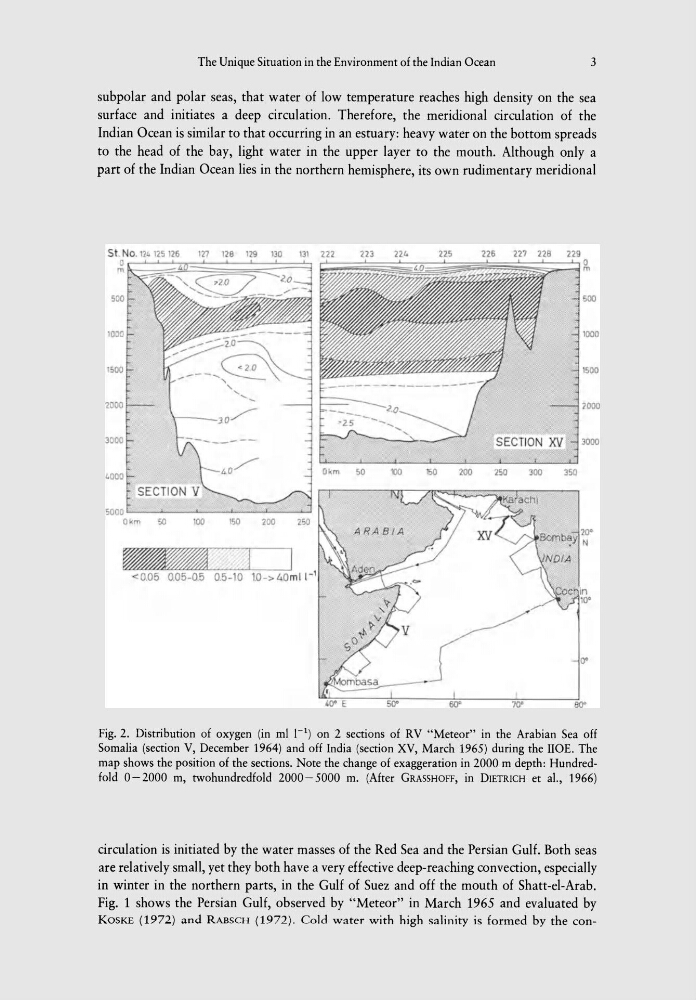
Fig. 2. Distribution of oxygen (in mil- I) on 2 sections of RV "Meteor" in the Arabian Sea off
Somalia (section V, December 1964) and off India (section XV, March 1965) during the HOE. The
map shows the position of the sections. Note the change of exaggeration in 2000 m depth: Hundredfold 0-2000 m, twohundredfold 2000-5000 m. (After GRASSHOFF, in DIETRICH et al., 1966)
circulation is initiated by the water masses of the Red Sea and the Persian Gulf. Both seas
are relatively small, yet they both have a very effective deep-reaching convection, especially
in winter in the northern parts, in the Gulf of Suez and off the mouth of Shatt-el-Arab.
Fig. 1 shows the Persian Gulf, observed by "Meteor" in March 1965 and evaluated by
KOSKE (1972) and RABSCH (1972). Cold water with high salinity is formed by the con-
3
subpolar and polar seas, that water of low temperature reaches high density on the sea
surface and initiates a deep circulation. Therefore, the meridional circulation of the
Indian Ocean is similar to that occurring in an estuary: heavy water on the bottom spreads
to the head of the bay, light water in the upper layer to the mouth. Although only a
part of the Indian Ocean lies in the northern hemisphere, its own rudimentary meridional
St. No. 12" 125 126
121 128 129
130
131 222
223
22~
225
226
227 228
~
~~~~~~~~~~
500
500
1000
1000
1500
1500
2000
2000
3000
. SECTION}N
3000
"000
300
350
Okm
50
100
150
200
<0..0.5 0..0.5-0.5 0..5-10. lQ-> 4.o ml l- 1
80'
Fig. 2. Distribution of oxygen (in mil- I) on 2 sections of RV "Meteor" in the Arabian Sea off
Somalia (section V, December 1964) and off India (section XV, March 1965) during the HOE. The
map shows the position of the sections. Note the change of exaggeration in 2000 m depth: Hundredfold 0-2000 m, twohundredfold 2000-5000 m. (After GRASSHOFF, in DIETRICH et al., 1966)
circulation is initiated by the water masses of the Red Sea and the Persian Gulf. Both seas
are relatively small, yet they both have a very effective deep-reaching convection, especially
in winter in the northern parts, in the Gulf of Suez and off the mouth of Shatt-el-Arab.
Fig. 1 shows the Persian Gulf, observed by "Meteor" in March 1965 and evaluated by
KOSKE (1972) and RABSCH (1972). Cold water with high salinity is formed by the con-