

Productivity of Backwaters and Estuaries
153
v. Primary Production and Environmental Factors
A comparison between the annual cycle of primary productivity and the seasonal
variation in the environmental features described above reveals that the peaks in
production are independent of the high and low values of solar radiation falling on the
surface of water. Monthly variations in total solar radiation are never a limiting factor,
although light penetration in the water column is considerably reduced by high turbidity
and thus becomes a serious limiting factor for maximum photosynthesis in the backwater.
The water temperature seems to have no direct effect on primary production, but changes
in salinity are important in favouring phytoplankton productivity. The peaks in primary
production occur during the monsoon months when salinity in the backwater is low. The
predominant phytoplankton during the monsoon months consists of diatoms and green
algae. To test whether low salinity would influence the growth of phytoplankton, the
following experiments were conducted:
Several organisms isolated from the inshore areas were cultured in enriched seawater.
When the cultures became sufficiently dense, known volumes of these were added to
bottles containing seawater of different salinities, 5 -35 %0. These were exposed to constant illumination and their rates of photosynthesis were measured by 14C assimilation
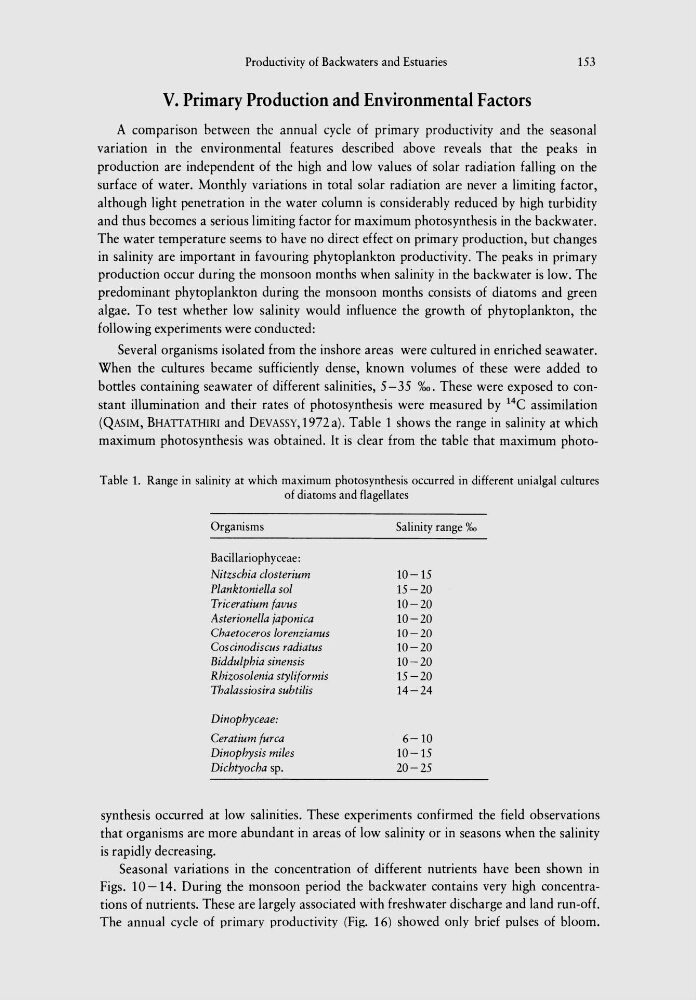
(QASIM, BHATIATHIRI and DEVASSY, 1972a). Table 1 shows the range in salinity at which
maximum photosynthesis was obtained. It is clear from the table that maximum photoTable 1. Range in salinity at which maximum photosynthesis occurred in different unialgal cultures
of diatoms and flagellates
Organisms
Bacillariophyceae:
Nitzschia closterium
Planktoniella sol
Triceratium favus
Asterionella japonica
Chaetoceros lorenzianus
Coscinodiscus radiatus
Biddulphia sinensis
Rhizosolenia styliformis
Thalassiosira subtilis
Dinophyceae:
Ceratium furea
Dinophysis miles
Dichtyocha sp.
Salini ty range %0
10-15
15-20
10-20
10-20
10-20
10-20
10-20
15-20
14-24
6-10
10-15
20-25
synthesis occurred at low salinities. These experiments confirmed the field observations
that organisms are more abundant in areas of low salinity or in seasons when the salinity
is rapidly decreasing.
Seasonal variations in the concentration of different nutrients have been shown in
Figs. 10 -14. During the monsoon period the backwater contains very high concentrations of nutrients. These are largely associated with freshwater discharge and land run-off.
The annual cycle of primary productivity (Fig. 16) showed only brief pulses of bloom.
153
v. Primary Production and Environmental Factors
A comparison between the annual cycle of primary productivity and the seasonal
variation in the environmental features described above reveals that the peaks in
production are independent of the high and low values of solar radiation falling on the
surface of water. Monthly variations in total solar radiation are never a limiting factor,
although light penetration in the water column is considerably reduced by high turbidity
and thus becomes a serious limiting factor for maximum photosynthesis in the backwater.
The water temperature seems to have no direct effect on primary production, but changes
in salinity are important in favouring phytoplankton productivity. The peaks in primary
production occur during the monsoon months when salinity in the backwater is low. The
predominant phytoplankton during the monsoon months consists of diatoms and green
algae. To test whether low salinity would influence the growth of phytoplankton, the
following experiments were conducted:
Several organisms isolated from the inshore areas were cultured in enriched seawater.
When the cultures became sufficiently dense, known volumes of these were added to
bottles containing seawater of different salinities, 5 -35 %0. These were exposed to constant illumination and their rates of photosynthesis were measured by 14C assimilation
(QASIM, BHATIATHIRI and DEVASSY, 1972a). Table 1 shows the range in salinity at which
maximum photosynthesis was obtained. It is clear from the table that maximum photoTable 1. Range in salinity at which maximum photosynthesis occurred in different unialgal cultures
of diatoms and flagellates
Organisms
Bacillariophyceae:
Nitzschia closterium
Planktoniella sol
Triceratium favus
Asterionella japonica
Chaetoceros lorenzianus
Coscinodiscus radiatus
Biddulphia sinensis
Rhizosolenia styliformis
Thalassiosira subtilis
Dinophyceae:
Ceratium furea
Dinophysis miles
Dichtyocha sp.
Salini ty range %0
10-15
15-20
10-20
10-20
10-20
10-20
10-20
15-20
14-24
6-10
10-15
20-25
synthesis occurred at low salinities. These experiments confirmed the field observations
that organisms are more abundant in areas of low salinity or in seasons when the salinity
is rapidly decreasing.
Seasonal variations in the concentration of different nutrients have been shown in
Figs. 10 -14. During the monsoon period the backwater contains very high concentrations of nutrients. These are largely associated with freshwater discharge and land run-off.
The annual cycle of primary productivity (Fig. 16) showed only brief pulses of bloom.