

126
J. KREY: Primary Production in the Indian Ocean I
Gulf of Oman with potential production values of 5 mg C m- 3 h- 1 • This is due to the
combined effect of river drainage and upwelling water.
Charts have been prepared showing the distribution of in situ primary production
during both the above-discussed seasons. These were drawn on the basis of the very few
direct observations available and calculations based on daily production rates for the
surface layers, derived from the potential assimilation rates (Figs. 8 and 9). The basic
trends in the distribution of fertile and infertile areas, as evidenced by the chlorophyll
distribution charts, are clearly maintained here, too. The "desert regions" on both sides
of the Equator are still the least productive while the most productive regions are the
northern Arabian Sea, coastal waters of Ceylon, west coast of Indonesia, west-wind drift
region and to some extent the Equatorial Current region.
The general correlation between productive regions and areas of mixing and upwelling
is evident. The water movements transport nutrient-rich deep water to the surface; these
water masses may be designated young water as against old water from the point of view
of fertility potential. Such old water masses are seen in the central Indian Ocean region
to the south and north of the Equator where currents are weak and the thermocline is
very well developed. In the polar zones, light also plays an important role, acting as a
limiting factor.
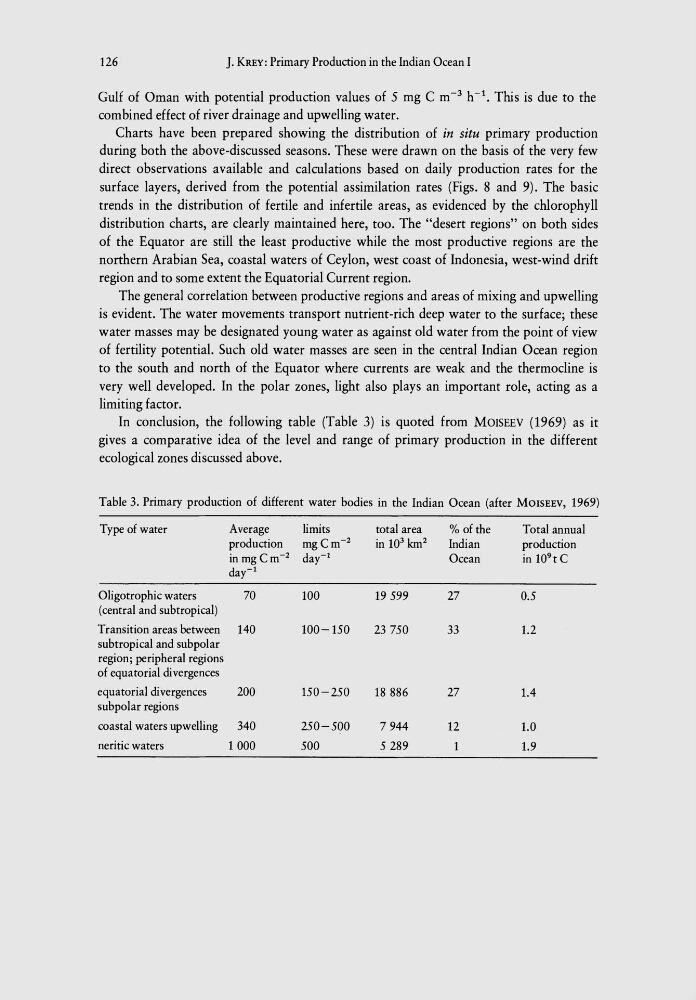
In conclusion, the following table (Table 3) is quoted from MOISEEV (1969) as it
gives a comparative idea of the level and range of primary production in the different
ecological zones discussed above.
Table 3. Primary production of different water bodies in the Indian Ocean (after MorSEEV, 1969)
Type of water
Average
limits
total area
% of the
Total annual
production
mgCm- 2
in 10 3 km 2
Indian
production
in mg Cm- 2 day-l
Ocean
in 10 9 t C
day-l
Oligotrophic waters
70
100
19599
27
0.5
(central and subtropical)
Transition areas between 140
100-150
23750
33
1.2
subtropical and subpolar
region; peripheral regions
of equatorial divergences
equatorial divergences
200
150-250
18886
27
1.4
subpolar regions
coastal waters upwelling
340
250-500
7944
12
1.0
neritic waters
1000
500
5289
1
1.9
J. KREY: Primary Production in the Indian Ocean I
Gulf of Oman with potential production values of 5 mg C m- 3 h- 1 • This is due to the
combined effect of river drainage and upwelling water.
Charts have been prepared showing the distribution of in situ primary production
during both the above-discussed seasons. These were drawn on the basis of the very few
direct observations available and calculations based on daily production rates for the
surface layers, derived from the potential assimilation rates (Figs. 8 and 9). The basic
trends in the distribution of fertile and infertile areas, as evidenced by the chlorophyll
distribution charts, are clearly maintained here, too. The "desert regions" on both sides
of the Equator are still the least productive while the most productive regions are the
northern Arabian Sea, coastal waters of Ceylon, west coast of Indonesia, west-wind drift
region and to some extent the Equatorial Current region.
The general correlation between productive regions and areas of mixing and upwelling
is evident. The water movements transport nutrient-rich deep water to the surface; these
water masses may be designated young water as against old water from the point of view
of fertility potential. Such old water masses are seen in the central Indian Ocean region
to the south and north of the Equator where currents are weak and the thermocline is
very well developed. In the polar zones, light also plays an important role, acting as a
limiting factor.
In conclusion, the following table (Table 3) is quoted from MOISEEV (1969) as it
gives a comparative idea of the level and range of primary production in the different
ecological zones discussed above.
Table 3. Primary production of different water bodies in the Indian Ocean (after MorSEEV, 1969)
Type of water
Average
limits
total area
% of the
Total annual
production
mgCm- 2
in 10 3 km 2
Indian
production
in mg Cm- 2 day-l
Ocean
in 10 9 t C
day-l
Oligotrophic waters
70
100
19599
27
0.5
(central and subtropical)
Transition areas between 140
100-150
23750
33
1.2
subtropical and subpolar
region; peripheral regions
of equatorial divergences
equatorial divergences
200
150-250
18886
27
1.4
subpolar regions
coastal waters upwelling
340
250-500
7944
12
1.0
neritic waters
1000
500
5289
1
1.9