

44
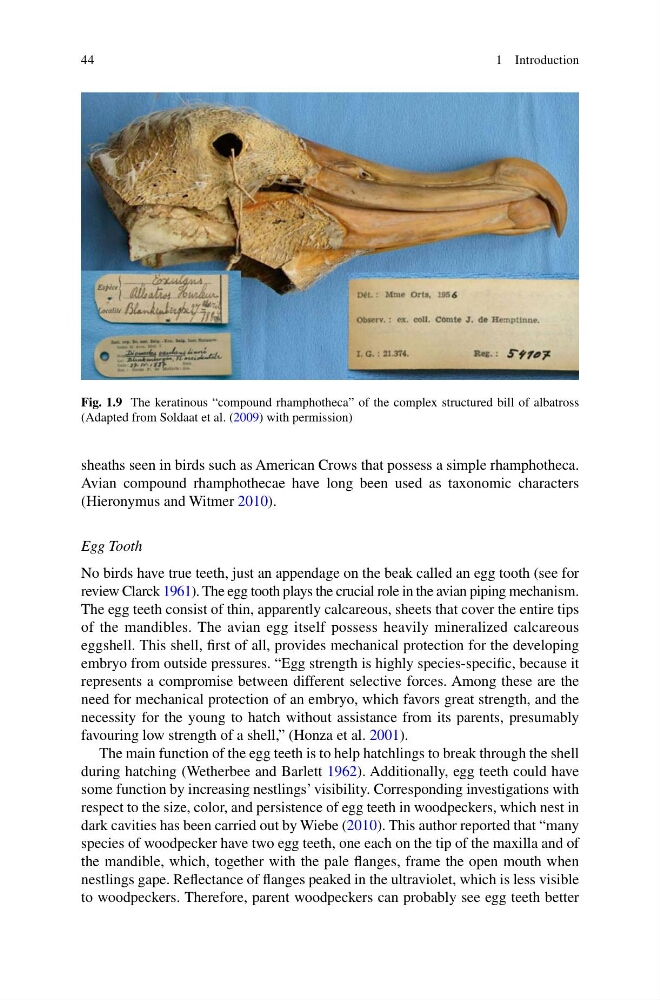
sheaths seen in birds such as American Crows that possess a simple rhamphotheca.
Avian compound rhamphothecae have long been used as taxonomic characters
(Hieronymus and Witmer 2010 ).
Egg Tooth
No birds have true teeth, just an appendage on the beak called an egg tooth (see for
review Clarck 1961 ). The egg tooth plays the crucial role in the avian piping mechanism.
The egg teeth consist of thin, apparently calcareous, sheets that cover the entire tips
of the mandibles. The avian egg itself possess heavily mineralized calcareous
eggshell. This shell, fi rst of all, provides mechanical protection for the developing
embryo from outside pressures. “Egg strength is highly species-specifi c, because it
represents a compromise between different selective forces. Among these are the
need for mechanical protection of an embryo, which favors great strength, and the
necessity for the young to hatch without assistance from its parents, presumably
favouring low strength of a shell,” (Honza et al. 2001 ).
The main function of the egg teeth is to help hatchlings to break through the shell
during hatching (Wetherbee and Barlett 1962 ). Additionally, egg teeth could have
some function by increasing nestlings’ visibility. Corresponding investigations with
respect to the size, color, and persistence of egg teeth in woodpeckers, which nest in
dark cavities has been carried out by Wiebe ( 2010 ). This author reported that “many
species of woodpecker have two egg teeth, one each on the tip of the maxilla and of
the mandible, which, together with the pale fl anges, frame the open mouth when
nestlings gape. Refl ectance of fl anges peaked in the ultraviolet, which is less visible
to woodpeckers. Therefore, parent woodpeckers can probably see egg teeth better
Fig. 1.9 The keratinous “compound rhamphotheca” of the complex structured bill of albatross
(Adapted from Soldaat et al. ( 2009 ) with permission)
1 Introduction
sheaths seen in birds such as American Crows that possess a simple rhamphotheca.
Avian compound rhamphothecae have long been used as taxonomic characters
(Hieronymus and Witmer 2010 ).
Egg Tooth
No birds have true teeth, just an appendage on the beak called an egg tooth (see for
review Clarck 1961 ). The egg tooth plays the crucial role in the avian piping mechanism.
The egg teeth consist of thin, apparently calcareous, sheets that cover the entire tips
of the mandibles. The avian egg itself possess heavily mineralized calcareous
eggshell. This shell, fi rst of all, provides mechanical protection for the developing
embryo from outside pressures. “Egg strength is highly species-specifi c, because it
represents a compromise between different selective forces. Among these are the
need for mechanical protection of an embryo, which favors great strength, and the
necessity for the young to hatch without assistance from its parents, presumably
favouring low strength of a shell,” (Honza et al. 2001 ).
The main function of the egg teeth is to help hatchlings to break through the shell
during hatching (Wetherbee and Barlett 1962 ). Additionally, egg teeth could have
some function by increasing nestlings’ visibility. Corresponding investigations with
respect to the size, color, and persistence of egg teeth in woodpeckers, which nest in
dark cavities has been carried out by Wiebe ( 2010 ). This author reported that “many
species of woodpecker have two egg teeth, one each on the tip of the maxilla and of
the mandible, which, together with the pale fl anges, frame the open mouth when
nestlings gape. Refl ectance of fl anges peaked in the ultraviolet, which is less visible
to woodpeckers. Therefore, parent woodpeckers can probably see egg teeth better
Fig. 1.9 The keratinous “compound rhamphotheca” of the complex structured bill of albatross
(Adapted from Soldaat et al. ( 2009 ) with permission)
1 Introduction