

430
What about the mechanism of disc action? This is described by Fulcher and
Motta ( 2006 ) as follow:
“Disk muscles erect or depress the numerous paired laminae, or toothed plates,
which bear two to four rows of posteriorly directed spinules. The erect laminae create a sub-ambient chamber, allowing these fi sh to adhere to other fi sh and inanimate
objects. Resting sub-ambient suction pressure differentials were recorded, as were
the greatest sub-ambient pressure differentials as the fi sh were pulled posteriorly to
simulate drag induced by a swimming host. The resting pressure differential averaged –0.5 kPa, with no signifi cant difference between Plexiglas® and shark skin
surfaces. With a force applied to their caudal peduncle, the echeneids generated
suction pressure differentials averaging –92.7 kPa within the disk cavity while
attached to Plexiglas. On shark skin, the use of spinules increased friction and
reduced the maximum sub-ambient suction pressure differential to –46.6 kPa; considerably more force (17.4 N) was required to dislodge the echeneids from the shark
skin than from the smooth Plexiglas (11.2 N),” (Fulcher and Motta 2006 ).
Here, I absolutely agree with Fulcher and Motta that “future research should
investigate the relationships between sub-ambient suction pressure differential, disk
size, and host specifi city, as well as the possibility of greater reliance on spinules in
species that adhere to rough-scaled hosts. Furthermore, future research should
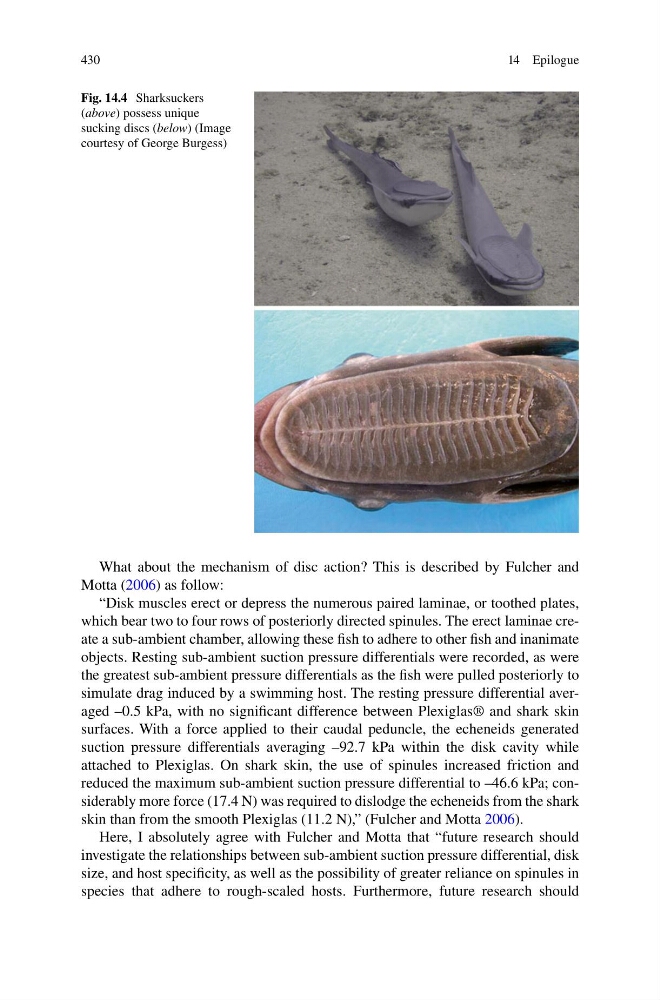
Fig. 14.4 Sharksuckers
( above ) possess unique
sucking discs ( below ) (Image
courtesy of George Burgess)
14 Epilogue
What about the mechanism of disc action? This is described by Fulcher and
Motta ( 2006 ) as follow:
“Disk muscles erect or depress the numerous paired laminae, or toothed plates,
which bear two to four rows of posteriorly directed spinules. The erect laminae create a sub-ambient chamber, allowing these fi sh to adhere to other fi sh and inanimate
objects. Resting sub-ambient suction pressure differentials were recorded, as were
the greatest sub-ambient pressure differentials as the fi sh were pulled posteriorly to
simulate drag induced by a swimming host. The resting pressure differential averaged –0.5 kPa, with no signifi cant difference between Plexiglas® and shark skin
surfaces. With a force applied to their caudal peduncle, the echeneids generated
suction pressure differentials averaging –92.7 kPa within the disk cavity while
attached to Plexiglas. On shark skin, the use of spinules increased friction and
reduced the maximum sub-ambient suction pressure differential to –46.6 kPa; considerably more force (17.4 N) was required to dislodge the echeneids from the shark
skin than from the smooth Plexiglas (11.2 N),” (Fulcher and Motta 2006 ).
Here, I absolutely agree with Fulcher and Motta that “future research should
investigate the relationships between sub-ambient suction pressure differential, disk
size, and host specifi city, as well as the possibility of greater reliance on spinules in
species that adhere to rough-scaled hosts. Furthermore, future research should
Fig. 14.4 Sharksuckers
( above ) possess unique
sucking discs ( below ) (Image
courtesy of George Burgess)
14 Epilogue