

30
As recently reviewed by Rasmussen and co-workers (Rasmussen et al. 2011a , b ),
only about 100 of the more than 12,000 species and subspecies of extant reptiles,
have re-entered the sea. Among them are sea turtles (7 species) and sea snakes
(about 80 species and subspecies). Also, various other snakes, the saltwater crocodile,
and the marine iguana of the Galapagos Islands are occasionally or regularly found
in brackish waters. The sea snakes occur in the tropical and subtropical waters of the
Indian and Pacifi c Oceans and represent the species richest group of marine reptiles.
“They inhabit shallow waters along coasts, around islands and coral reefs, river
mouths and travel into rivers more than 150 km away from the open ocean. A single
species has been found more than 1,000 km up rivers,” (Rasmussen et al. 2011b ).
Order Testudines
The robust protective shell surrounding their body is the structural feature of the
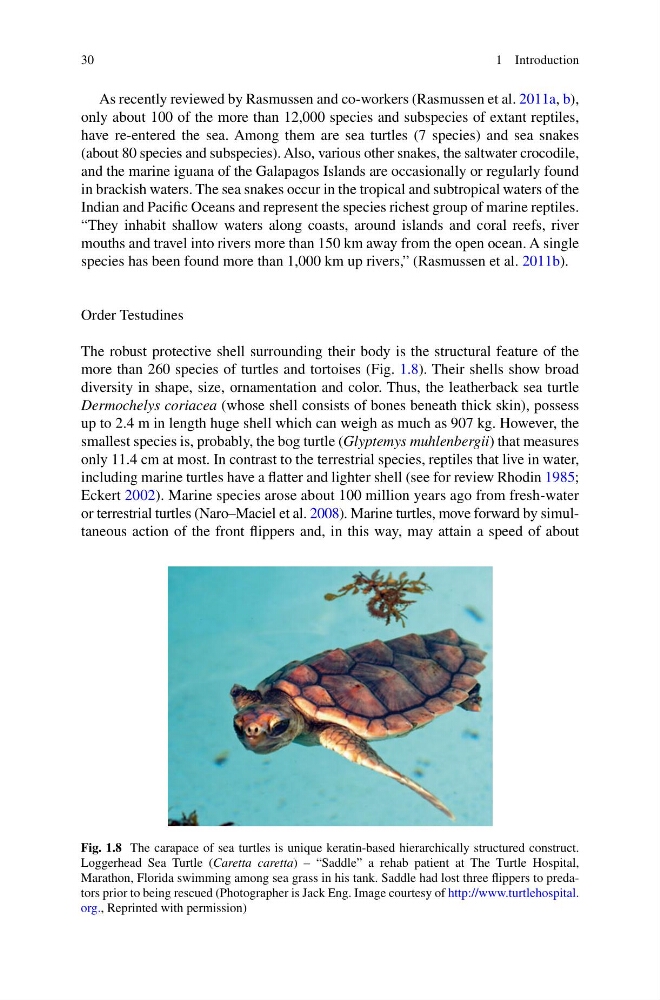
more than 260 species of turtles and tortoises (Fig. 1.8 ). Their shells show broad
diversity in shape, size, ornamentation and color. Thus, the leatherback sea turtle
Dermochelys coriacea (whose shell consists of bones beneath thick skin), possess
up to 2.4 m in length huge shell which can weigh as much as 907 kg. However, the
smallest species is, probably, the bog turtle ( Glyptemys muhlenbergii ) that measures
only 11.4 cm at most. In contrast to the terrestrial species, reptiles that live in water,
including marine turtles have a fl atter and lighter shell (see for review Rhodin 1985 ;
Eckert 2002 ). Marine species arose about 100 million years ago from fresh-water
or terrestrial turtles (Naro–Maciel et al. 2008 ). Marine turtles, move forward by simultaneous action of the front fl ippers and, in this way, may attain a speed of about
Fig. 1.8 The carapace of sea turtles is unique keratin-based hierarchically structured construct.
Loggerhead Sea Turtle ( Caretta caretta ) – “Saddle” a rehab patient at The Turtle Hospital,
Marathon, Florida swimming among sea grass in his tank. Saddle had lost three fl ippers to predators prior to being rescued (Photographer is Jack Eng. Image courtesy of http://www.turtlehospital.
org. , Reprinted with permission)
1 Introduction
As recently reviewed by Rasmussen and co-workers (Rasmussen et al. 2011a , b ),
only about 100 of the more than 12,000 species and subspecies of extant reptiles,
have re-entered the sea. Among them are sea turtles (7 species) and sea snakes
(about 80 species and subspecies). Also, various other snakes, the saltwater crocodile,
and the marine iguana of the Galapagos Islands are occasionally or regularly found
in brackish waters. The sea snakes occur in the tropical and subtropical waters of the
Indian and Pacifi c Oceans and represent the species richest group of marine reptiles.
“They inhabit shallow waters along coasts, around islands and coral reefs, river
mouths and travel into rivers more than 150 km away from the open ocean. A single
species has been found more than 1,000 km up rivers,” (Rasmussen et al. 2011b ).
Order Testudines
The robust protective shell surrounding their body is the structural feature of the
more than 260 species of turtles and tortoises (Fig. 1.8 ). Their shells show broad
diversity in shape, size, ornamentation and color. Thus, the leatherback sea turtle
Dermochelys coriacea (whose shell consists of bones beneath thick skin), possess
up to 2.4 m in length huge shell which can weigh as much as 907 kg. However, the
smallest species is, probably, the bog turtle ( Glyptemys muhlenbergii ) that measures
only 11.4 cm at most. In contrast to the terrestrial species, reptiles that live in water,
including marine turtles have a fl atter and lighter shell (see for review Rhodin 1985 ;
Eckert 2002 ). Marine species arose about 100 million years ago from fresh-water
or terrestrial turtles (Naro–Maciel et al. 2008 ). Marine turtles, move forward by simultaneous action of the front fl ippers and, in this way, may attain a speed of about
Fig. 1.8 The carapace of sea turtles is unique keratin-based hierarchically structured construct.
Loggerhead Sea Turtle ( Caretta caretta ) – “Saddle” a rehab patient at The Turtle Hospital,
Marathon, Florida swimming among sea grass in his tank. Saddle had lost three fl ippers to predators prior to being rescued (Photographer is Jack Eng. Image courtesy of http://www.turtlehospital.
org. , Reprinted with permission)
1 Introduction