

369
therefore, the elastic fi bers created during development must last the entire lifetime
of the animal (Cheng and Wagenseil 2012 ). According to Greenwald et al. ( 2001 ),
unlike other proteins has a turnover rate close to zero, elastin undergoes fatigue
failure in arteries due to cyclic stress. The protein becomes progressively fragmented with age, and is gradually replaced by much stiffer fi brous tissue. These
changes are well advanced after one billion heartbeats, by which time most animals,
whatever their size or heart-rate, are nearing the end of their lives. In man this
number is achieved by the age of 30 years, which from an evolutionary point of
view, is close to the end of useful life. The progressive failure of elastin with age
and the consequent increase in arterial stiffness leads to an inexorable rise in blood
pressure (Greenwald et al. 2001 ).
Now, I would like to represent the whale heart and arteries for better understanding of the role of elastin as a biological material with crucial importance for cetacean organisms. In their classical and well-illustrated paper entitled “ A Large Whale
Heart Circulation ” Race and co-workers ( 1959 ), described the heart of adult sperm
whale ( Physeter catadon ): The heart of the animal weighed 116 kg. “Crude ventricular volume and cardiac output was calculated to be 453 L per minute based on
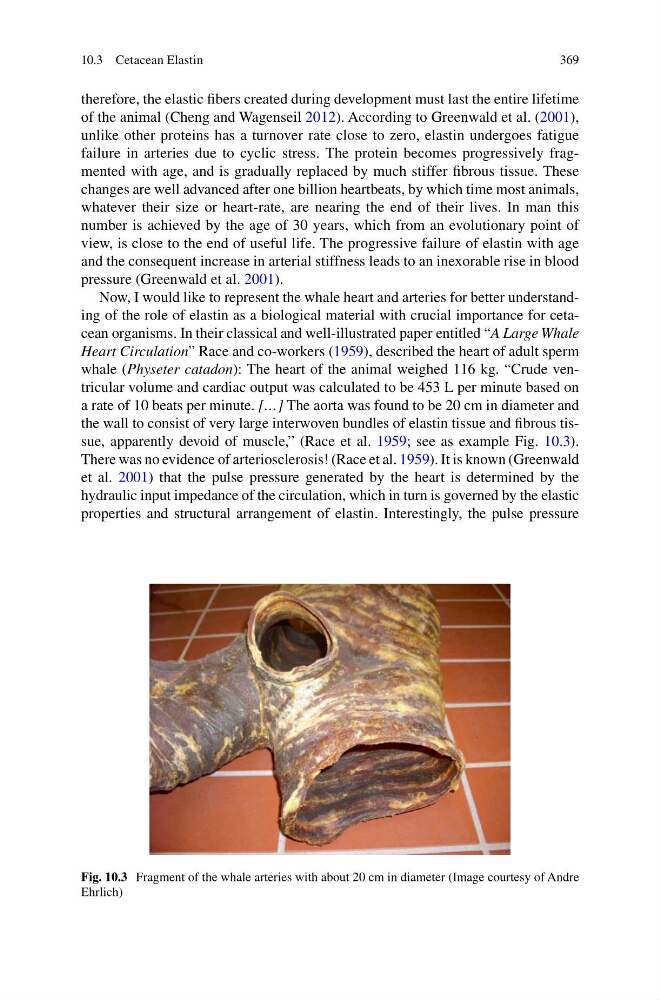
a rate of 10 beats per minute. […] The aorta was found to be 20 cm in diameter and
the wall to consist of very large interwoven bundles of elastin tissue and fi brous tissue, apparently devoid of muscle,” (Race et al. 1959 ; see as example Fig. 10.3 ).
There was no evidence of arteriosclerosis! (Race et al. 1959 ). It is known (Greenwald
et al. 2001 ) that the pulse pressure generated by the heart is determined by the
hydraulic input impedance of the circulation, which in turn is governed by the elastic
properties and structural arrangement of elastin. Interestingly, the pulse pressure
Fig. 10.3 Fragment of the whale arteries with about 20 cm in diameter (Image courtesy of Andre
Ehrlich)
10.3 Cetacean Elastin
therefore, the elastic fi bers created during development must last the entire lifetime
of the animal (Cheng and Wagenseil 2012 ). According to Greenwald et al. ( 2001 ),
unlike other proteins has a turnover rate close to zero, elastin undergoes fatigue
failure in arteries due to cyclic stress. The protein becomes progressively fragmented with age, and is gradually replaced by much stiffer fi brous tissue. These
changes are well advanced after one billion heartbeats, by which time most animals,
whatever their size or heart-rate, are nearing the end of their lives. In man this
number is achieved by the age of 30 years, which from an evolutionary point of
view, is close to the end of useful life. The progressive failure of elastin with age
and the consequent increase in arterial stiffness leads to an inexorable rise in blood
pressure (Greenwald et al. 2001 ).
Now, I would like to represent the whale heart and arteries for better understanding of the role of elastin as a biological material with crucial importance for cetacean organisms. In their classical and well-illustrated paper entitled “ A Large Whale
Heart Circulation ” Race and co-workers ( 1959 ), described the heart of adult sperm
whale ( Physeter catadon ): The heart of the animal weighed 116 kg. “Crude ventricular volume and cardiac output was calculated to be 453 L per minute based on
a rate of 10 beats per minute. […] The aorta was found to be 20 cm in diameter and
the wall to consist of very large interwoven bundles of elastin tissue and fi brous tissue, apparently devoid of muscle,” (Race et al. 1959 ; see as example Fig. 10.3 ).
There was no evidence of arteriosclerosis! (Race et al. 1959 ). It is known (Greenwald
et al. 2001 ) that the pulse pressure generated by the heart is determined by the
hydraulic input impedance of the circulation, which in turn is governed by the elastic
properties and structural arrangement of elastin. Interestingly, the pulse pressure
Fig. 10.3 Fragment of the whale arteries with about 20 cm in diameter (Image courtesy of Andre
Ehrlich)
10.3 Cetacean Elastin