

25
(Arsenault 1982 ) as one of the best known of any fossil vertebrate (Jarvik 1980 ), are
related to the tetrapods and the Elpistostegalids. E. foordi seems to be unique because
of special characters of its vertebral development (Cote et al. 2002 ).
The Elpistostegelia (also known as the Panderichthyida) possess an enlarged
and fl attened head made rigid by the loss of the intracranial joint, infolded (labyrinthodont) teeth, an elongated humerus, and expanded ribs, and no anal and dorsal
fi ns. The genera like Elpistostege , Livonia , Panderichthys , and Tiktaalik are typical
representatives of this group (see for review Shubin et al. 2006 ).
Sargopterygii possess hierarchically constructed and nanostructured cosmoid
scales (Zylberberg et al. 2010 ), which are found in several ancient lobe-fi nned
species. Similar structures are known for the earliest lungfi shes, and were probably
derived from a fusion of placoid scales. Placoid scales are found in the cartilaginous
fi sh. According to Meunier ( 1980 ), cosmoid scales possess complex multi-layered
structure made by lamellar, dense bone tissue termed isopedine and of upper spongy
bone layer that contains blood vessels. Correspondingly, cosmine (Thomson 1975 )
that represents a complex dentine layer covers the bone layers additionally to a
superfi cial outer coating of vitrodentine. The lamellar bone layer is responsible for
increase in size of cosmoid scales (Meunier 1980 ).
1.2.2.2 Class Placodermi
Placoderms (armor-skinned) arrived during the Silurian and Devonian time replacing the Ostracoderms (Gardiner 1984 ; Goujet 1984 ; Young 1986 ). The armor of the
placoderm covered their entire head and some of their body. Some placoderms even
had armor surrounding their eyes, and unlike the ostracoderms the placoderms, they
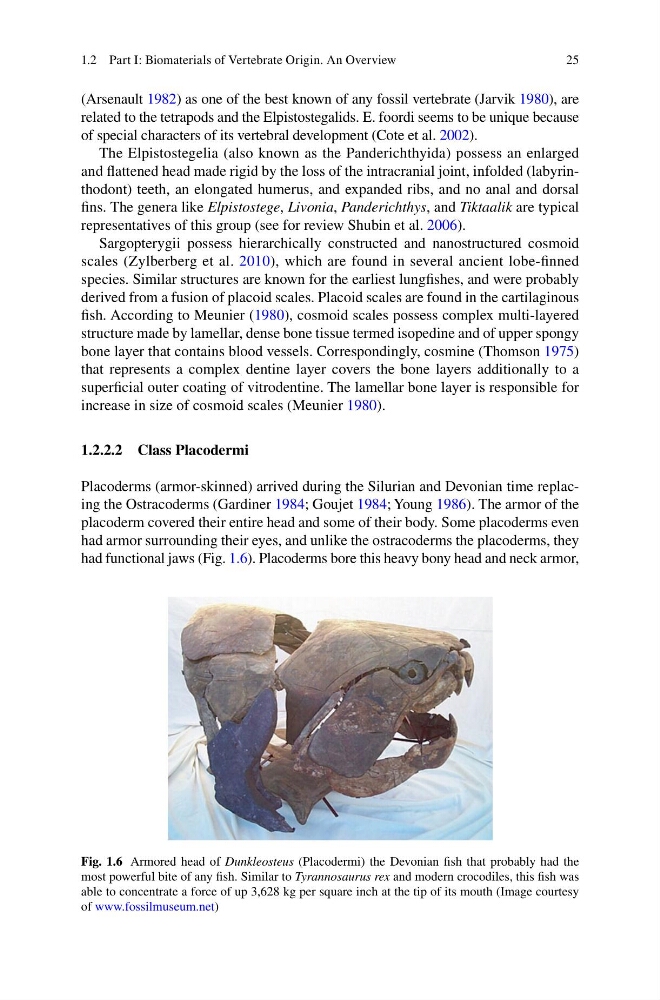
had functional jaws (Fig. 1.6 ). Placoderms bore this heavy bony head and neck armor,
Fig. 1.6 Armored head of Dunkleosteus (Placodermi) the Devonian fi sh that probably had the
most powerful bite of any fi sh. Similar to Tyrannosaurus rex and modern crocodiles, this fi sh was
able to concentrate a force of up 3,628 kg per square inch at the tip of its mouth (Image courtesy
of www.fossilmuseum.net )
1.2 Part I: Biomaterials of Vertebrate Origin. An Overview
(Arsenault 1982 ) as one of the best known of any fossil vertebrate (Jarvik 1980 ), are
related to the tetrapods and the Elpistostegalids. E. foordi seems to be unique because
of special characters of its vertebral development (Cote et al. 2002 ).
The Elpistostegelia (also known as the Panderichthyida) possess an enlarged
and fl attened head made rigid by the loss of the intracranial joint, infolded (labyrinthodont) teeth, an elongated humerus, and expanded ribs, and no anal and dorsal
fi ns. The genera like Elpistostege , Livonia , Panderichthys , and Tiktaalik are typical
representatives of this group (see for review Shubin et al. 2006 ).
Sargopterygii possess hierarchically constructed and nanostructured cosmoid
scales (Zylberberg et al. 2010 ), which are found in several ancient lobe-fi nned
species. Similar structures are known for the earliest lungfi shes, and were probably
derived from a fusion of placoid scales. Placoid scales are found in the cartilaginous
fi sh. According to Meunier ( 1980 ), cosmoid scales possess complex multi-layered
structure made by lamellar, dense bone tissue termed isopedine and of upper spongy
bone layer that contains blood vessels. Correspondingly, cosmine (Thomson 1975 )
that represents a complex dentine layer covers the bone layers additionally to a
superfi cial outer coating of vitrodentine. The lamellar bone layer is responsible for
increase in size of cosmoid scales (Meunier 1980 ).
1.2.2.2 Class Placodermi
Placoderms (armor-skinned) arrived during the Silurian and Devonian time replacing the Ostracoderms (Gardiner 1984 ; Goujet 1984 ; Young 1986 ). The armor of the
placoderm covered their entire head and some of their body. Some placoderms even
had armor surrounding their eyes, and unlike the ostracoderms the placoderms, they
had functional jaws (Fig. 1.6 ). Placoderms bore this heavy bony head and neck armor,
Fig. 1.6 Armored head of Dunkleosteus (Placodermi) the Devonian fi sh that probably had the
most powerful bite of any fi sh. Similar to Tyrannosaurus rex and modern crocodiles, this fi sh was
able to concentrate a force of up 3,628 kg per square inch at the tip of its mouth (Image courtesy
of www.fossilmuseum.net )
1.2 Part I: Biomaterials of Vertebrate Origin. An Overview