

346
Yang 2009 ). Up to 80.8 % gelatin recovery has been achieved in experiments with
silver carp ( Hypophthalmichthys molitrix ) skin. The optimum extraction conditions
were as follow: “50 °C for the extraction temperature, 0.1 N HCl for the acid concentration, 45 min for the acid pretreatment time, and fi nally 4:1 (v/w) for the water/
skin ratio. The predicted responses for these extraction conditions were 630 g gel
strength and 6.3 cP viscosity,” (Boran and Regenstein 2009 ).
Gelatin was isolated from the skins of different fresh water species, including
catfi sh (Yang et al. 2007 ; Yang and Wang 2009 ), silver carp (Boran and Regenstein
2009 ), grass carp ( Catenopharyngodon idella ) (Ladislaus et al. 2007 ); and marine
fi shes such as sharks (Hamada 1990 ), dogfi sh ( Squalus suckleyi ) (Geiger et al.
1962 ), yellowfi n tuna ( Thunnus albacares ) (Andre et al. 2003 ; Cho et al. 2005 ;
Gómez-Estaca et al. 2009b ), megrim ( Lepidorhombus boscii ) (Montero and GomezGuillen 2000 ), cod (Gudmundsson and Hafsteinsson 1997 ), Atlantic salmon (Salmo
salar) (Arnesen and Gildberg 2007 ), Chum salmon ( Oncorhynchus keta ) (Zhang
et al. 2011 ), greater Lizardfi sh ( Saurida tumbil ) (Taheri et al. 2009 ), grouper
(Rahman and Al-Mahrouqi 2009 ), pollock (Bower et al. 2010 ), bigeye snapper and
brownstripe red snapper (Jongjareonrak et al. 2006 ), sin croaker ( Johnius dussumieri )
and shortfi n scad ( Decapterus macrosoma ) (Cheow et al. 2007 ). Gelatins from the
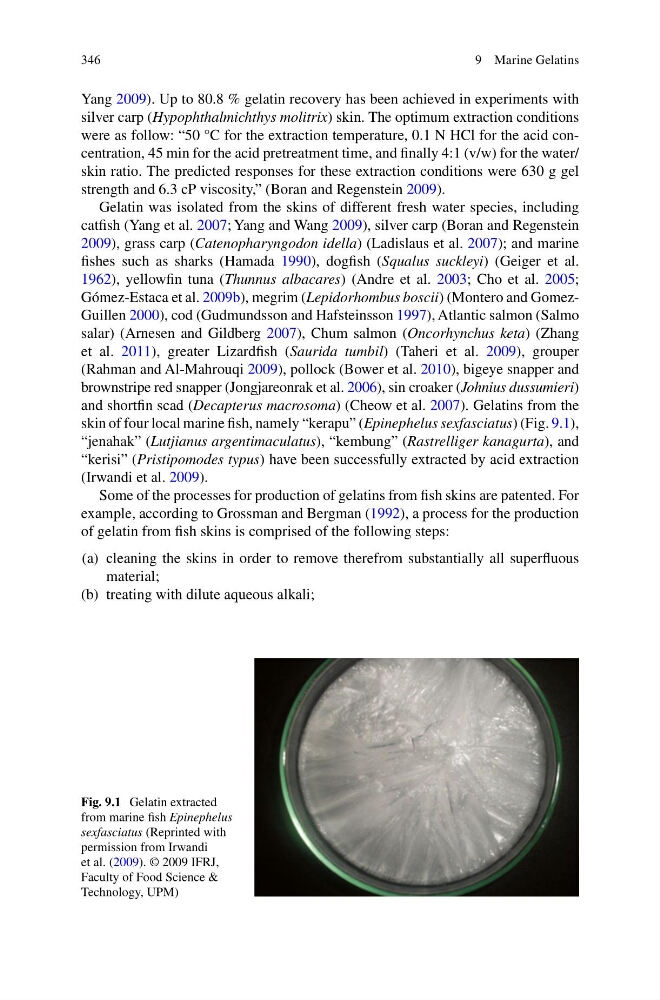
skin of four local marine fi sh, namely “kerapu” ( Epinephelus sexfasciatus ) (Fig. 9.1 ),
“jenahak” ( Lutjianus argentimaculatus ), “kembung” ( Rastrelliger kanagurta ), and
“kerisi” ( Pristipomodes typus ) have been successfully extracted by acid extraction
(Irwandi et al. 2009 ).
Some of the processes for production of gelatins from fi sh skins are patented. For
example, according to Grossman and Bergman ( 1992 ), a process for the production
of gelatin from fi sh skins is comprised of the following steps:
(a) cleaning the skins in order to remove therefrom substantially all superfl uous
material;
(b) treating with dilute aqueous alkali;
Fig. 9.1 Gelatin extracted
from marine fi sh Epinephelus
sexfasciatus (Reprinted with
permission from Irwandi
et al. ( 2009 ). © 2009 IFRJ,
Faculty of Food Science &
Technology, UPM)
9 Marine Gelatins
Yang 2009 ). Up to 80.8 % gelatin recovery has been achieved in experiments with
silver carp ( Hypophthalmichthys molitrix ) skin. The optimum extraction conditions
were as follow: “50 °C for the extraction temperature, 0.1 N HCl for the acid concentration, 45 min for the acid pretreatment time, and fi nally 4:1 (v/w) for the water/
skin ratio. The predicted responses for these extraction conditions were 630 g gel
strength and 6.3 cP viscosity,” (Boran and Regenstein 2009 ).
Gelatin was isolated from the skins of different fresh water species, including
catfi sh (Yang et al. 2007 ; Yang and Wang 2009 ), silver carp (Boran and Regenstein
2009 ), grass carp ( Catenopharyngodon idella ) (Ladislaus et al. 2007 ); and marine
fi shes such as sharks (Hamada 1990 ), dogfi sh ( Squalus suckleyi ) (Geiger et al.
1962 ), yellowfi n tuna ( Thunnus albacares ) (Andre et al. 2003 ; Cho et al. 2005 ;
Gómez-Estaca et al. 2009b ), megrim ( Lepidorhombus boscii ) (Montero and GomezGuillen 2000 ), cod (Gudmundsson and Hafsteinsson 1997 ), Atlantic salmon (Salmo
salar) (Arnesen and Gildberg 2007 ), Chum salmon ( Oncorhynchus keta ) (Zhang
et al. 2011 ), greater Lizardfi sh ( Saurida tumbil ) (Taheri et al. 2009 ), grouper
(Rahman and Al-Mahrouqi 2009 ), pollock (Bower et al. 2010 ), bigeye snapper and
brownstripe red snapper (Jongjareonrak et al. 2006 ), sin croaker ( Johnius dussumieri )
and shortfi n scad ( Decapterus macrosoma ) (Cheow et al. 2007 ). Gelatins from the
skin of four local marine fi sh, namely “kerapu” ( Epinephelus sexfasciatus ) (Fig. 9.1 ),
“jenahak” ( Lutjianus argentimaculatus ), “kembung” ( Rastrelliger kanagurta ), and
“kerisi” ( Pristipomodes typus ) have been successfully extracted by acid extraction
(Irwandi et al. 2009 ).
Some of the processes for production of gelatins from fi sh skins are patented. For
example, according to Grossman and Bergman ( 1992 ), a process for the production
of gelatin from fi sh skins is comprised of the following steps:
(a) cleaning the skins in order to remove therefrom substantially all superfl uous
material;
(b) treating with dilute aqueous alkali;
Fig. 9.1 Gelatin extracted
from marine fi sh Epinephelus
sexfasciatus (Reprinted with
permission from Irwandi
et al. ( 2009 ). © 2009 IFRJ,
Faculty of Food Science &
Technology, UPM)
9 Marine Gelatins