

20
Subclass Actinopterygii (Ray-Finned Fishes)
These fi shes form the other lineage, are probably the most successful of vertebrates
and certainly the most “successful” fi sh, which are the dominant aquatic vertebrates
today. Actinopterygians appeared in the fossil record during the Devonian period,
between 400 and 350 (Ma). During the Carboniferous period (360 Ma) they were
dominant in freshwaters and started to invade the seas (Lund 2000 ; Basden and
Young 2001 ). From the Carboniferous to the Triassic, generally small fish,
palaeoniscoids were the dominant ray-fi nned fi shes. They possess scales covered
by a biological material known as ganoine. Their morphological features were quite
diverse from elongated eel-like forms to compressed forms resembling living
angelfi sh. It is believed that all palaeoniscoids were extinct by the end of the
Mesozoic, leaving only a few distant, primitive species alive today- the paddlefi sh,
sturgeons, and bichirs (see for review Lauder and Liem 1983 ). At present, approximately 42 orders and 431 families are recognized within this subclass. There are
about 23,000 of Teleosts of the 24,000 species within the actinopterygians,
and 96 % of all living fi sh species.
The anatomical features of ray-fi nned fi sh are as follow: pharyngeal slits, body wall
muscles arranged in segmented block, a nerve cord, as well as the lateral line (Romer
and Parsons 1986 ). This is a long canal running down each side of the fi sh body. This
organ possesses specialized sensors that can detect water movements and currents.
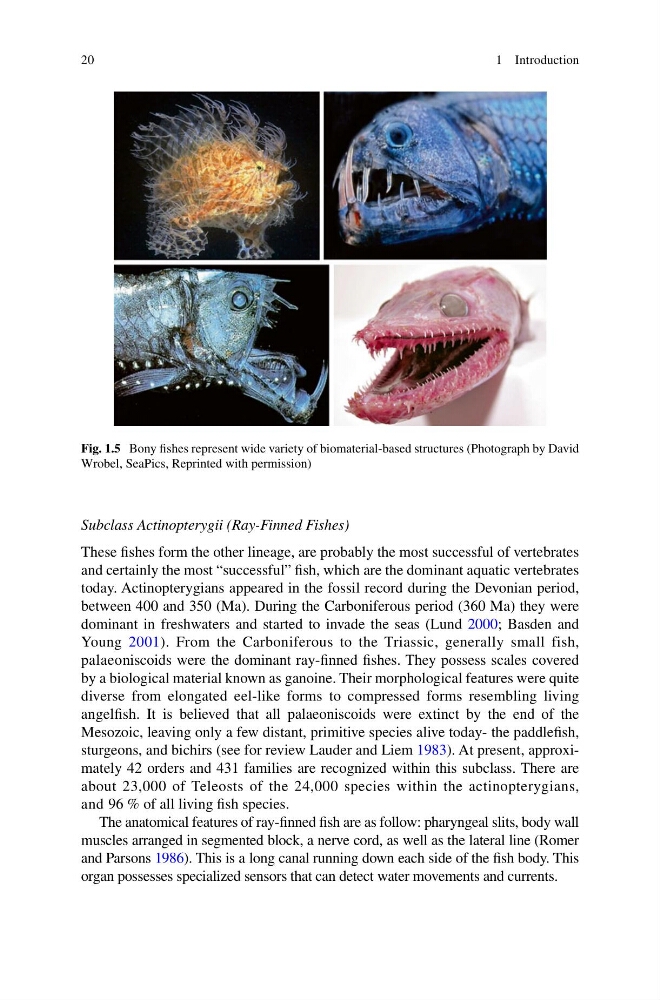
Fig. 1.5 Bony fi shes represent wide variety of biomaterial-based structures (Photograph by David
Wrobel, SeaPics, Reprinted with permission)
1 Introduction
Subclass Actinopterygii (Ray-Finned Fishes)
These fi shes form the other lineage, are probably the most successful of vertebrates
and certainly the most “successful” fi sh, which are the dominant aquatic vertebrates
today. Actinopterygians appeared in the fossil record during the Devonian period,
between 400 and 350 (Ma). During the Carboniferous period (360 Ma) they were
dominant in freshwaters and started to invade the seas (Lund 2000 ; Basden and
Young 2001 ). From the Carboniferous to the Triassic, generally small fish,
palaeoniscoids were the dominant ray-fi nned fi shes. They possess scales covered
by a biological material known as ganoine. Their morphological features were quite
diverse from elongated eel-like forms to compressed forms resembling living
angelfi sh. It is believed that all palaeoniscoids were extinct by the end of the
Mesozoic, leaving only a few distant, primitive species alive today- the paddlefi sh,
sturgeons, and bichirs (see for review Lauder and Liem 1983 ). At present, approximately 42 orders and 431 families are recognized within this subclass. There are
about 23,000 of Teleosts of the 24,000 species within the actinopterygians,
and 96 % of all living fi sh species.
The anatomical features of ray-fi nned fi sh are as follow: pharyngeal slits, body wall
muscles arranged in segmented block, a nerve cord, as well as the lateral line (Romer
and Parsons 1986 ). This is a long canal running down each side of the fi sh body. This
organ possesses specialized sensors that can detect water movements and currents.
Fig. 1.5 Bony fi shes represent wide variety of biomaterial-based structures (Photograph by David
Wrobel, SeaPics, Reprinted with permission)
1 Introduction