

284
As recently reviewed by Esposito et al. ( 2012 ), bony fi sh such as bluegill sunfi sh
( Lepomis macrochirus ) are able to actively deform the surface of their fi ns through
individual fi n ray motions and/or by altering the stiffness of individual fi n rays. The
caudal fi n of this fi sh has been demonstrated to generate locomotor forces in the lateral, lift, and thrust directions, indicating that the tail is being used for more than just
propulsion. Fish are capable of altering the relative magnitudes of these forces and to
vector water momentum in appropriate directions to execute maneuvers; this ability
is a function of the design of the caudal fi n with its individually controllable fi n rays.
George Lauder and co-workers (Esposito et al. 2012 ) “designed a robotic fi sh caudal
fi n with six individually moveable fi n rays based on the tail of the bluegill sunfi sh.
Previous fi sh robotic tail designs have loosely resembled the caudal fi n of fi shes, but
have not incorporated key biomechanical components. These includes fi n rays that
can be controlled to generate complex tail conformations, and motion programs similar to those seen in the locomotor repertoire of live fi shes. The researchers used this
robotic caudal fi n to test for the effects of fi n ray stiffness, frequency and motion
program on the generation of thrust and lift forces. Five different sets of fi n rays were
constructed to be from 150 to 2,000 times the stiffness of biological fi n rays, appropriately scaled for the robotic caudal fi n, which had linear dimensions approximately
four times larger than those of adult bluegill sunfi sh. Five caudal fi n motion programs
were identifi ed as kinematic features of swimming behaviours in live bluegill sunfi sh. It was shown that more compliant fi n rays produced lower peak magnitude
forces than the stiffer fi n rays at the same frequency. Thrust and lift forces increased
with increasing fl apping frequency. Thrust was maximized by the 500× stiffness fi n
rays, and lift was maximized by the 1,000× stiffness fi n rays,” (Esposito et al. 2012 ).
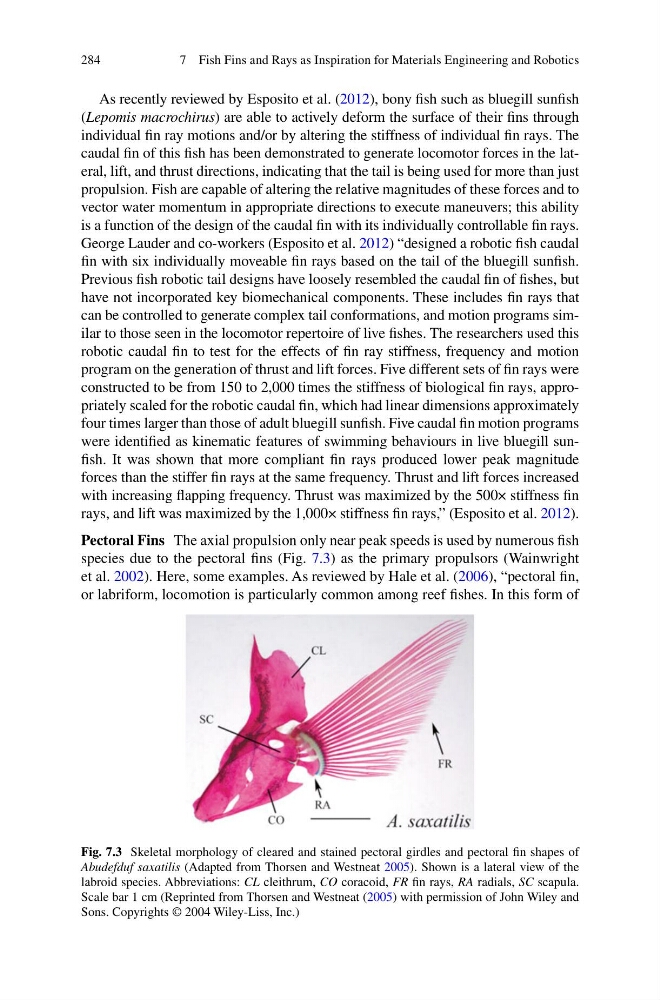
Pectoral Fins The axial propulsion only near peak speeds is used by numerous fi sh
species due to the pectoral fi ns (Fig. 7.3 ) as the primary propulsors (Wainwright
et al. 2002 ). Here, some examples. As reviewed by Hale et al. ( 2006 ), “pectoral fi n,
or labriform, locomotion is particularly common among reef fi shes. In this form of
Fig. 7.3 Skeletal morphology of cleared and stained pectoral girdles and pectoral fi n shapes of
Abudefduf saxatilis (Adapted from Thorsen and Westneat 2005 ). Shown is a lateral view of the
labroid species. Abbreviations: CL cleithrum, CO coracoid, FR fi n rays, RA radials, SC scapula.
Scale bar 1 cm (Reprinted from Thorsen and Westneat ( 2005 ) with permission of John Wiley and
Sons. Copyrights © 2004 Wiley-Liss, Inc.)
7 Fish Fins and Rays as Inspiration for Materials Engineering and Robotics
As recently reviewed by Esposito et al. ( 2012 ), bony fi sh such as bluegill sunfi sh
( Lepomis macrochirus ) are able to actively deform the surface of their fi ns through
individual fi n ray motions and/or by altering the stiffness of individual fi n rays. The
caudal fi n of this fi sh has been demonstrated to generate locomotor forces in the lateral, lift, and thrust directions, indicating that the tail is being used for more than just
propulsion. Fish are capable of altering the relative magnitudes of these forces and to
vector water momentum in appropriate directions to execute maneuvers; this ability
is a function of the design of the caudal fi n with its individually controllable fi n rays.
George Lauder and co-workers (Esposito et al. 2012 ) “designed a robotic fi sh caudal
fi n with six individually moveable fi n rays based on the tail of the bluegill sunfi sh.
Previous fi sh robotic tail designs have loosely resembled the caudal fi n of fi shes, but
have not incorporated key biomechanical components. These includes fi n rays that
can be controlled to generate complex tail conformations, and motion programs similar to those seen in the locomotor repertoire of live fi shes. The researchers used this
robotic caudal fi n to test for the effects of fi n ray stiffness, frequency and motion
program on the generation of thrust and lift forces. Five different sets of fi n rays were
constructed to be from 150 to 2,000 times the stiffness of biological fi n rays, appropriately scaled for the robotic caudal fi n, which had linear dimensions approximately
four times larger than those of adult bluegill sunfi sh. Five caudal fi n motion programs
were identifi ed as kinematic features of swimming behaviours in live bluegill sunfi sh. It was shown that more compliant fi n rays produced lower peak magnitude
forces than the stiffer fi n rays at the same frequency. Thrust and lift forces increased
with increasing fl apping frequency. Thrust was maximized by the 500× stiffness fi n
rays, and lift was maximized by the 1,000× stiffness fi n rays,” (Esposito et al. 2012 ).
Pectoral Fins The axial propulsion only near peak speeds is used by numerous fi sh
species due to the pectoral fi ns (Fig. 7.3 ) as the primary propulsors (Wainwright
et al. 2002 ). Here, some examples. As reviewed by Hale et al. ( 2006 ), “pectoral fi n,
or labriform, locomotion is particularly common among reef fi shes. In this form of
Fig. 7.3 Skeletal morphology of cleared and stained pectoral girdles and pectoral fi n shapes of
Abudefduf saxatilis (Adapted from Thorsen and Westneat 2005 ). Shown is a lateral view of the
labroid species. Abbreviations: CL cleithrum, CO coracoid, FR fi n rays, RA radials, SC scapula.
Scale bar 1 cm (Reprinted from Thorsen and Westneat ( 2005 ) with permission of John Wiley and
Sons. Copyrights © 2004 Wiley-Liss, Inc.)
7 Fish Fins and Rays as Inspiration for Materials Engineering and Robotics