

248
Figure 5.11 summarizes these trends. The authors suggest that “according to its
environment and size, a species of fi sh may emphasize certain functions over others.
For instance, in cases where locomotion speed is emphasized, the structure will be
‘designed’ in terms of the strain-stiffening (the role of external tendons) and being
light-weight. On the other hand, if protection against predator is critical, the design
will favour a higher resistance to fracture and average bending stiffness. This fl exibility in choice may explain the large diversity of scale structures encountered in
nature, from large to small scale, high to low density, all of them within region of
acceptable design depicted by the grey region,” (Vernerey and Barthelat 2010 ) in
Fig. 5.11 .
As reviewed by Browning et al. ( 2013 ), tensile testing of elasmoid fi sh scales
reports an effective scale elastic modulus is about 1 GPa, but varies among species
and along the length of the body of the fi sh. Testing of scales in a hydrated state
(more closely resembling in vivo conditions) yields a reduced elastic modulus 0.1–
0.8 GPa and tensile strength to range 22–65 MPa. The elastic properties of fi sh
scales are in the range of common engineering polymers (e.g., polycarbonate, acrylonitrile butadiene styrene). The density of elasmoid fi sh scales ranges between 1.92
and 2.43 g/cm
3 based on measurements and available literature (Ikom et al. 2003 ;
Torres et al. 2008 ).
The mechanical properties of really existing elasmoid fi sh scales have been
described by Ikom et al. ( 2003 ) on example of sea bream, Pagrus major and recently
by Garrano et al. ( 2012 ) on carp ( Cyprinus carpio ). The scale of sea beam shows an
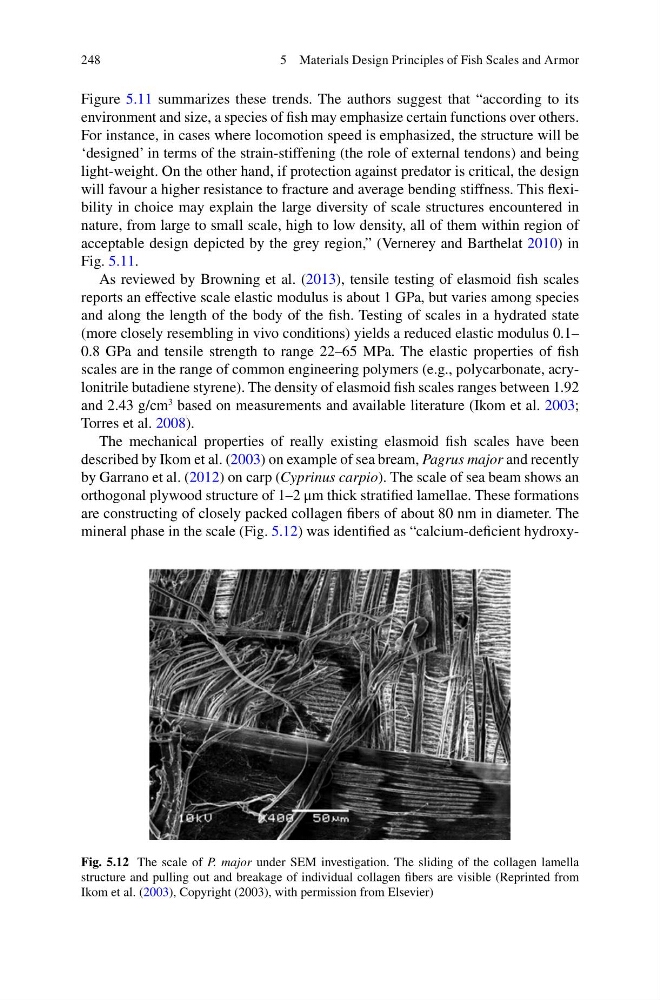
orthogonal plywood structure of 1–2 μm thick stratifi ed lamellae. These formations
are constructing of closely packed collagen fi bers of about 80 nm in diameter. The
mineral phase in the scale (Fig. 5.12 ) was identifi ed as “calcium-defi cient hydroxyFig. 5.12 The scale of P. major under SEM investigation. The sliding of the collagen lamella
structure and pulling out and breakage of individual collagen fi bers are visible (Reprinted from
Ikom et al. ( 2003 ), Copyright (2003), with permission from Elsevier)
5 Materials Design Principles of Fish Scales and Armor
Figure 5.11 summarizes these trends. The authors suggest that “according to its
environment and size, a species of fi sh may emphasize certain functions over others.
For instance, in cases where locomotion speed is emphasized, the structure will be
‘designed’ in terms of the strain-stiffening (the role of external tendons) and being
light-weight. On the other hand, if protection against predator is critical, the design
will favour a higher resistance to fracture and average bending stiffness. This fl exibility in choice may explain the large diversity of scale structures encountered in
nature, from large to small scale, high to low density, all of them within region of
acceptable design depicted by the grey region,” (Vernerey and Barthelat 2010 ) in
Fig. 5.11 .
As reviewed by Browning et al. ( 2013 ), tensile testing of elasmoid fi sh scales
reports an effective scale elastic modulus is about 1 GPa, but varies among species
and along the length of the body of the fi sh. Testing of scales in a hydrated state
(more closely resembling in vivo conditions) yields a reduced elastic modulus 0.1–
0.8 GPa and tensile strength to range 22–65 MPa. The elastic properties of fi sh
scales are in the range of common engineering polymers (e.g., polycarbonate, acrylonitrile butadiene styrene). The density of elasmoid fi sh scales ranges between 1.92
and 2.43 g/cm
3 based on measurements and available literature (Ikom et al. 2003 ;
Torres et al. 2008 ).
The mechanical properties of really existing elasmoid fi sh scales have been
described by Ikom et al. ( 2003 ) on example of sea bream, Pagrus major and recently
by Garrano et al. ( 2012 ) on carp ( Cyprinus carpio ). The scale of sea beam shows an
orthogonal plywood structure of 1–2 μm thick stratifi ed lamellae. These formations
are constructing of closely packed collagen fi bers of about 80 nm in diameter. The
mineral phase in the scale (Fig. 5.12 ) was identifi ed as “calcium-defi cient hydroxyFig. 5.12 The scale of P. major under SEM investigation. The sliding of the collagen lamella
structure and pulling out and breakage of individual collagen fi bers are visible (Reprinted from
Ikom et al. ( 2003 ), Copyright (2003), with permission from Elsevier)
5 Materials Design Principles of Fish Scales and Armor