

245
rocky surfaces in fast-fl owing streams. At the same time, the ideal fi sh scale must
possess properties which correspond to the optimal hydrodynamic conditions for
swimming. I mean drug reduction properties, superoleophobicity in water and self
cleaning. There are no doubts that fi sh scales as structurally highly diverse and complex biocomposites require multi-scale (Ortiz and Boyce 2008 ; Bruet et al. 2008 ;
Song et al. 2011 ) and interdisciplinary physics (Wang et al. 2012 ) research to
connect the structure to properties and ultimately to function.
Because mechanical characterization of fi sh scales is crucial to understand
naturally occurring design principles for engineering of composites and protective
systems, selected modern approaches are used to obtain results in detail.
According to the modern strategies, micromechanical models based on fi nite
element and artifi cially constructed macroscale prototypes are employed to measure
mechanical response to blunt and penetrating indentation loading. For example, in
the recent Master Thesis by Ashley Browning (MIT) entitled “Mechanics of
Composite Elasmoid Fish Scale Assemblies and their Bioinspired Analogues,”
(Browning et al. 2013 ), “deformation mechanisms of fi sh scale bending, scale rotation,
tissue shear, and tissue constraint were found to govern the ability of the composite
to protect the underlying substrate. These deformation mechanisms, the resistance
to deformation, and the resulting energy absorption can all be tailored by structural
parameters including architectural arrangement (angle of the scales, degree of scale
overlap), composition (volume fraction of the scales), morphometry, and material
properties (tissue modulus and scale modulus),” (Browning et al. 2013 ).
There is still lack on information concerning the contribution and synergies of
each length of scale in spite the hierarchical organization of the fi sh skin probably
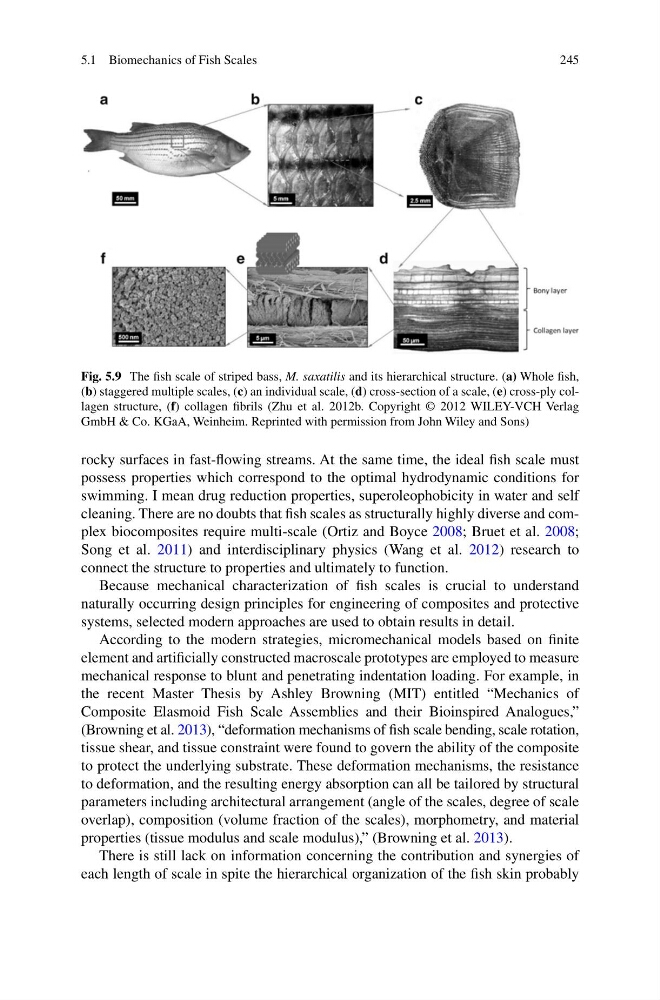
Fig. 5.9 The fi sh scale of striped bass, M. saxatilis and its hierarchical structure. ( a) Whole fi sh,
( b ) staggered multiple scales, ( c ) an individual scale, ( d ) cross-section of a scale, ( e ) cross-ply collagen structure, ( f ) collagen fi brils (Zhu et al. 2012b. Copyright © 2012 WILEY-VCH Verlag
GmbH & Co. KGaA, Weinheim. Reprinted with permission from John Wiley and Sons)
5.1 Biomechanics of Fish Scales
rocky surfaces in fast-fl owing streams. At the same time, the ideal fi sh scale must
possess properties which correspond to the optimal hydrodynamic conditions for
swimming. I mean drug reduction properties, superoleophobicity in water and self
cleaning. There are no doubts that fi sh scales as structurally highly diverse and complex biocomposites require multi-scale (Ortiz and Boyce 2008 ; Bruet et al. 2008 ;
Song et al. 2011 ) and interdisciplinary physics (Wang et al. 2012 ) research to
connect the structure to properties and ultimately to function.
Because mechanical characterization of fi sh scales is crucial to understand
naturally occurring design principles for engineering of composites and protective
systems, selected modern approaches are used to obtain results in detail.
According to the modern strategies, micromechanical models based on fi nite
element and artifi cially constructed macroscale prototypes are employed to measure
mechanical response to blunt and penetrating indentation loading. For example, in
the recent Master Thesis by Ashley Browning (MIT) entitled “Mechanics of
Composite Elasmoid Fish Scale Assemblies and their Bioinspired Analogues,”
(Browning et al. 2013 ), “deformation mechanisms of fi sh scale bending, scale rotation,
tissue shear, and tissue constraint were found to govern the ability of the composite
to protect the underlying substrate. These deformation mechanisms, the resistance
to deformation, and the resulting energy absorption can all be tailored by structural
parameters including architectural arrangement (angle of the scales, degree of scale
overlap), composition (volume fraction of the scales), morphometry, and material
properties (tissue modulus and scale modulus),” (Browning et al. 2013 ).
There is still lack on information concerning the contribution and synergies of
each length of scale in spite the hierarchical organization of the fi sh skin probably
Fig. 5.9 The fi sh scale of striped bass, M. saxatilis and its hierarchical structure. ( a) Whole fi sh,
( b ) staggered multiple scales, ( c ) an individual scale, ( d ) cross-section of a scale, ( e ) cross-ply collagen structure, ( f ) collagen fi brils (Zhu et al. 2012b. Copyright © 2012 WILEY-VCH Verlag
GmbH & Co. KGaA, Weinheim. Reprinted with permission from John Wiley and Sons)
5.1 Biomechanics of Fish Scales