

11
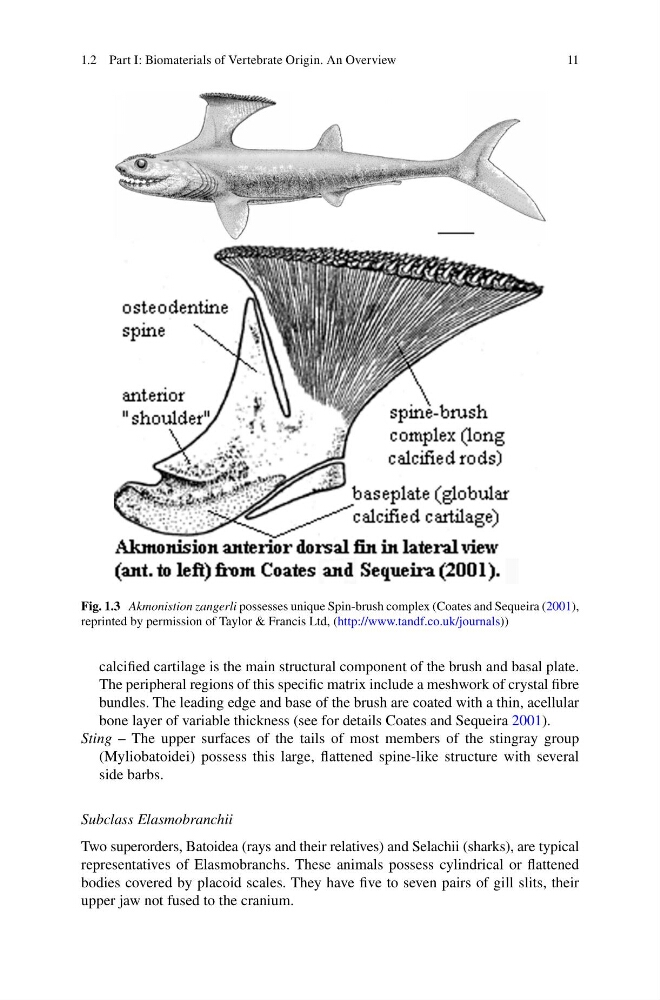
calcifi ed cartilage is the main structural component of the brush and basal plate.
The peripheral regions of this specifi c matrix include a meshwork of crystal fi bre
bundles. The leading edge and base of the brush are coated with a thin, acellular
bone layer of variable thickness (see for details Coates and Sequeira 2001 ).
Sting – The upper surfaces of the tails of most members of the stingray group
(Myliobatoidei) possess this large, fl attened spine-like structure with several
side barbs.
Subclass Elasmobranchii
Two superorders, Batoidea (rays and their relatives) and Selachii (sharks), are typical
representatives of Elasmobranchs. These animals possess cylindrical or fl attened
bodies covered by placoid scales. They have fi ve to seven pairs of gill slits, their
upper jaw not fused to the cranium.
Fig. 1.3 Akmonistion zangerli possesses unique Spin-brush complex (Coates and Sequeira ( 2001 ),
reprinted by permission of Taylor & Francis Ltd, ( http://www.tandf.co.uk/journals ))
1.2 Part I: Biomaterials of Vertebrate Origin. An Overview
calcifi ed cartilage is the main structural component of the brush and basal plate.
The peripheral regions of this specifi c matrix include a meshwork of crystal fi bre
bundles. The leading edge and base of the brush are coated with a thin, acellular
bone layer of variable thickness (see for details Coates and Sequeira 2001 ).
Sting – The upper surfaces of the tails of most members of the stingray group
(Myliobatoidei) possess this large, fl attened spine-like structure with several
side barbs.
Subclass Elasmobranchii
Two superorders, Batoidea (rays and their relatives) and Selachii (sharks), are typical
representatives of Elasmobranchs. These animals possess cylindrical or fl attened
bodies covered by placoid scales. They have fi ve to seven pairs of gill slits, their
upper jaw not fused to the cranium.
Fig. 1.3 Akmonistion zangerli possesses unique Spin-brush complex (Coates and Sequeira ( 2001 ),
reprinted by permission of Taylor & Francis Ltd, ( http://www.tandf.co.uk/journals ))
1.2 Part I: Biomaterials of Vertebrate Origin. An Overview