

214
refl ecting the similarities of their early development involving epithelial–mesenchymal interactions,” (Sharpe 2001 ; see also Thesleff and Sharpe 1997 ). Corresponding
confi rmation has been reported in experiments with the rs-3 mutant in the teleost
Medaka that is known as a model organism with a failure of the development of
most scales. “The rs-3 locus has been shown to encode EDAR (Ectodysplasin A
receptor) and thus mammalian hair loss and failure of fi sh scale development involve
the same TNF pathway,” (Sharpe 2001 ; see also Kondo et al. 2001 ).
In addition, there are differences in function and composition. For example,
scales and hair are not homologous organs. Hairs like feathers are keratinous ectodermal structures localized in ectoderma. They probably evolved from keratinised
epidermal scales in a common ancestor of mammals and reptiles. However, there is
no keratin within fi sh scales. These observation lead to the conclusions formulated
by Sharpe ( 2001 ) as follow:
– “The identifi cation of a common requirement in the development of hair and fi sh
scales thus refl ects a common developmental mechanism for appendage formation. This involves epidermal–dermal interactions, and probably not a direct evolutionary link.
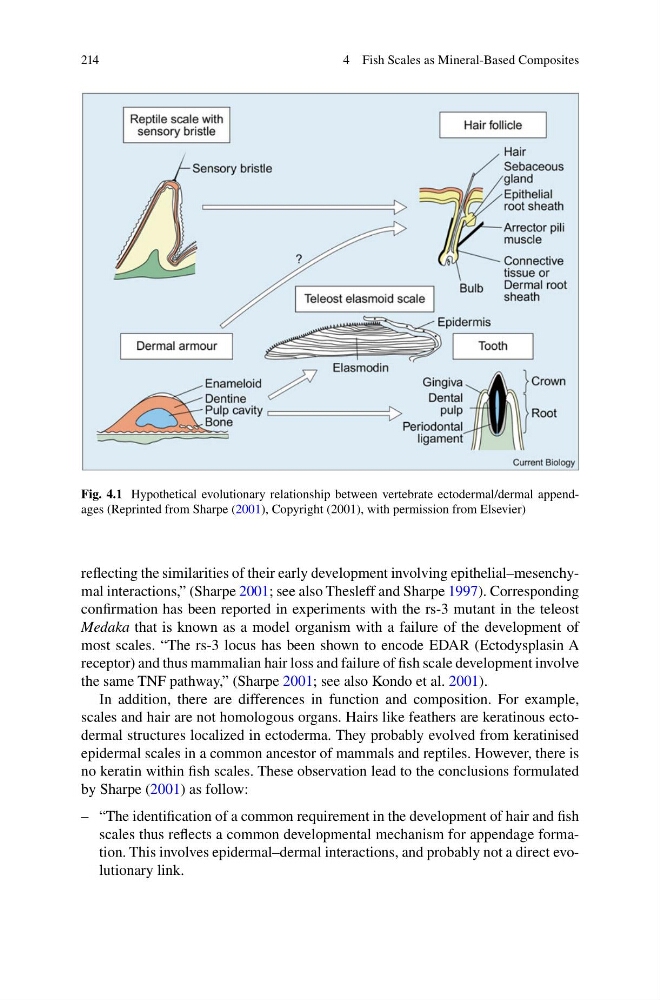
Fig. 4.1 Hypothetical evolutionary relationship between vertebrate ectodermal/dermal appendages (Reprinted from Sharpe ( 2001 ), Copyright (2001), with permission from Elsevier)
4 Fish Scales as Mineral-Based Composites
refl ecting the similarities of their early development involving epithelial–mesenchymal interactions,” (Sharpe 2001 ; see also Thesleff and Sharpe 1997 ). Corresponding
confi rmation has been reported in experiments with the rs-3 mutant in the teleost
Medaka that is known as a model organism with a failure of the development of
most scales. “The rs-3 locus has been shown to encode EDAR (Ectodysplasin A
receptor) and thus mammalian hair loss and failure of fi sh scale development involve
the same TNF pathway,” (Sharpe 2001 ; see also Kondo et al. 2001 ).
In addition, there are differences in function and composition. For example,
scales and hair are not homologous organs. Hairs like feathers are keratinous ectodermal structures localized in ectoderma. They probably evolved from keratinised
epidermal scales in a common ancestor of mammals and reptiles. However, there is
no keratin within fi sh scales. These observation lead to the conclusions formulated
by Sharpe ( 2001 ) as follow:
– “The identifi cation of a common requirement in the development of hair and fi sh
scales thus refl ects a common developmental mechanism for appendage formation. This involves epidermal–dermal interactions, and probably not a direct evolutionary link.
Fig. 4.1 Hypothetical evolutionary relationship between vertebrate ectodermal/dermal appendages (Reprinted from Sharpe ( 2001 ), Copyright (2001), with permission from Elsevier)
4 Fish Scales as Mineral-Based Composites