

167
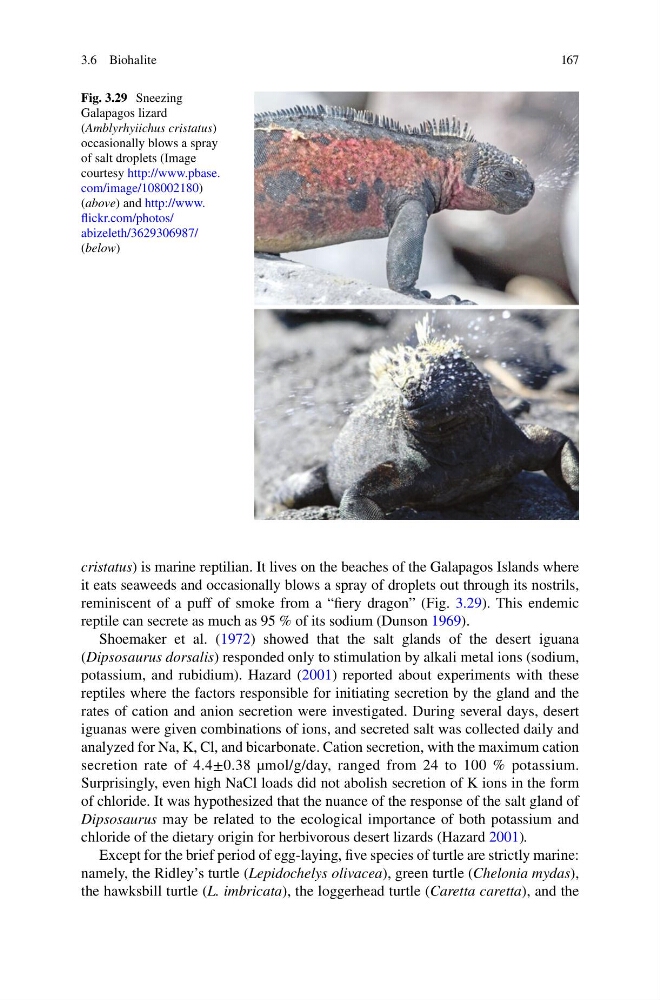
cristatus ) is marine reptilian. It lives on the beaches of the Galapagos Islands where
it eats seaweeds and occasionally blows a spray of droplets out through its nostrils,
reminiscent of a puff of smoke from a “fi ery dragon” (Fig. 3.29 ). This endemic
reptile can secrete as much as 95 % of its sodium (Dunson 1969 ).
Shoemaker et al. ( 1972 ) showed that the salt glands of the desert iguana
( Dipsosaurus dorsalis ) responded only to stimulation by alkali metal ions (sodium,
potassium, and rubidium). Hazard ( 2001 ) reported about experiments with these
reptiles where the factors responsible for initiating secretion by the gland and the
rates of cation and anion secretion were investigated. During several days, desert
iguanas were given combinations of ions, and secreted salt was collected daily and
analyzed for Na, K, Cl, and bicarbonate. Cation secretion, with the maximum cation
secretion rate of 4.4±0.38 µmol/g/day, ranged from 24 to 100 % potassium.
Surprisingly, even high NaCl loads did not abolish secretion of K ions in the form
of chloride. It was hypothesized that the nuance of the response of the salt gland of
Dipsosaurus may be related to the ecological importance of both potassium and
chloride of the dietary origin for herbivorous desert lizards (Hazard 2001 ) .
Except for the brief period of egg-laying, fi ve species of turtle are strictly marine:
namely, the Ridley’s turtle ( Lepidochelys olivacea ), green turtle ( Chelonia mydas ),
the hawksbill turtle ( L. imbricata ), the loggerhead turtle ( Caretta caretta ), and the
Fig. 3.29 Sneezing
Galapagos lizard
( Amblyrhyiichus cristatus )
occasionally blows a spray
of salt droplets (Image
courtesy http://www.pbase.
com/image/108002180 )
( above ) and http://www.
fl ickr.com/photos/
abizeleth/3629306987/
( below )
3.6 Biohalite
cristatus ) is marine reptilian. It lives on the beaches of the Galapagos Islands where
it eats seaweeds and occasionally blows a spray of droplets out through its nostrils,
reminiscent of a puff of smoke from a “fi ery dragon” (Fig. 3.29 ). This endemic
reptile can secrete as much as 95 % of its sodium (Dunson 1969 ).
Shoemaker et al. ( 1972 ) showed that the salt glands of the desert iguana
( Dipsosaurus dorsalis ) responded only to stimulation by alkali metal ions (sodium,
potassium, and rubidium). Hazard ( 2001 ) reported about experiments with these
reptiles where the factors responsible for initiating secretion by the gland and the
rates of cation and anion secretion were investigated. During several days, desert
iguanas were given combinations of ions, and secreted salt was collected daily and
analyzed for Na, K, Cl, and bicarbonate. Cation secretion, with the maximum cation
secretion rate of 4.4±0.38 µmol/g/day, ranged from 24 to 100 % potassium.
Surprisingly, even high NaCl loads did not abolish secretion of K ions in the form
of chloride. It was hypothesized that the nuance of the response of the salt gland of
Dipsosaurus may be related to the ecological importance of both potassium and
chloride of the dietary origin for herbivorous desert lizards (Hazard 2001 ) .
Except for the brief period of egg-laying, fi ve species of turtle are strictly marine:
namely, the Ridley’s turtle ( Lepidochelys olivacea ), green turtle ( Chelonia mydas ),
the hawksbill turtle ( L. imbricata ), the loggerhead turtle ( Caretta caretta ), and the
Fig. 3.29 Sneezing
Galapagos lizard
( Amblyrhyiichus cristatus )
occasionally blows a spray
of salt droplets (Image
courtesy http://www.pbase.
com/image/108002180 )
( above ) and http://www.
fl ickr.com/photos/
abizeleth/3629306987/
( below )
3.6 Biohalite