

154
currents in the outer core. Part of the remaining 1–2 % of the crustal fi eld is from
magnetized rock in the crust, and part from the external fi elds of ionized particles in
the upper atmosphere and solar wind,” (Muheim 2004 ).
The phenomenon observed by numerous animal taxa to navigate over long
distances during migration and homing using the magnetic fi eld of the Earth, have
been formulated by Viguier ( 1882 ) as hypothesis. This is based on suggestions
concerning the existence of magnetic sense in living organisms. This hypothesis
seems to be true, as today biogenic magnetite is found in numerous organisms
including bacteria, invertebrates (insect) (Gould et al. 1978 ; Maher 1998 ) and
vertebrates (fi sh, birds, mammals) (Phillips 1996 ; Kirschvink et al. 2001 ; Holland
et al. 2008 ); and as fossil remnants in sedimentary deposits and soils. Bacterial
magnetosomes (Mann et al. 1984 ; Gorby et al. 1988 ; Schüler 1999 ; Matsunaga and
Sakaguchi 2000 ; McCartney et al. 2001 ; Komeili 2007 ; Faivre and Schüler 2008 )
and their fossils, (magnetofossils), can signifi cantly contribute to the bulk magnetic
properties and the remnant magnetization recorded in marine sediments (Petersen
et al. 1986 ; Fassbinder et al. 1990 ). Heinz Adolf Lowenstam was the fi rst to identify
magnetite in the radula teeth of chitons (marine molluscs), showing that life had
also devised mechanisms to synthesize magnetite by using biochemical processes
(Lowenstam 1962 ).
When studying biogenic magnetite (Kirschvink and Gould 1981 ), it is
paramount to determine the size of the particles produced by, or localized
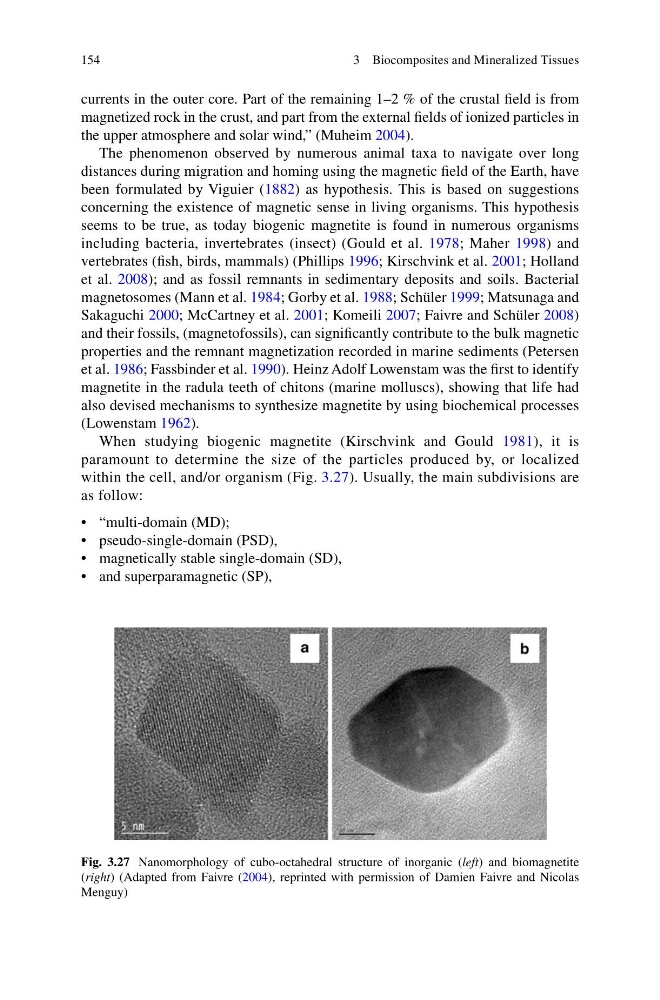
within the cell, and/or organism (Fig. 3.27 ). Usually, the main subdivisions are
as follow:
• “multi-domain (MD);
• pseudo-single-domain (PSD),
• magnetically stable single-domain (SD),
• and superparamagnetic (SP),
Fig. 3.27 Nanomorphology of cubo-octahedral structure of inorganic ( left ) and biomagnetite
( right ) (Adapted from Faivre ( 2004 ), reprinted with permission of Damien Faivre and Nicolas
Menguy)
3 Biocomposites and Mineralized Tissues
currents in the outer core. Part of the remaining 1–2 % of the crustal fi eld is from
magnetized rock in the crust, and part from the external fi elds of ionized particles in
the upper atmosphere and solar wind,” (Muheim 2004 ).
The phenomenon observed by numerous animal taxa to navigate over long
distances during migration and homing using the magnetic fi eld of the Earth, have
been formulated by Viguier ( 1882 ) as hypothesis. This is based on suggestions
concerning the existence of magnetic sense in living organisms. This hypothesis
seems to be true, as today biogenic magnetite is found in numerous organisms
including bacteria, invertebrates (insect) (Gould et al. 1978 ; Maher 1998 ) and
vertebrates (fi sh, birds, mammals) (Phillips 1996 ; Kirschvink et al. 2001 ; Holland
et al. 2008 ); and as fossil remnants in sedimentary deposits and soils. Bacterial
magnetosomes (Mann et al. 1984 ; Gorby et al. 1988 ; Schüler 1999 ; Matsunaga and
Sakaguchi 2000 ; McCartney et al. 2001 ; Komeili 2007 ; Faivre and Schüler 2008 )
and their fossils, (magnetofossils), can signifi cantly contribute to the bulk magnetic
properties and the remnant magnetization recorded in marine sediments (Petersen
et al. 1986 ; Fassbinder et al. 1990 ). Heinz Adolf Lowenstam was the fi rst to identify
magnetite in the radula teeth of chitons (marine molluscs), showing that life had
also devised mechanisms to synthesize magnetite by using biochemical processes
(Lowenstam 1962 ).
When studying biogenic magnetite (Kirschvink and Gould 1981 ), it is
paramount to determine the size of the particles produced by, or localized
within the cell, and/or organism (Fig. 3.27 ). Usually, the main subdivisions are
as follow:
• “multi-domain (MD);
• pseudo-single-domain (PSD),
• magnetically stable single-domain (SD),
• and superparamagnetic (SP),
Fig. 3.27 Nanomorphology of cubo-octahedral structure of inorganic ( left ) and biomagnetite
( right ) (Adapted from Faivre ( 2004 ), reprinted with permission of Damien Faivre and Nicolas
Menguy)
3 Biocomposites and Mineralized Tissues