

147
fi brous layers) ultrastructure of turtle eggshell, confi rms previous investigations on
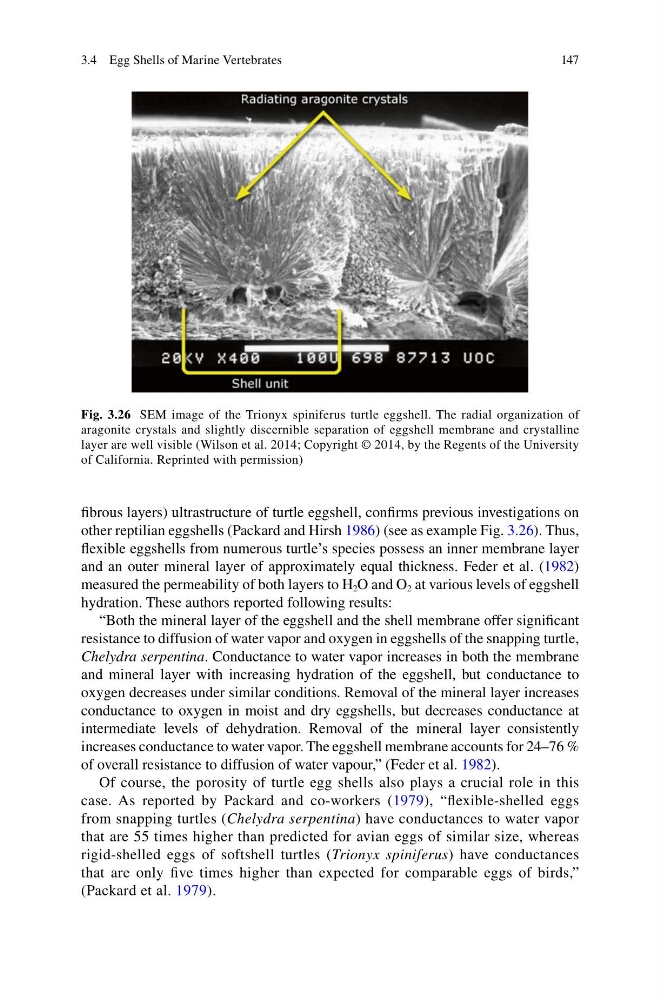
other reptilian eggshells (Packard and Hirsh 1986 ) (see as example Fig. 3.26 ). Thus,
fl exible eggshells from numerous turtle’s species possess an inner membrane layer
and an outer mineral layer of approximately equal thickness. Feder et al. ( 1982 )
measured the permeability of both layers to H 2 O and O 2 at various levels of eggshell
hydration. These authors reported following results:
“Both the mineral layer of the eggshell and the shell membrane offer signifi cant
resistance to diffusion of water vapor and oxygen in eggshells of the snapping turtle,
Chelydra serpentina . Conductance to water vapor increases in both the membrane
and mineral layer with increasing hydration of the eggshell, but conductance to
oxygen decreases under similar conditions. Removal of the mineral layer increases
conductance to oxygen in moist and dry eggshells, but decreases conductance at
intermediate levels of dehydration. Removal of the mineral layer consistently
increases conductance to water vapor. The eggshell membrane accounts for 24–76 %
of overall resistance to diffusion of water vapour,” (Feder et al. 1982 ).
Of course, the porosity of turtle egg shells also plays a crucial role in this
case. As reported by Packard and co-workers ( 1979 ), “fl exible-shelled eggs
from snapping turtles ( Chelydra serpentina ) have conductances to water vapor
that are 55 times higher than predicted for avian eggs of similar size, whereas
rigid-shelled eggs of softshell turtles ( Trionyx spiniferus ) have conductances
that are only fi ve times higher than expected for comparable eggs of birds,”
(Packard et al. 1979 ).
Fig. 3.26 SEM image of the Trionyx spiniferus turtle eggshell. The radial organization of
aragonite crystals and slightly discernible separation of eggshell membrane and crystalline
layer are well visible (Wilson et al. 2014; Copyright © 2014, by the Regents of the University
of California. Reprinted with permission)
3.4 Egg Shells of Marine Vertebrates
fi brous layers) ultrastructure of turtle eggshell, confi rms previous investigations on
other reptilian eggshells (Packard and Hirsh 1986 ) (see as example Fig. 3.26 ). Thus,
fl exible eggshells from numerous turtle’s species possess an inner membrane layer
and an outer mineral layer of approximately equal thickness. Feder et al. ( 1982 )
measured the permeability of both layers to H 2 O and O 2 at various levels of eggshell
hydration. These authors reported following results:
“Both the mineral layer of the eggshell and the shell membrane offer signifi cant
resistance to diffusion of water vapor and oxygen in eggshells of the snapping turtle,
Chelydra serpentina . Conductance to water vapor increases in both the membrane
and mineral layer with increasing hydration of the eggshell, but conductance to
oxygen decreases under similar conditions. Removal of the mineral layer increases
conductance to oxygen in moist and dry eggshells, but decreases conductance at
intermediate levels of dehydration. Removal of the mineral layer consistently
increases conductance to water vapor. The eggshell membrane accounts for 24–76 %
of overall resistance to diffusion of water vapour,” (Feder et al. 1982 ).
Of course, the porosity of turtle egg shells also plays a crucial role in this
case. As reported by Packard and co-workers ( 1979 ), “fl exible-shelled eggs
from snapping turtles ( Chelydra serpentina ) have conductances to water vapor
that are 55 times higher than predicted for avian eggs of similar size, whereas
rigid-shelled eggs of softshell turtles ( Trionyx spiniferus ) have conductances
that are only fi ve times higher than expected for comparable eggs of birds,”
(Packard et al. 1979 ).
Fig. 3.26 SEM image of the Trionyx spiniferus turtle eggshell. The radial organization of
aragonite crystals and slightly discernible separation of eggshell membrane and crystalline
layer are well visible (Wilson et al. 2014; Copyright © 2014, by the Regents of the University
of California. Reprinted with permission)
3.4 Egg Shells of Marine Vertebrates