

145
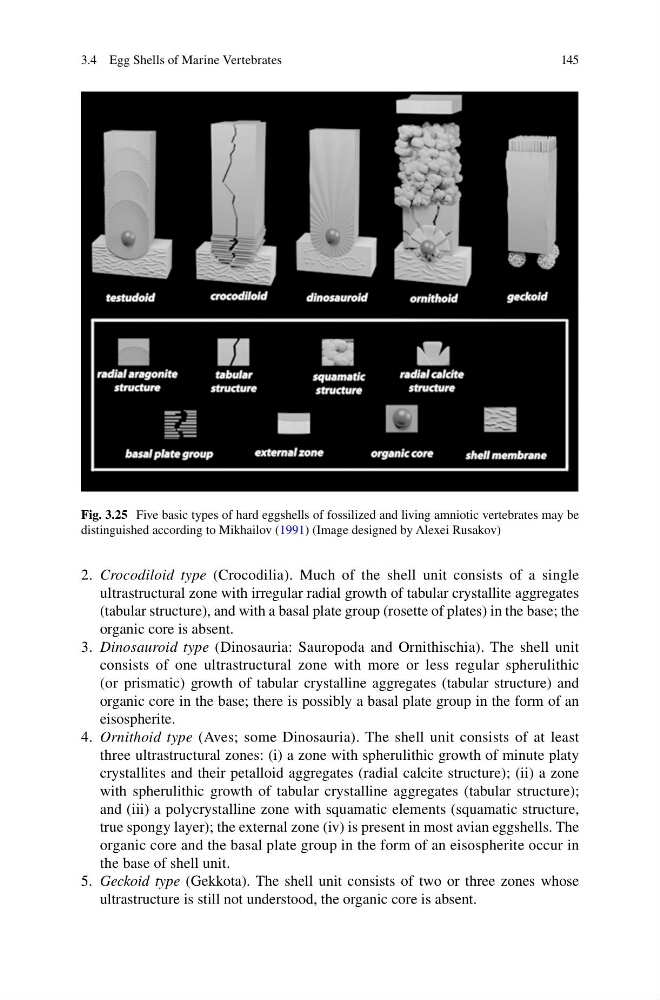
2. Crocodiloid type (Crocodilia). Much of the shell unit consists of a single
ultrastructural zone with irregular radial growth of tabular crystallite aggregates
(tabular structure), and with a basal plate group (rosette of plates) in the base; the
organic core is absent.
3. Dinosauroid type (Dinosauria: Sauropoda and Ornithischia). The shell unit
consists of one ultrastructural zone with more or less regular spherulithic
(or prismatic) growth of tabular crystalline aggregates (tabular structure) and
organic core in the base; there is possibly a basal plate group in the form of an
eisospherite.
4. Ornithoid type (Aves; some Dinosauria). The shell unit consists of at least
three ultrastructural zones: (i) a zone with spherulithic growth of minute platy
crystallites and their petalloid aggregates (radial calcite structure); (ii) a zone
with spherulithic growth of tabular crystalline aggregates (tabular structure);
and (iii) a polycrystalline zone with squamatic elements (squamatic structure,
true spongy layer); the external zone (iv) is present in most avian eggshells. The
organic core and the basal plate group in the form of an eisospherite occur in
the base of shell unit.
5. Geckoid type (Gekkota). The shell unit consists of two or three zones whose
ultrastructure is still not understood, the organic core is absent.
Fig. 3.25 Five basic types of hard eggshells of fossilized and living amniotic vertebrates may be
distinguished according to Mikhailov ( 1991 ) (Image designed by Alexei Rusakov)
3.4 Egg Shells of Marine Vertebrates
2. Crocodiloid type (Crocodilia). Much of the shell unit consists of a single
ultrastructural zone with irregular radial growth of tabular crystallite aggregates
(tabular structure), and with a basal plate group (rosette of plates) in the base; the
organic core is absent.
3. Dinosauroid type (Dinosauria: Sauropoda and Ornithischia). The shell unit
consists of one ultrastructural zone with more or less regular spherulithic
(or prismatic) growth of tabular crystalline aggregates (tabular structure) and
organic core in the base; there is possibly a basal plate group in the form of an
eisospherite.
4. Ornithoid type (Aves; some Dinosauria). The shell unit consists of at least
three ultrastructural zones: (i) a zone with spherulithic growth of minute platy
crystallites and their petalloid aggregates (radial calcite structure); (ii) a zone
with spherulithic growth of tabular crystalline aggregates (tabular structure);
and (iii) a polycrystalline zone with squamatic elements (squamatic structure,
true spongy layer); the external zone (iv) is present in most avian eggshells. The
organic core and the basal plate group in the form of an eisospherite occur in
the base of shell unit.
5. Geckoid type (Gekkota). The shell unit consists of two or three zones whose
ultrastructure is still not understood, the organic core is absent.
Fig. 3.25 Five basic types of hard eggshells of fossilized and living amniotic vertebrates may be
distinguished according to Mikhailov ( 1991 ) (Image designed by Alexei Rusakov)
3.4 Egg Shells of Marine Vertebrates