

142
3.3.3 Conclusion
The main principal question of my personal interest regarding otoconia and
otolith research is determined by the existence of these biocomposites within
Arctic and Antarctic fi sh specimens. It is well known that fi sh that live in the polar
oceans survive at low temperatures by virtue of antifreeze plasma proteins (AFPs)
in the blood that bind to ice crystals and prevent these from growing, up to the level
of −1.5 °C (Marshall et al. 2004 ). Although our own investigations, showed with
strong evidence the presence of crystalline hydroxyapatite within bones, teeth and
scales of numerous ice fi sh species, it is established that both reduced bone density
and decreased mineralization of their skeleton are examples of the characteristic
features. Moreover, these fi shes are used as appropriative model organisms to study a
reduction in bone mineral density termed as osteopenia in human. However, the
following open question still exists: if the skeleton of this fi sh is really poorlymineralized, what about their otoliths?
Previously, it was reported that otoliths of some Antarctic ice fi sh species grew
very slowly (Townsend 1980 ; Radtke and Targett 1984 ) and contain aragonite and
vaterite (Avallone et al. 2003 ). Also, the “high concentration of calcium-binding
proteins in matrices suggests that, in these Antarctic fi sh, all otoliths are involved in
calcium metabolism. This specialization might have occurred as an adaptation to
the exceptionally stressing environmental conditions,” (Motta et al. 2009 ). In spite
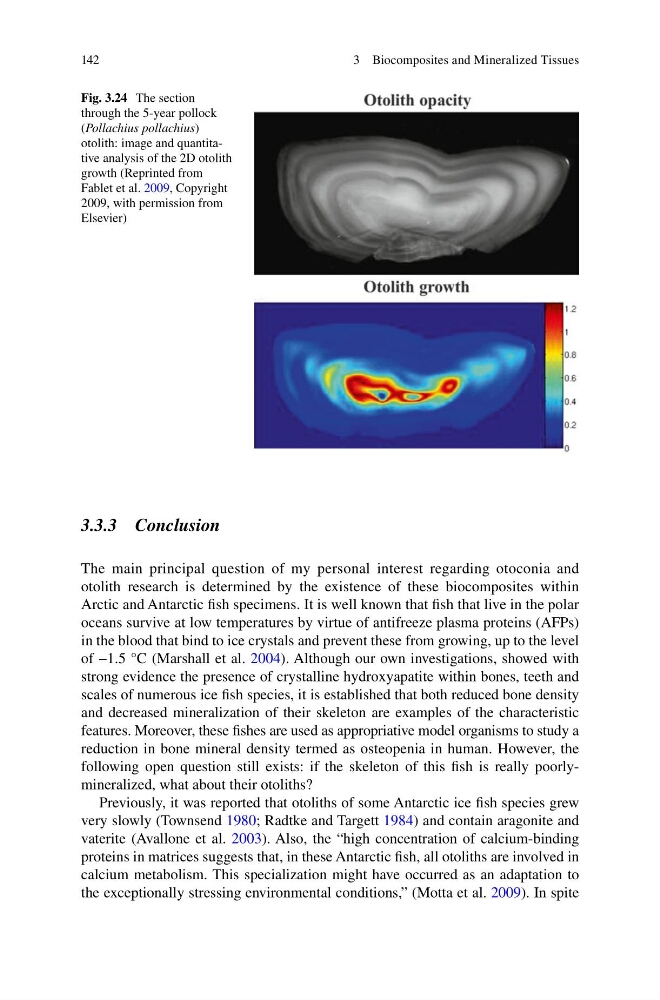
Fig. 3.24 The section
through the 5-year pollock
( Pollachius pollachius )
otolith: image and quantitative analysis of the 2D otolith
growth (Reprinted from
Fablet et al. 2009 , Copyright
2009, with permission from
Elsevier)
3 Biocomposites and Mineralized Tissues
3.3.3 Conclusion
The main principal question of my personal interest regarding otoconia and
otolith research is determined by the existence of these biocomposites within
Arctic and Antarctic fi sh specimens. It is well known that fi sh that live in the polar
oceans survive at low temperatures by virtue of antifreeze plasma proteins (AFPs)
in the blood that bind to ice crystals and prevent these from growing, up to the level
of −1.5 °C (Marshall et al. 2004 ). Although our own investigations, showed with
strong evidence the presence of crystalline hydroxyapatite within bones, teeth and
scales of numerous ice fi sh species, it is established that both reduced bone density
and decreased mineralization of their skeleton are examples of the characteristic
features. Moreover, these fi shes are used as appropriative model organisms to study a
reduction in bone mineral density termed as osteopenia in human. However, the
following open question still exists: if the skeleton of this fi sh is really poorlymineralized, what about their otoliths?
Previously, it was reported that otoliths of some Antarctic ice fi sh species grew
very slowly (Townsend 1980 ; Radtke and Targett 1984 ) and contain aragonite and
vaterite (Avallone et al. 2003 ). Also, the “high concentration of calcium-binding
proteins in matrices suggests that, in these Antarctic fi sh, all otoliths are involved in
calcium metabolism. This specialization might have occurred as an adaptation to
the exceptionally stressing environmental conditions,” (Motta et al. 2009 ). In spite
Fig. 3.24 The section
through the 5-year pollock
( Pollachius pollachius )
otolith: image and quantitative analysis of the 2D otolith
growth (Reprinted from
Fablet et al. 2009 , Copyright
2009, with permission from
Elsevier)
3 Biocomposites and Mineralized Tissues