

138
otoliths was reported as follow: proteins (48 %), collagens (23 %), and proteoglycans
(29 %). However, in the endolymph these compounds were found in other
concentrations (proteins 85 %, collagens 12 %, and proteoglycans 3 %) (Borelli
et al. 1994 ).
The inorganic salt was found by Wicke ( 1863 ) to be calcium carbonate admixed
with small amounts of magnesium carbonate, calcium phosphate and calcium
sulphate. However, otoconia and otoliths are made not only from calcium carbonate
and aragonite as usually thought. For example, the lamprey possesses gravity- sensing
calcium-phosphate-based biominerals, instead of calcium carbonate. As described
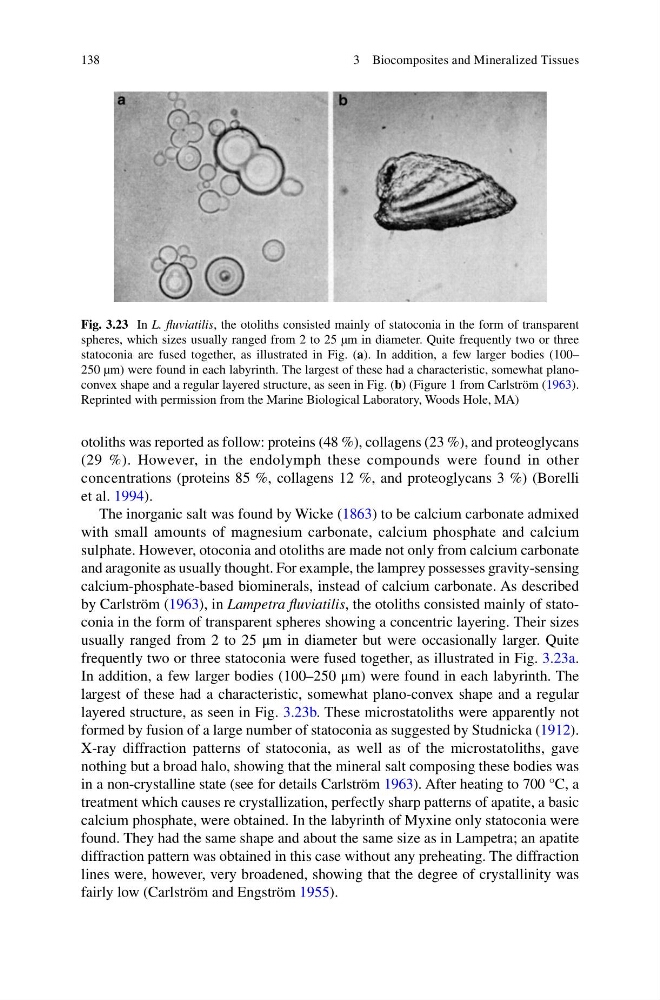
by Carlström ( 1963 ), in Lampetra fl uviatilis , the otoliths consisted mainly of statoconia in the form of transparent spheres showing a concentric layering. Their sizes
usually ranged from 2 to 25 μm in diameter but were occasionally larger. Quite
frequently two or three statoconia were fused together, as illustrated in Fig. 3.23a .
In addition, a few larger bodies (100–250 μm) were found in each labyrinth. The
largest of these had a characteristic, somewhat plano-convex shape and a regular
layered structure, as seen in Fig. 3.23b . These microstatoliths were apparently not
formed by fusion of a large number of statoconia as suggested by Studnicka ( 1912 ).
X-ray diffraction patterns of statoconia, as well as of the microstatoliths, gave
nothing but a broad halo, showing that the mineral salt composing these bodies was
in a non-crystalline state (see for details Carlström 1963 ). After heating to 700 °C, a
treatment which causes re crystallization, perfectly sharp patterns of apatite, a basic
calcium phosphate, were obtained. In the labyrinth of Myxine only statoconia were
found. They had the same shape and about the same size as in Lampetra; an apatite
diffraction pattern was obtained in this case without any preheating. The diffraction
lines were, however, very broadened, showing that the degree of crystallinity was
fairly low (Carlström and Engström 1955 ).
Fig. 3.23 In L. fl uviatilis , the otoliths consisted mainly of statoconia in the form of transparent
spheres, which sizes usually ranged from 2 to 25 µm in diameter. Quite frequently two or three
statoconia are fused together, as illustrated in Fig. ( a ). In addition, a few larger bodies (100–
250 µm) were found in each labyrinth. The largest of these had a characteristic, somewhat planoconvex shape and a regular layered structure, as seen in Fig. ( b ) (Figure 1 from Carlström ( 1963 ).
Reprinted with permission from the Marine Biological Laboratory, Woods Hole, MA)
3 Biocomposites and Mineralized Tissues
otoliths was reported as follow: proteins (48 %), collagens (23 %), and proteoglycans
(29 %). However, in the endolymph these compounds were found in other
concentrations (proteins 85 %, collagens 12 %, and proteoglycans 3 %) (Borelli
et al. 1994 ).
The inorganic salt was found by Wicke ( 1863 ) to be calcium carbonate admixed
with small amounts of magnesium carbonate, calcium phosphate and calcium
sulphate. However, otoconia and otoliths are made not only from calcium carbonate
and aragonite as usually thought. For example, the lamprey possesses gravity- sensing
calcium-phosphate-based biominerals, instead of calcium carbonate. As described
by Carlström ( 1963 ), in Lampetra fl uviatilis , the otoliths consisted mainly of statoconia in the form of transparent spheres showing a concentric layering. Their sizes
usually ranged from 2 to 25 μm in diameter but were occasionally larger. Quite
frequently two or three statoconia were fused together, as illustrated in Fig. 3.23a .
In addition, a few larger bodies (100–250 μm) were found in each labyrinth. The
largest of these had a characteristic, somewhat plano-convex shape and a regular
layered structure, as seen in Fig. 3.23b . These microstatoliths were apparently not
formed by fusion of a large number of statoconia as suggested by Studnicka ( 1912 ).
X-ray diffraction patterns of statoconia, as well as of the microstatoliths, gave
nothing but a broad halo, showing that the mineral salt composing these bodies was
in a non-crystalline state (see for details Carlström 1963 ). After heating to 700 °C, a
treatment which causes re crystallization, perfectly sharp patterns of apatite, a basic
calcium phosphate, were obtained. In the labyrinth of Myxine only statoconia were
found. They had the same shape and about the same size as in Lampetra; an apatite
diffraction pattern was obtained in this case without any preheating. The diffraction
lines were, however, very broadened, showing that the degree of crystallinity was
fairly low (Carlström and Engström 1955 ).
Fig. 3.23 In L. fl uviatilis , the otoliths consisted mainly of statoconia in the form of transparent
spheres, which sizes usually ranged from 2 to 25 µm in diameter. Quite frequently two or three
statoconia are fused together, as illustrated in Fig. ( a ). In addition, a few larger bodies (100–
250 µm) were found in each labyrinth. The largest of these had a characteristic, somewhat planoconvex shape and a regular layered structure, as seen in Fig. ( b ) (Figure 1 from Carlström ( 1963 ).
Reprinted with permission from the Marine Biological Laboratory, Woods Hole, MA)
3 Biocomposites and Mineralized Tissues