

128
dentin tubules communicate entirely through the wall of the tusk with the ocean
environment (Nweeia et al. 2009 ). Thus, narwhal teeth have similar physiology to
human teeth, having both pulpal neurons and dentin tubules (Nweeia et al. 2010 ).
The most distinguishing difference is that the tubules in the narwhal tusk are not
protected by an overlying layer of enamel. This raises the distinct possibility that the
tusk could provide a variety of sensory capabilities. Any stimulus that would result
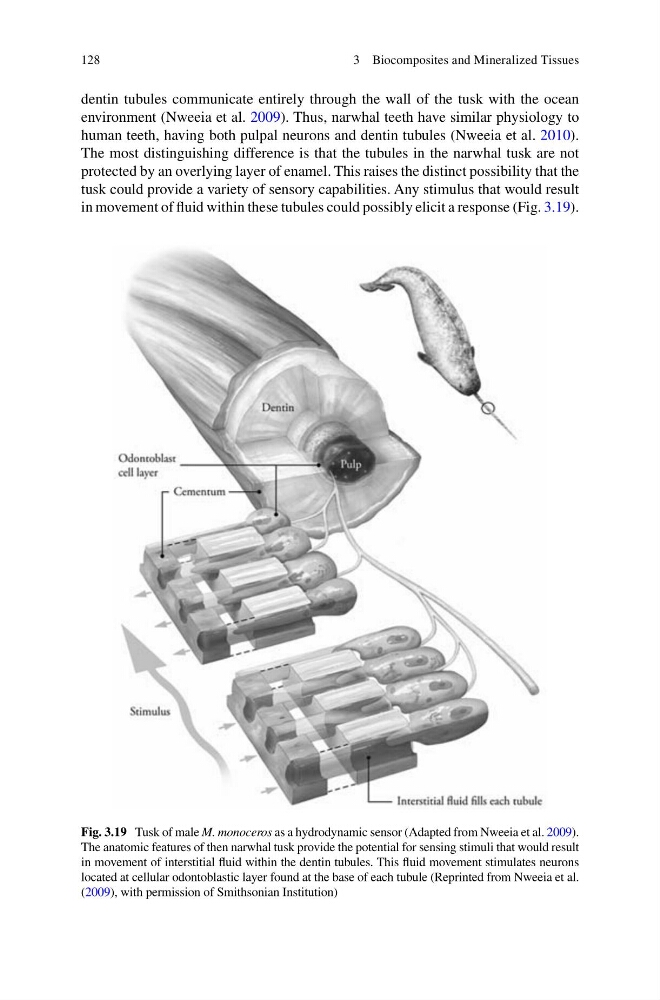
in movement of fl uid within these tubules could possibly elicit a response (Fig. 3.19 ).
Fig. 3.19 Tusk of male M. monoceros as a hydrodynamic sensor (Adapted from Nweeia et al. 2009 ).
The anatomic features of then narwhal tusk provide the potential for sensing stimuli that would result
in movement of interstitial fl uid within the dentin tubules. This fl uid movement stimulates neurons
located at cellular odontoblastic layer found at the base of each tubule (Reprinted from Nweeia et al.
( 2009 ), with permission of Smithsonian Institution)
3 Biocomposites and Mineralized Tissues
dentin tubules communicate entirely through the wall of the tusk with the ocean
environment (Nweeia et al. 2009 ). Thus, narwhal teeth have similar physiology to
human teeth, having both pulpal neurons and dentin tubules (Nweeia et al. 2010 ).
The most distinguishing difference is that the tubules in the narwhal tusk are not
protected by an overlying layer of enamel. This raises the distinct possibility that the
tusk could provide a variety of sensory capabilities. Any stimulus that would result
in movement of fl uid within these tubules could possibly elicit a response (Fig. 3.19 ).
Fig. 3.19 Tusk of male M. monoceros as a hydrodynamic sensor (Adapted from Nweeia et al. 2009 ).
The anatomic features of then narwhal tusk provide the potential for sensing stimuli that would result
in movement of interstitial fl uid within the dentin tubules. This fl uid movement stimulates neurons
located at cellular odontoblastic layer found at the base of each tubule (Reprinted from Nweeia et al.
( 2009 ), with permission of Smithsonian Institution)
3 Biocomposites and Mineralized Tissues