

126
Access to museum collections of sperm whale artefacts may allow assessment of
the impact of whaling by enabling examination of genetic diversity in historic
(whaling-era) sperm whale populations, ” (Pichler et al. 2001 ).
3.2.6.5 Narwhal Tusk
Tusks and teeth differ in their functions, but are similar because of their common
origin. Teeth are necessary for food mastication. Tusks have evolved from teeth and
are examples of extremely large teeth projecting beyond the lips of the animal.
These specialized structures show an evolutionary advantage in some species.
Tuskbearing marine mammals include the narwhal and walrus. “ Large teeth and
tusks are often used interchangeably to describe ivory, ” (Chen et al. 2008 ).
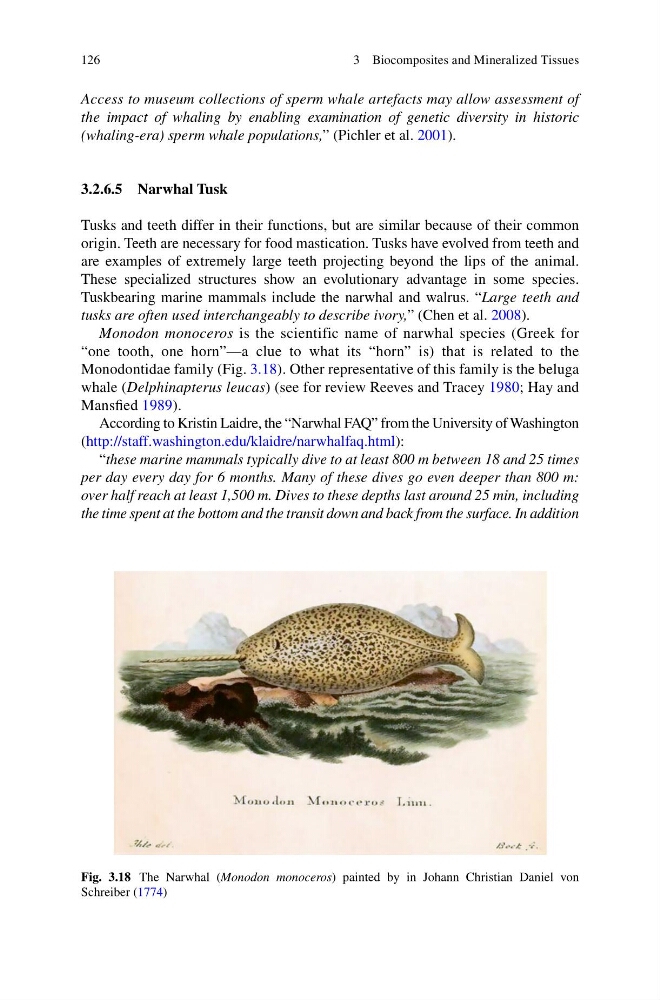
Monodon monoceros is the scientific name of narwhal species (Greek for
“one tooth, one horn”—a clue to what its “horn” is) that is related to the
Monodontidae family (Fig. 3.18 ). Other representative of this family is the beluga
whale ( Delphinapterus leucas ) (see for review Reeves and Tracey 1980 ; Hay and
Mansfi ed 1989 ).
According to Kristin Laidre, the “Narwhal FAQ” from the University of Washington
( http://staff.washington.edu/klaidre/narwhalfaq.html ):
“ these marine mammals typically dive to at least 800 m between 18 and 25 times
per day every day for 6 months. Many of these dives go even deeper than 800 m:
over half reach at least 1,500 m. Dives to these depths last around 25 min, including
the time spent at the bottom and the transit down and back from the surface. In addition
Fig. 3.18 The Narwhal ( Monodon monoceros ) painted by in Johann Christian Daniel von
Schreiber ( 1774 )
3 Biocomposites and Mineralized Tissues
Access to museum collections of sperm whale artefacts may allow assessment of
the impact of whaling by enabling examination of genetic diversity in historic
(whaling-era) sperm whale populations, ” (Pichler et al. 2001 ).
3.2.6.5 Narwhal Tusk
Tusks and teeth differ in their functions, but are similar because of their common
origin. Teeth are necessary for food mastication. Tusks have evolved from teeth and
are examples of extremely large teeth projecting beyond the lips of the animal.
These specialized structures show an evolutionary advantage in some species.
Tuskbearing marine mammals include the narwhal and walrus. “ Large teeth and
tusks are often used interchangeably to describe ivory, ” (Chen et al. 2008 ).
Monodon monoceros is the scientific name of narwhal species (Greek for
“one tooth, one horn”—a clue to what its “horn” is) that is related to the
Monodontidae family (Fig. 3.18 ). Other representative of this family is the beluga
whale ( Delphinapterus leucas ) (see for review Reeves and Tracey 1980 ; Hay and
Mansfi ed 1989 ).
According to Kristin Laidre, the “Narwhal FAQ” from the University of Washington
( http://staff.washington.edu/klaidre/narwhalfaq.html ):
“ these marine mammals typically dive to at least 800 m between 18 and 25 times
per day every day for 6 months. Many of these dives go even deeper than 800 m:
over half reach at least 1,500 m. Dives to these depths last around 25 min, including
the time spent at the bottom and the transit down and back from the surface. In addition
Fig. 3.18 The Narwhal ( Monodon monoceros ) painted by in Johann Christian Daniel von
Schreiber ( 1774 )
3 Biocomposites and Mineralized Tissues