

103
have investigated the construction of these houses, as well as how social relations
infl uence their design (Savelle 1997 ; Patton and Savelle 2006 ). The bones of baleen
whales were used by the Thule culture (AD 1100–1400). For the Thule inhabiting
the whaling regions of the central and eastern Canadian Arctic, wood and other
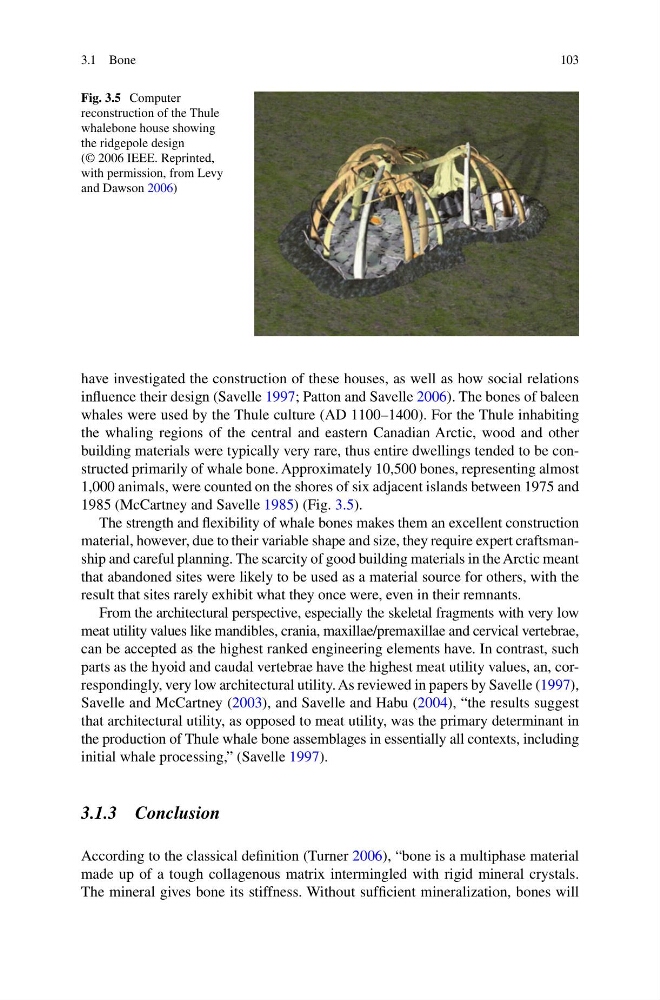
building materials were typically very rare, thus entire dwellings tended to be constructed primarily of whale bone. Approximately 10,500 bones, representing almost
1,000 animals, were counted on the shores of six adjacent islands between 1975 and
1985 (McCartney and Savelle 1985 ) (Fig. 3.5 ).
The strength and fl exibility of whale bones makes them an excellent construction
material, however, due to their variable shape and size, they require expert craftsmanship and careful planning. The scarcity of good building materials in the Arctic meant
that abandoned sites were likely to be used as a material source for others, with the
result that sites rarely exhibit what they once were, even in their remnants.
From the architectural perspective, especially the skeletal fragments with very low
meat utility values like mandibles, crania, maxillae/premaxillae and cervical vertebrae,
can be accepted as the highest ranked engineering elements have. In contrast, such
parts as the hyoid and caudal vertebrae have the highest meat utility values, an, correspondingly, very low architectural utility. As reviewed in papers by Savelle ( 1997 ),
Savelle and McCartney ( 2003 ), and Savelle and Habu ( 2004 ), “the results suggest
that architectural utility, as opposed to meat utility, was the primary determinant in
the production of Thule whale bone assemblages in essentially all contexts, including
initial whale processing,” (Savelle 1997 ).
3.1.3 Conclusion
According to the classical defi nition (Turner 2006 ), “bone is a multiphase material
made up of a tough collagenous matrix intermingled with rigid mineral crystals.
The mineral gives bone its stiffness. Without suffi cient mineralization, bones will
Fig. 3.5 Computer
reconstruction of the Thule
whalebone house showing
the ridgepole design
(© 2006 IEEE. Reprinted,
with permission, from Levy
and Dawson 2006 )
3.1 Bone
have investigated the construction of these houses, as well as how social relations
infl uence their design (Savelle 1997 ; Patton and Savelle 2006 ). The bones of baleen
whales were used by the Thule culture (AD 1100–1400). For the Thule inhabiting
the whaling regions of the central and eastern Canadian Arctic, wood and other
building materials were typically very rare, thus entire dwellings tended to be constructed primarily of whale bone. Approximately 10,500 bones, representing almost
1,000 animals, were counted on the shores of six adjacent islands between 1975 and
1985 (McCartney and Savelle 1985 ) (Fig. 3.5 ).
The strength and fl exibility of whale bones makes them an excellent construction
material, however, due to their variable shape and size, they require expert craftsmanship and careful planning. The scarcity of good building materials in the Arctic meant
that abandoned sites were likely to be used as a material source for others, with the
result that sites rarely exhibit what they once were, even in their remnants.
From the architectural perspective, especially the skeletal fragments with very low
meat utility values like mandibles, crania, maxillae/premaxillae and cervical vertebrae,
can be accepted as the highest ranked engineering elements have. In contrast, such
parts as the hyoid and caudal vertebrae have the highest meat utility values, an, correspondingly, very low architectural utility. As reviewed in papers by Savelle ( 1997 ),
Savelle and McCartney ( 2003 ), and Savelle and Habu ( 2004 ), “the results suggest
that architectural utility, as opposed to meat utility, was the primary determinant in
the production of Thule whale bone assemblages in essentially all contexts, including
initial whale processing,” (Savelle 1997 ).
3.1.3 Conclusion
According to the classical defi nition (Turner 2006 ), “bone is a multiphase material
made up of a tough collagenous matrix intermingled with rigid mineral crystals.
The mineral gives bone its stiffness. Without suffi cient mineralization, bones will
Fig. 3.5 Computer
reconstruction of the Thule
whalebone house showing
the ridgepole design
(© 2006 IEEE. Reprinted,
with permission, from Levy
and Dawson 2006 )
3.1 Bone