

3 Populations and Pathways
79
only <20 unlinked loci are used. The number of loci used is then of primary importance to correctly assess the impact of selection (e.g. Beaumont and Nichols 1996),
or bottlenecks (Luikart et al. 1998). Moreover, AFLPs are useful markers for the
investigation of other issues such as inbreeding (an important parameter in managing populations) (Dasmahapatra et al. 2008), and analysing systems characterized by
weak population structuring (Campbell et al. 2003), as is the case in marine organisms (Ward et al. 1994, DeWoody and Avise 2000). Although much less used for
marine invertebrates compared to terrestrial plants or animals, AFLPs have recently
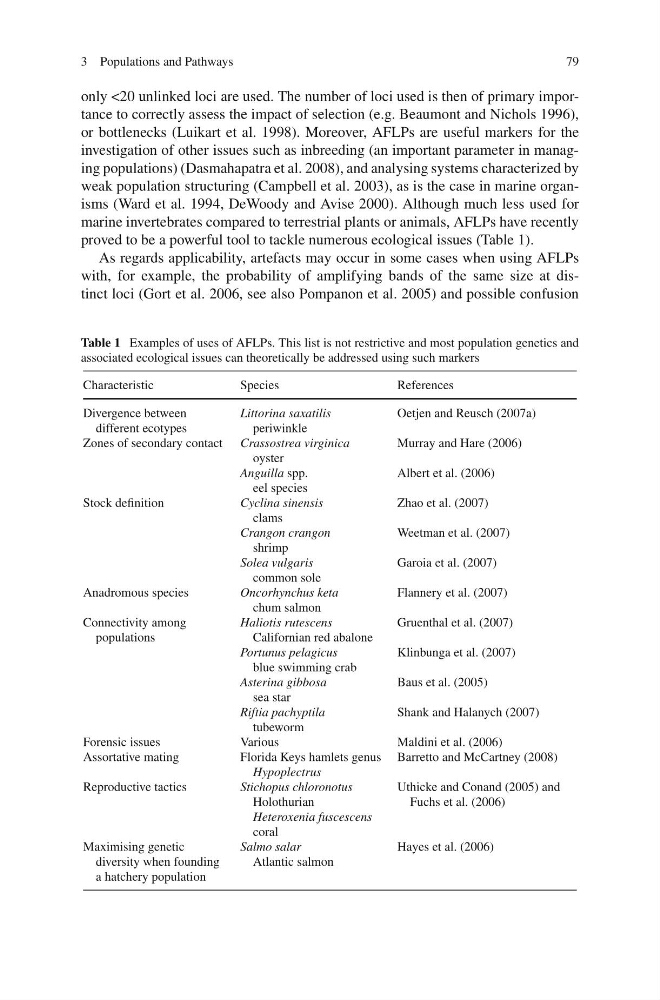
proved to be a powerful tool to tackle numerous ecological issues (Table 1).
As regards applicability, artefacts may occur in some cases when using AFLPs
with, for example, the probability of amplifying bands of the same size at distinct loci (Gort et al. 2006, see also Pompanon et al. 2005) and possible confusion
Table 1 Examples of uses of AFLPs. This list is not restrictive and most population genetics and
associated ecological issues can theoretically be addressed using such markers
Characteristic
Species
References
Divergence between
different ecotypes
Littorina saxatilis
periwinkle
Oetjen and Reusch (2007a)
Zones of secondary contact Crassostrea virginica
oyster
Murray and Hare (2006)
Anguilla spp.
eel species
Albert et al. (2006)
Stock definition
Cyclina sinensis
clams
Zhao et al. (2007)
Crangon crangon
shrimp
Weetman et al. (2007)
Solea vulgaris
common sole
Garoia et al. (2007)
Anadromous species
Oncorhynchus keta
chum salmon
Flannery et al. (2007)
Connectivity among
populations
Haliotis rutescens
Californian red abalone
Gruenthal et al. (2007)
Portunus pelagicus
blue swimming crab
Klinbunga et al. (2007)
Asterina gibbosa
sea star
Baus et al. (2005)
Riftia pachyptila
tubeworm
Shank and Halanych (2007)
Forensic issues
Various
Maldini et al. (2006)
Assortative mating
Florida Keys hamlets genus
Hypoplectrus
Barretto and McCartney (2008)
Reproductive tactics
Stichopus chloronotus
Holothurian
Heteroxenia fuscescens
coral
Uthicke and Conand (2005) and
Fuchs et al. (2006)
Maximising genetic
diversity when founding
a hatchery population
Salmo salar
Atlantic salmon
Hayes et al. (2006)
79
only <20 unlinked loci are used. The number of loci used is then of primary importance to correctly assess the impact of selection (e.g. Beaumont and Nichols 1996),
or bottlenecks (Luikart et al. 1998). Moreover, AFLPs are useful markers for the
investigation of other issues such as inbreeding (an important parameter in managing populations) (Dasmahapatra et al. 2008), and analysing systems characterized by
weak population structuring (Campbell et al. 2003), as is the case in marine organisms (Ward et al. 1994, DeWoody and Avise 2000). Although much less used for
marine invertebrates compared to terrestrial plants or animals, AFLPs have recently
proved to be a powerful tool to tackle numerous ecological issues (Table 1).
As regards applicability, artefacts may occur in some cases when using AFLPs
with, for example, the probability of amplifying bands of the same size at distinct loci (Gort et al. 2006, see also Pompanon et al. 2005) and possible confusion
Table 1 Examples of uses of AFLPs. This list is not restrictive and most population genetics and
associated ecological issues can theoretically be addressed using such markers
Characteristic
Species
References
Divergence between
different ecotypes
Littorina saxatilis
periwinkle
Oetjen and Reusch (2007a)
Zones of secondary contact Crassostrea virginica
oyster
Murray and Hare (2006)
Anguilla spp.
eel species
Albert et al. (2006)
Stock definition
Cyclina sinensis
clams
Zhao et al. (2007)
Crangon crangon
shrimp
Weetman et al. (2007)
Solea vulgaris
common sole
Garoia et al. (2007)
Anadromous species
Oncorhynchus keta
chum salmon
Flannery et al. (2007)
Connectivity among
populations
Haliotis rutescens
Californian red abalone
Gruenthal et al. (2007)
Portunus pelagicus
blue swimming crab
Klinbunga et al. (2007)
Asterina gibbosa
sea star
Baus et al. (2005)
Riftia pachyptila
tubeworm
Shank and Halanych (2007)
Forensic issues
Various
Maldini et al. (2006)
Assortative mating
Florida Keys hamlets genus
Hypoplectrus
Barretto and McCartney (2008)
Reproductive tactics
Stichopus chloronotus
Holothurian
Heteroxenia fuscescens
coral
Uthicke and Conand (2005) and
Fuchs et al. (2006)
Maximising genetic
diversity when founding
a hatchery population
Salmo salar
Atlantic salmon
Hayes et al. (2006)