

356
V. Mittard-Runte et al.
Japan (PDBj) at Osaka University. The BioMagResBank or BMRB group (USA)
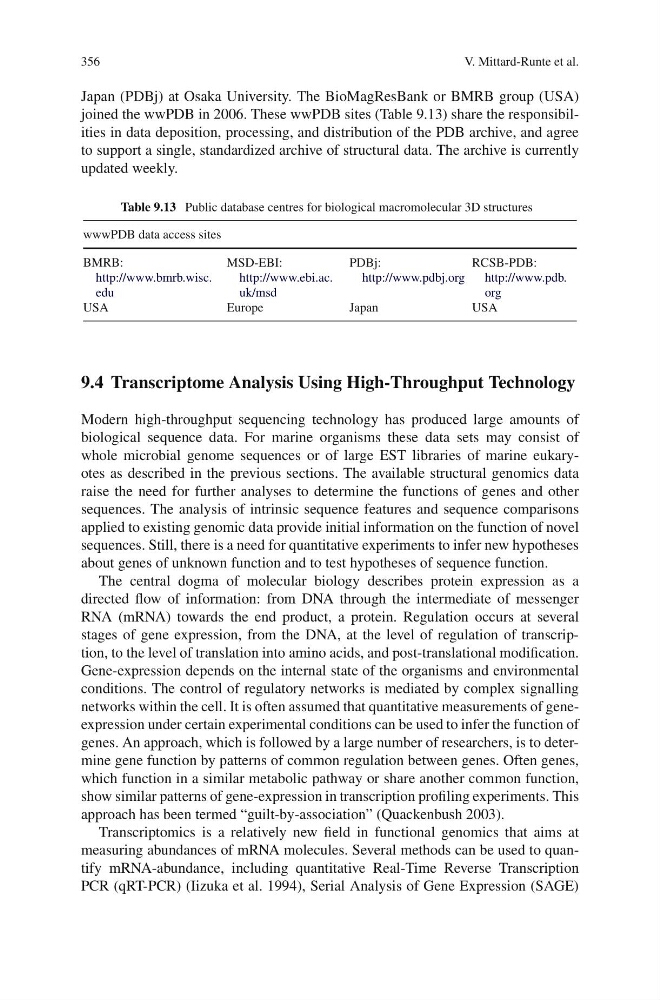
joined the wwPDB in 2006. These wwPDB sites (Table 9.13) share the responsibilities in data deposition, processing, and distribution of the PDB archive, and agree
to support a single, standardized archive of structural data. The archive is currently
updated weekly.
Table 9.13 Public database centres for biological macromolecular 3D structures
wwwPDB data access sites
BMRB:
http://www.bmrb.wisc.
edu
MSD-EBI:
http://www.ebi.ac.
uk/msd
PDBj:
http://www.pdbj.org
RCSB-PDB:
http://www.pdb.
org
USA
Europe
Japan
USA
9.4 Transcriptome Analysis Using High-Throughput Technology
Modern high-throughput sequencing technology has produced large amounts of
biological sequence data. For marine organisms these data sets may consist of
whole microbial genome sequences or of large EST libraries of marine eukaryotes as described in the previous sections. The available structural genomics data
raise the need for further analyses to determine the functions of genes and other
sequences. The analysis of intrinsic sequence features and sequence comparisons
applied to existing genomic data provide initial information on the function of novel
sequences. Still, there is a need for quantitative experiments to infer new hypotheses
about genes of unknown function and to test hypotheses of sequence function.
The central dogma of molecular biology describes protein expression as a
directed flow of information: from DNA through the intermediate of messenger
RNA (mRNA) towards the end product, a protein. Regulation occurs at several
stages of gene expression, from the DNA, at the level of regulation of transcription, to the level of translation into amino acids, and post-translational modification.
Gene-expression depends on the internal state of the organisms and environmental
conditions. The control of regulatory networks is mediated by complex signalling
networks within the cell. It is often assumed that quantitative measurements of geneexpression under certain experimental conditions can be used to infer the function of
genes. An approach, which is followed by a large number of researchers, is to determine gene function by patterns of common regulation between genes. Often genes,
which function in a similar metabolic pathway or share another common function,
show similar patterns of gene-expression in transcription profiling experiments. This
approach has been termed “guilt-by-association” (Quackenbush 2003).
Transcriptomics is a relatively new field in functional genomics that aims at
measuring abundances of mRNA molecules. Several methods can be used to quantify mRNA-abundance, including quantitative Real-Time Reverse Transcription
PCR (qRT-PCR) (Iizuka et al. 1994), Serial Analysis of Gene Expression (SAGE)
V. Mittard-Runte et al.
Japan (PDBj) at Osaka University. The BioMagResBank or BMRB group (USA)
joined the wwPDB in 2006. These wwPDB sites (Table 9.13) share the responsibilities in data deposition, processing, and distribution of the PDB archive, and agree
to support a single, standardized archive of structural data. The archive is currently
updated weekly.
Table 9.13 Public database centres for biological macromolecular 3D structures
wwwPDB data access sites
BMRB:
http://www.bmrb.wisc.
edu
MSD-EBI:
http://www.ebi.ac.
uk/msd
PDBj:
http://www.pdbj.org
RCSB-PDB:
http://www.pdb.
org
USA
Europe
Japan
USA
9.4 Transcriptome Analysis Using High-Throughput Technology
Modern high-throughput sequencing technology has produced large amounts of
biological sequence data. For marine organisms these data sets may consist of
whole microbial genome sequences or of large EST libraries of marine eukaryotes as described in the previous sections. The available structural genomics data
raise the need for further analyses to determine the functions of genes and other
sequences. The analysis of intrinsic sequence features and sequence comparisons
applied to existing genomic data provide initial information on the function of novel
sequences. Still, there is a need for quantitative experiments to infer new hypotheses
about genes of unknown function and to test hypotheses of sequence function.
The central dogma of molecular biology describes protein expression as a
directed flow of information: from DNA through the intermediate of messenger
RNA (mRNA) towards the end product, a protein. Regulation occurs at several
stages of gene expression, from the DNA, at the level of regulation of transcription, to the level of translation into amino acids, and post-translational modification.
Gene-expression depends on the internal state of the organisms and environmental
conditions. The control of regulatory networks is mediated by complex signalling
networks within the cell. It is often assumed that quantitative measurements of geneexpression under certain experimental conditions can be used to infer the function of
genes. An approach, which is followed by a large number of researchers, is to determine gene function by patterns of common regulation between genes. Often genes,
which function in a similar metabolic pathway or share another common function,
show similar patterns of gene-expression in transcription profiling experiments. This
approach has been termed “guilt-by-association” (Quackenbush 2003).
Transcriptomics is a relatively new field in functional genomics that aims at
measuring abundances of mRNA molecules. Several methods can be used to quantify mRNA-abundance, including quantitative Real-Time Reverse Transcription
PCR (qRT-PCR) (Iizuka et al. 1994), Serial Analysis of Gene Expression (SAGE)