

354
V. Mittard-Runte et al.
Table 9.12 Comparison RefSeq vs UniProt
RefSeq
UniProt
Coding sequences from the
NCBI’s set of genomic,
transcript and protein
reference sequences. Only
the entries with validated or
reviewed status are
annotated entries
UniProtKB/Swiss-Prot:
manually annotated protein
sequences mostly derived
from TrEMBL
UniProtKB/TrEMBL:
automatically annotated
protein sequences derived
from coding sequences in
nucleotide sequence
database
Release 27, January 11, 2008:
4,426,609 protein entries and
4,926 organisms
Release 13, February 26, 2008:
356,194 entries (release 55)
and 11,290 different species
Release 13, February 26, 2008:
5,395,414 entries (release
38) and 1,552,882 different
species
Bi-monthly release
Major release 3 times per year, minor release every 3 weeks
Limited to major organisms
All organisms
Exclusive NCBI database
Produced by EBI, PIR, and SIB
Protein and nucleotide data
Protein data only
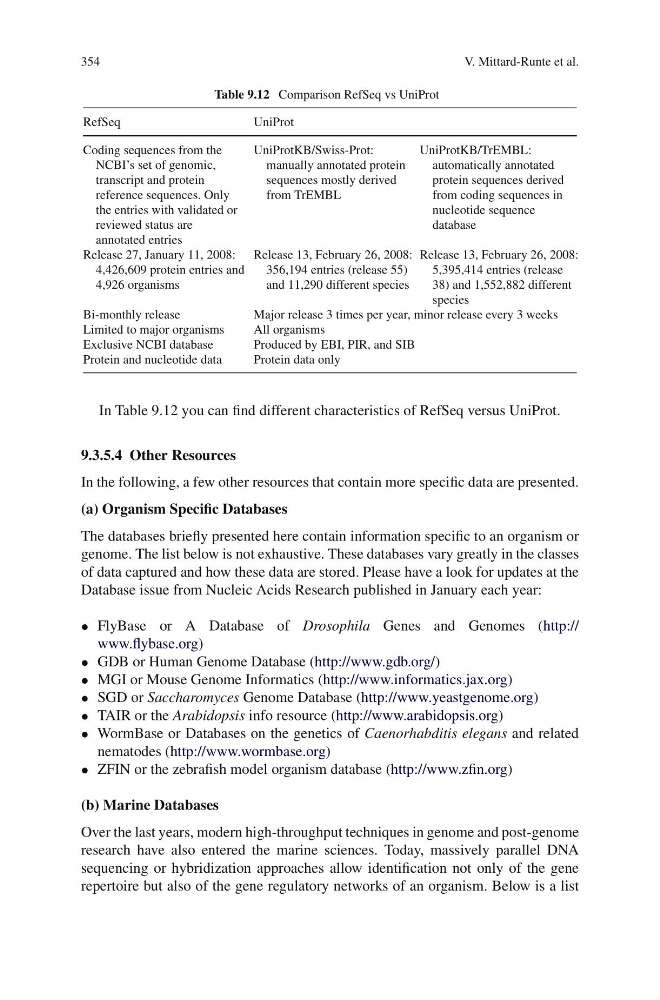
In Table 9.12 you can find different characteristics of RefSeq versus UniProt.
9.3.5.4 Other Resources
In the following, a few other resources that contain more specific data are presented.
(a) Organism Specific Databases
The databases briefly presented here contain information specific to an organism or
genome. The list below is not exhaustive. These databases vary greatly in the classes
of data captured and how these data are stored. Please have a look for updates at the
Database issue from Nucleic Acids Research published in January each year:
• FlyBase or A Database of Drosophila Genes and Genomes (http://
www.flybase.org)
• GDB or Human Genome Database (http://www.gdb.org/)
• MGI or Mouse Genome Informatics (http://www.informatics.jax.org)
• SGD or Saccharomyces Genome Database (http://www.yeastgenome.org)
• TAIR or the Arabidopsis info resource (http://www.arabidopsis.org)
• WormBase or Databases on the genetics of Caenorhabditis elegans and related
nematodes (http://www.wormbase.org)
• ZFIN or the zebrafish model organism database (http://www.zfin.org)
(b) Marine Databases
Over the last years, modern high-throughput techniques in genome and post-genome
research have also entered the marine sciences. Today, massively parallel DNA
sequencing or hybridization approaches allow identification not only of the gene
repertoire but also of the gene regulatory networks of an organism. Below is a list
V. Mittard-Runte et al.
Table 9.12 Comparison RefSeq vs UniProt
RefSeq
UniProt
Coding sequences from the
NCBI’s set of genomic,
transcript and protein
reference sequences. Only
the entries with validated or
reviewed status are
annotated entries
UniProtKB/Swiss-Prot:
manually annotated protein
sequences mostly derived
from TrEMBL
UniProtKB/TrEMBL:
automatically annotated
protein sequences derived
from coding sequences in
nucleotide sequence
database
Release 27, January 11, 2008:
4,426,609 protein entries and
4,926 organisms
Release 13, February 26, 2008:
356,194 entries (release 55)
and 11,290 different species
Release 13, February 26, 2008:
5,395,414 entries (release
38) and 1,552,882 different
species
Bi-monthly release
Major release 3 times per year, minor release every 3 weeks
Limited to major organisms
All organisms
Exclusive NCBI database
Produced by EBI, PIR, and SIB
Protein and nucleotide data
Protein data only
In Table 9.12 you can find different characteristics of RefSeq versus UniProt.
9.3.5.4 Other Resources
In the following, a few other resources that contain more specific data are presented.
(a) Organism Specific Databases
The databases briefly presented here contain information specific to an organism or
genome. The list below is not exhaustive. These databases vary greatly in the classes
of data captured and how these data are stored. Please have a look for updates at the
Database issue from Nucleic Acids Research published in January each year:
• FlyBase or A Database of Drosophila Genes and Genomes (http://
www.flybase.org)
• GDB or Human Genome Database (http://www.gdb.org/)
• MGI or Mouse Genome Informatics (http://www.informatics.jax.org)
• SGD or Saccharomyces Genome Database (http://www.yeastgenome.org)
• TAIR or the Arabidopsis info resource (http://www.arabidopsis.org)
• WormBase or Databases on the genetics of Caenorhabditis elegans and related
nematodes (http://www.wormbase.org)
• ZFIN or the zebrafish model organism database (http://www.zfin.org)
(b) Marine Databases
Over the last years, modern high-throughput techniques in genome and post-genome
research have also entered the marine sciences. Today, massively parallel DNA
sequencing or hybridization approaches allow identification not only of the gene
repertoire but also of the gene regulatory networks of an organism. Below is a list