

342
V. Mittard-Runte et al.
contains a hydrophobic core and can therefore be misclassified as the putative first
TM segment.
A signal peptide is a short peptide chain that directs the transport of a protein
out of the cytosol of the cell. Different types of signal peptides exist, depending
on the destination in the cell. SignalP 3.0 (http://www.cbs.dtu.dk/services/SignalP/)
is a tool that can predict the presence of a signal peptide and thus provide information about subcellular location. SignalP can predict the cleavage site within the
signal peptide in both in eukaryotic and prokaryotic sequences (Bendtsen et al. 2004,
Emanuelsson et al. 2007). Unfortunately, signal peptide prediction programs sometimes identify N-terminal TM segments as signal peptides. The Phobius web server
(http://phobius.binf.ku.dk), which combines transmembrane topology and signal
peptide prediction, was developed to address this problem (Kall et al. 2007).
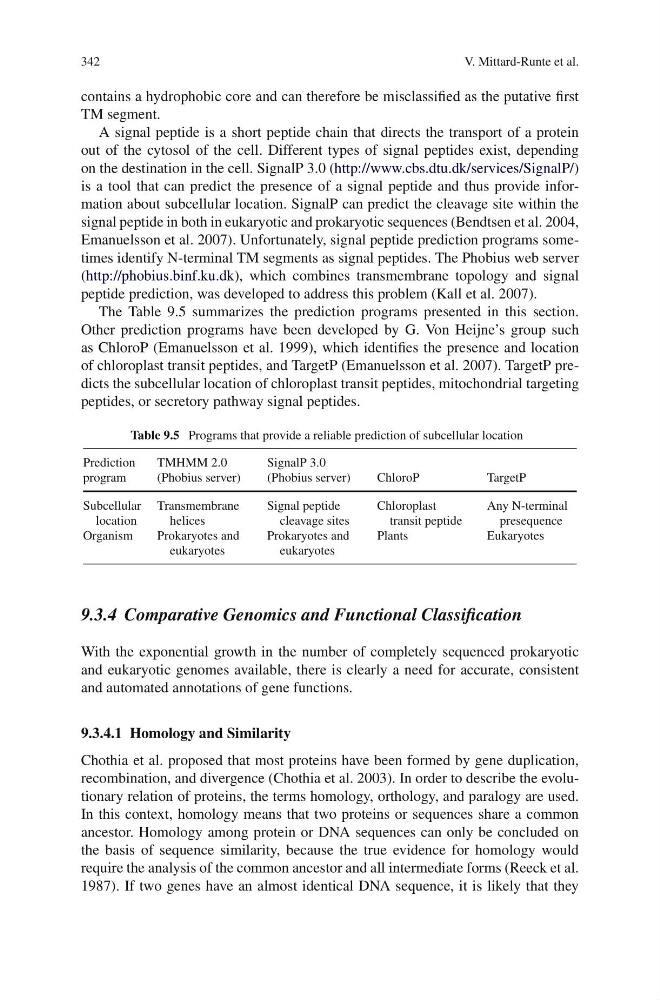
The Table 9.5 summarizes the prediction programs presented in this section.
Other prediction programs have been developed by G. Von Heijne’s group such
as ChloroP (Emanuelsson et al. 1999), which identifies the presence and location
of chloroplast transit peptides, and TargetP (Emanuelsson et al. 2007). TargetP predicts the subcellular location of chloroplast transit peptides, mitochondrial targeting
peptides, or secretory pathway signal peptides.
Table 9.5 Programs that provide a reliable prediction of subcellular location
Prediction
program
TMHMM 2.0
(Phobius server)
SignalP 3.0
(Phobius server)
ChloroP
TargetP
Subcellular
location
Transmembrane
helices
Signal peptide
cleavage sites
Chloroplast
transit peptide
Any N-terminal
presequence
Organism
Prokaryotes and
eukaryotes
Prokaryotes and
eukaryotes
Plants
Eukaryotes
9.3.4 Comparative Genomics and Functional Classification
With the exponential growth in the number of completely sequenced prokaryotic
and eukaryotic genomes available, there is clearly a need for accurate, consistent
and automated annotations of gene functions.
9.3.4.1 Homology and Similarity
Chothia et al. proposed that most proteins have been formed by gene duplication,
recombination, and divergence (Chothia et al. 2003). In order to describe the evolutionary relation of proteins, the terms homology, orthology, and paralogy are used.
In this context, homology means that two proteins or sequences share a common
ancestor. Homology among protein or DNA sequences can only be concluded on
the basis of sequence similarity, because the true evidence for homology would
require the analysis of the common ancestor and all intermediate forms (Reeck et al.
1987). If two genes have an almost identical DNA sequence, it is likely that they
V. Mittard-Runte et al.
contains a hydrophobic core and can therefore be misclassified as the putative first
TM segment.
A signal peptide is a short peptide chain that directs the transport of a protein
out of the cytosol of the cell. Different types of signal peptides exist, depending
on the destination in the cell. SignalP 3.0 (http://www.cbs.dtu.dk/services/SignalP/)
is a tool that can predict the presence of a signal peptide and thus provide information about subcellular location. SignalP can predict the cleavage site within the
signal peptide in both in eukaryotic and prokaryotic sequences (Bendtsen et al. 2004,
Emanuelsson et al. 2007). Unfortunately, signal peptide prediction programs sometimes identify N-terminal TM segments as signal peptides. The Phobius web server
(http://phobius.binf.ku.dk), which combines transmembrane topology and signal
peptide prediction, was developed to address this problem (Kall et al. 2007).
The Table 9.5 summarizes the prediction programs presented in this section.
Other prediction programs have been developed by G. Von Heijne’s group such
as ChloroP (Emanuelsson et al. 1999), which identifies the presence and location
of chloroplast transit peptides, and TargetP (Emanuelsson et al. 2007). TargetP predicts the subcellular location of chloroplast transit peptides, mitochondrial targeting
peptides, or secretory pathway signal peptides.
Table 9.5 Programs that provide a reliable prediction of subcellular location
Prediction
program
TMHMM 2.0
(Phobius server)
SignalP 3.0
(Phobius server)
ChloroP
TargetP
Subcellular
location
Transmembrane
helices
Signal peptide
cleavage sites
Chloroplast
transit peptide
Any N-terminal
presequence
Organism
Prokaryotes and
eukaryotes
Prokaryotes and
eukaryotes
Plants
Eukaryotes
9.3.4 Comparative Genomics and Functional Classification
With the exponential growth in the number of completely sequenced prokaryotic
and eukaryotic genomes available, there is clearly a need for accurate, consistent
and automated annotations of gene functions.
9.3.4.1 Homology and Similarity
Chothia et al. proposed that most proteins have been formed by gene duplication,
recombination, and divergence (Chothia et al. 2003). In order to describe the evolutionary relation of proteins, the terms homology, orthology, and paralogy are used.
In this context, homology means that two proteins or sequences share a common
ancestor. Homology among protein or DNA sequences can only be concluded on
the basis of sequence similarity, because the true evidence for homology would
require the analysis of the common ancestor and all intermediate forms (Reeck et al.
1987). If two genes have an almost identical DNA sequence, it is likely that they