

330
V. Mittard-Runte et al.
Once all the tools have been run, an automatic consensus annotation is generated, providing the EC number, gene name, KOG/COG groups and putative gene
functions. TCs, ESTs and singletons can be manually annotated using an annotation dialog window, which displays all the results of the previously calculated tools.
Backups of all annotations are kept and previous annotations can be restored within
seconds. All sequences, annotations and tool results can be exported via the SAMS
web interface in various file formats.
SteN – Statistical electronic Northern Blot: SteN is a tool to analyse gene expression using EST data. It compares the number of ESTs from each of several different
libraries that have been incorporated into TCs. Using SteN it is possible to filter
TCs according to the composition of ESTs from different libraries. In this way it
is possible to identify TCs for the genes that are expressed specifically in certain
libraries. EST collections from several cDNA libraries corresponding to different
time-points and/or tissues are needed for this analysis. After the TC filtering procedure, a statistical evaluation of the expression data is carried out and a list of results
is presented.
An alternative to SAMS: ESTexplorer: An alternative to SAMS is the
ESTexplorer application (Nagaraj et al. 2007), freely available for academic use at
the following website: http://estexplorer.els.mq.edu.au/estexplorer/main_page.php.
Once the data have been uploaded, vector clipping, repeat masking, and assembly procedures are performed with the following tools: SeqClean (Chen et al. 2007),
RepeatMasker (http://www.repeatmasker.org), and CAP3. Several bioinformatics
tools for annotation can be run using BLAST and Blast2GO (Conesa et al. 2005)
at the gene level, ESTSCAN (Iseli et al. 1999), InterProScan (see Section 9.3.3.3)
and KOBAS (Wu et al. 2006) at the protein level. The results are stored and once
the pipeline is completed, the results can be downloaded for 1 week, all files being
deleted after this time. There is no user management system to identify the user via
a login and password. Instead each user gets an id to access his files (like John_123).
It should be noted that there is a danger with such a system that, if a user guesses
the id of another user, the complete dataset can be accessed. The quantity of data
that can be uploaded and analysed is limited. A comparison between SAMS (Bekel
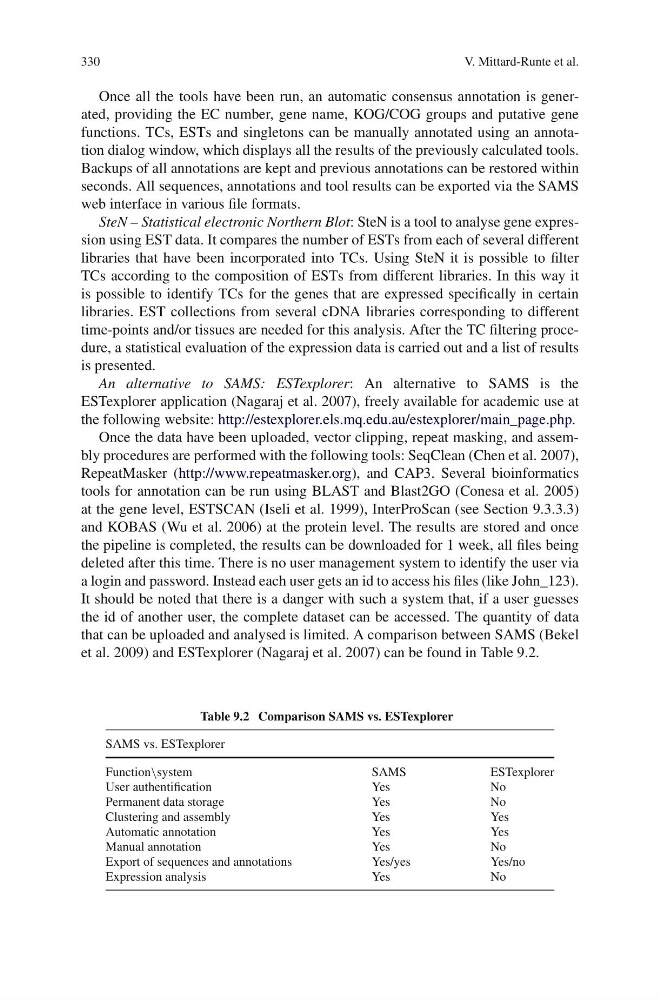
et al. 2009) and ESTexplorer (Nagaraj et al. 2007) can be found in Table 9.2.
Table 9.2 Comparison SAMS vs. ESTexplorer
SAMS vs. ESTexplorer
Function\system
SAMS
ESTexplorer
User authentification
Yes
No
Permanent data storage
Yes
No
Clustering and assembly
Yes
Yes
Automatic annotation
Yes
Yes
Manual annotation
Yes
No
Export of sequences and annotations
Yes/yes
Yes/no
Expression analysis
Yes
No
V. Mittard-Runte et al.
Once all the tools have been run, an automatic consensus annotation is generated, providing the EC number, gene name, KOG/COG groups and putative gene
functions. TCs, ESTs and singletons can be manually annotated using an annotation dialog window, which displays all the results of the previously calculated tools.
Backups of all annotations are kept and previous annotations can be restored within
seconds. All sequences, annotations and tool results can be exported via the SAMS
web interface in various file formats.
SteN – Statistical electronic Northern Blot: SteN is a tool to analyse gene expression using EST data. It compares the number of ESTs from each of several different
libraries that have been incorporated into TCs. Using SteN it is possible to filter
TCs according to the composition of ESTs from different libraries. In this way it
is possible to identify TCs for the genes that are expressed specifically in certain
libraries. EST collections from several cDNA libraries corresponding to different
time-points and/or tissues are needed for this analysis. After the TC filtering procedure, a statistical evaluation of the expression data is carried out and a list of results
is presented.
An alternative to SAMS: ESTexplorer: An alternative to SAMS is the
ESTexplorer application (Nagaraj et al. 2007), freely available for academic use at
the following website: http://estexplorer.els.mq.edu.au/estexplorer/main_page.php.
Once the data have been uploaded, vector clipping, repeat masking, and assembly procedures are performed with the following tools: SeqClean (Chen et al. 2007),
RepeatMasker (http://www.repeatmasker.org), and CAP3. Several bioinformatics
tools for annotation can be run using BLAST and Blast2GO (Conesa et al. 2005)
at the gene level, ESTSCAN (Iseli et al. 1999), InterProScan (see Section 9.3.3.3)
and KOBAS (Wu et al. 2006) at the protein level. The results are stored and once
the pipeline is completed, the results can be downloaded for 1 week, all files being
deleted after this time. There is no user management system to identify the user via
a login and password. Instead each user gets an id to access his files (like John_123).
It should be noted that there is a danger with such a system that, if a user guesses
the id of another user, the complete dataset can be accessed. The quantity of data
that can be uploaded and analysed is limited. A comparison between SAMS (Bekel
et al. 2009) and ESTexplorer (Nagaraj et al. 2007) can be found in Table 9.2.
Table 9.2 Comparison SAMS vs. ESTexplorer
SAMS vs. ESTexplorer
Function\system
SAMS
ESTexplorer
User authentification
Yes
No
Permanent data storage
Yes
No
Clustering and assembly
Yes
Yes
Automatic annotation
Yes
Yes
Manual annotation
Yes
No
Export of sequences and annotations
Yes/yes
Yes/no
Expression analysis
Yes
No