

328
V. Mittard-Runte et al.
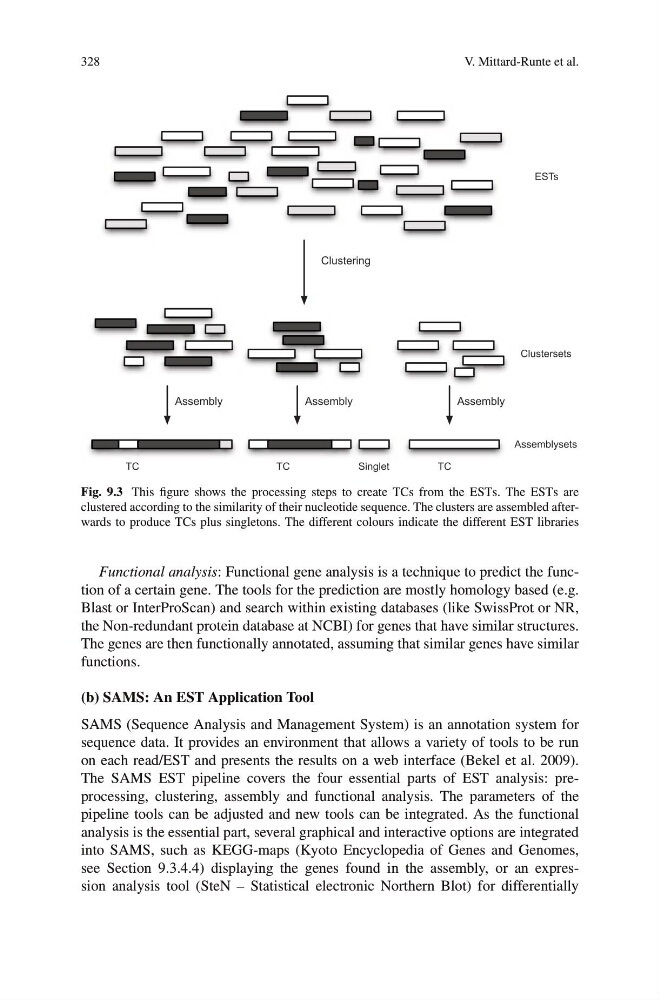
Fig. 9.3 This figure shows the processing steps to create TCs from the ESTs. The ESTs are
clustered according to the similarity of their nucleotide sequence. The clusters are assembled afterwards to produce TCs plus singletons. The different colours indicate the different EST libraries
Functional analysis: Functional gene analysis is a technique to predict the function of a certain gene. The tools for the prediction are mostly homology based (e.g.
Blast or InterProScan) and search within existing databases (like SwissProt or NR,
the Non-redundant protein database at NCBI) for genes that have similar structures.
The genes are then functionally annotated, assuming that similar genes have similar
functions.
(b) SAMS: An EST Application Tool
SAMS (Sequence Analysis and Management System) is an annotation system for
sequence data. It provides an environment that allows a variety of tools to be run
on each read/EST and presents the results on a web interface (Bekel et al. 2009).
The SAMS EST pipeline covers the four essential parts of EST analysis: preprocessing, clustering, assembly and functional analysis. The parameters of the
pipeline tools can be adjusted and new tools can be integrated. As the functional
analysis is the essential part, several graphical and interactive options are integrated
into SAMS, such as KEGG-maps (Kyoto Encyclopedia of Genes and Genomes,
see Section 9.3.4.4) displaying the genes found in the assembly, or an expression analysis tool (SteN – Statistical electronic Northern Blot) for differentially
V. Mittard-Runte et al.
Fig. 9.3 This figure shows the processing steps to create TCs from the ESTs. The ESTs are
clustered according to the similarity of their nucleotide sequence. The clusters are assembled afterwards to produce TCs plus singletons. The different colours indicate the different EST libraries
Functional analysis: Functional gene analysis is a technique to predict the function of a certain gene. The tools for the prediction are mostly homology based (e.g.
Blast or InterProScan) and search within existing databases (like SwissProt or NR,
the Non-redundant protein database at NCBI) for genes that have similar structures.
The genes are then functionally annotated, assuming that similar genes have similar
functions.
(b) SAMS: An EST Application Tool
SAMS (Sequence Analysis and Management System) is an annotation system for
sequence data. It provides an environment that allows a variety of tools to be run
on each read/EST and presents the results on a web interface (Bekel et al. 2009).
The SAMS EST pipeline covers the four essential parts of EST analysis: preprocessing, clustering, assembly and functional analysis. The parameters of the
pipeline tools can be adjusted and new tools can be integrated. As the functional
analysis is the essential part, several graphical and interactive options are integrated
into SAMS, such as KEGG-maps (Kyoto Encyclopedia of Genes and Genomes,
see Section 9.3.4.4) displaying the genes found in the assembly, or an expression analysis tool (SteN – Statistical electronic Northern Blot) for differentially