

9 Genomic Techniques and How to Apply Them to Marine Questions
319
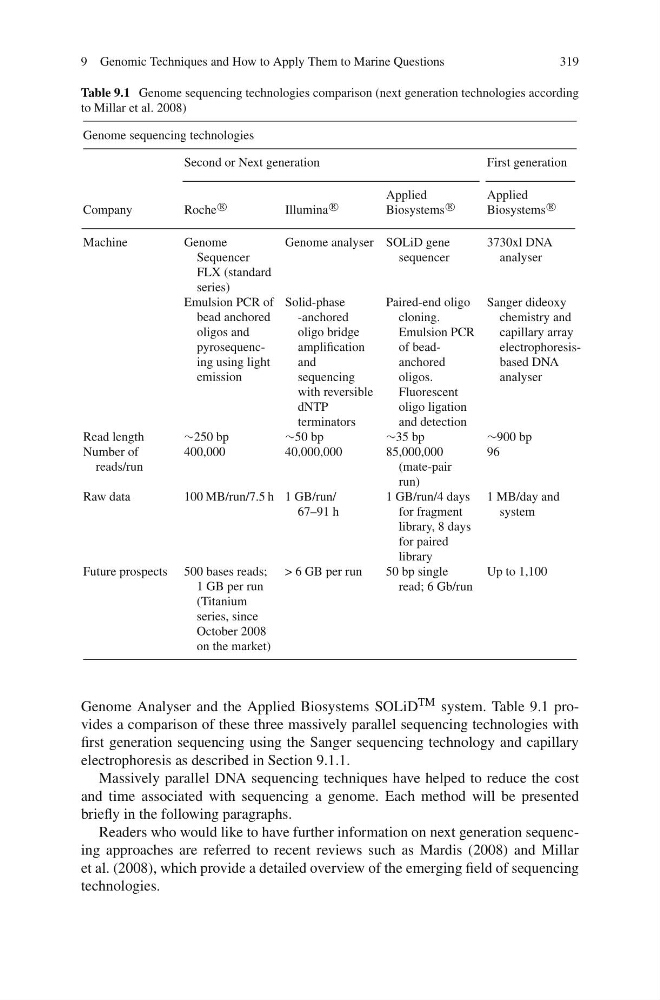
Table 9.1 Genome sequencing technologies comparison (next generation technologies according
to Millar et al. 2008)
Genome sequencing technologies
Second or Next generation
First generation
Applied
Applied
Company
Roche
R
Illumina
R
Biosystems
R
Biosystems
R
Machine
Genome
Sequencer
FLX (standard
series)
Genome analyser SOLiD gene
sequencer
3730xl DNA
analyser
Emulsion PCR of
bead anchored
oligos and
pyrosequencing using light
emission
Solid-phase
-anchored
oligo bridge
amplification
and
sequencing
with reversible
dNTP
terminators
Paired-end oligo
cloning.
Emulsion PCR
of beadanchored
oligos.
Fluorescent
oligo ligation
and detection
Sanger dideoxy
chemistry and
capillary array
electrophoresisbased DNA
analyser
Read length
∼250 bp
∼50 bp
∼35 bp
∼900 bp
Number of
reads/run
400,000
40,000,000
85,000,000
(mate-pair
run)
96
Raw data
100 MB/run/7.5 h 1 GB/run/
67–91 h
1 GB/run/4 days
for fragment
library, 8 days
for paired
library
1 MB/day and
system
Future prospects 500 bases reads;
1 GB per run
(Titanium
series, since
October 2008
on the market)
> 6 GB per run
50 bp single
read; 6 Gb/run
Up to 1,100
Genome Analyser and the Applied Biosystems SOLiD TM system. Table 9.1 provides a comparison of these three massively parallel sequencing technologies with
first generation sequencing using the Sanger sequencing technology and capillary
electrophoresis as described in Section 9.1.1.
Massively parallel DNA sequencing techniques have helped to reduce the cost
and time associated with sequencing a genome. Each method will be presented
briefly in the following paragraphs.
Readers who would like to have further information on next generation sequencing approaches are referred to recent reviews such as Mardis (2008) and Millar
et al. (2008), which provide a detailed overview of the emerging field of sequencing
technologies.
319
Table 9.1 Genome sequencing technologies comparison (next generation technologies according
to Millar et al. 2008)
Genome sequencing technologies
Second or Next generation
First generation
Applied
Applied
Company
Roche
R
Illumina
R
Biosystems
R
Biosystems
R
Machine
Genome
Sequencer
FLX (standard
series)
Genome analyser SOLiD gene
sequencer
3730xl DNA
analyser
Emulsion PCR of
bead anchored
oligos and
pyrosequencing using light
emission
Solid-phase
-anchored
oligo bridge
amplification
and
sequencing
with reversible
dNTP
terminators
Paired-end oligo
cloning.
Emulsion PCR
of beadanchored
oligos.
Fluorescent
oligo ligation
and detection
Sanger dideoxy
chemistry and
capillary array
electrophoresisbased DNA
analyser
Read length
∼250 bp
∼50 bp
∼35 bp
∼900 bp
Number of
reads/run
400,000
40,000,000
85,000,000
(mate-pair
run)
96
Raw data
100 MB/run/7.5 h 1 GB/run/
67–91 h
1 GB/run/4 days
for fragment
library, 8 days
for paired
library
1 MB/day and
system
Future prospects 500 bases reads;
1 GB per run
(Titanium
series, since
October 2008
on the market)
> 6 GB per run
50 bp single
read; 6 Gb/run
Up to 1,100
Genome Analyser and the Applied Biosystems SOLiD TM system. Table 9.1 provides a comparison of these three massively parallel sequencing technologies with
first generation sequencing using the Sanger sequencing technology and capillary
electrophoresis as described in Section 9.1.1.
Massively parallel DNA sequencing techniques have helped to reduce the cost
and time associated with sequencing a genome. Each method will be presented
briefly in the following paragraphs.
Readers who would like to have further information on next generation sequencing approaches are referred to recent reviews such as Mardis (2008) and Millar
et al. (2008), which provide a detailed overview of the emerging field of sequencing
technologies.