

292
J. Querellou et al.
Penicillium chrysogenum, with two genome sequences currently being completed
(www.genomesonline.org/gold.cgi).
The microbes whose complete genome have been sequenced up to date (August
2008) are mostly from the Bacteria (684 in NCBI Entrez Genome Database; 696
in Genomesonline Database), followed by Archaea (52–53). Fungi, despite being
present in many marine habitats, are underrepresented in the list of complete
genomes. The ratio of marine to terrestrial species varies considerably depending
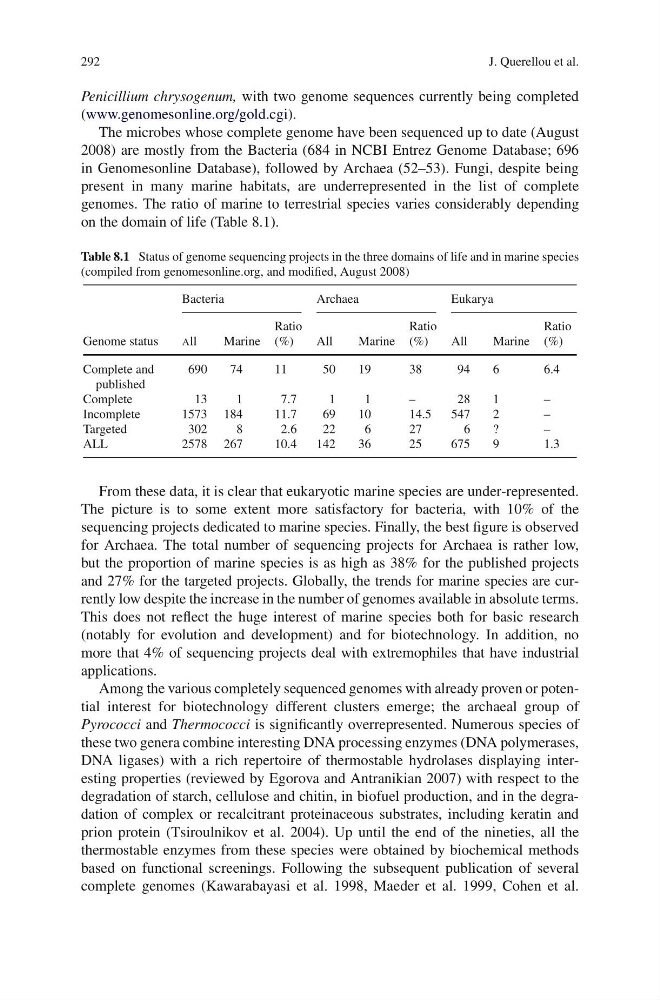
on the domain of life (Table 8.1).
Table 8.1 Status of genome sequencing projects in the three domains of life and in marine species
(compiled from genomesonline.org, and modified, August 2008)
Bacteria
Archaea
Eukarya
Genome status
All
Marine
Ratio
(%)
All
Marine
Ratio
(%)
All
Marine
Ratio
(%)
Complete and
published
690
74
11
50
19
38
94
6
6.4
Complete
13
1
7.7
1
1
–
28
1
–
Incomplete
1573 184
11.7
69
10
14.5
547
2
–
Targeted
302
8
2.6
22
6
27
6
?
–
ALL
2578 267
10.4
142
36
25
675
9
1.3
From these data, it is clear that eukaryotic marine species are under-represented.
The picture is to some extent more satisfactory for bacteria, with 10% of the
sequencing projects dedicated to marine species. Finally, the best figure is observed
for Archaea. The total number of sequencing projects for Archaea is rather low,
but the proportion of marine species is as high as 38% for the published projects
and 27% for the targeted projects. Globally, the trends for marine species are currently low despite the increase in the number of genomes available in absolute terms.
This does not reflect the huge interest of marine species both for basic research
(notably for evolution and development) and for biotechnology. In addition, no
more that 4% of sequencing projects deal with extremophiles that have industrial
applications.
Among the various completely sequenced genomes with already proven or potential interest for biotechnology different clusters emerge; the archaeal group of
Pyrococci and Thermococci is significantly overrepresented. Numerous species of
these two genera combine interesting DNA processing enzymes (DNA polymerases,
DNA ligases) with a rich repertoire of thermostable hydrolases displaying interesting properties (reviewed by Egorova and Antranikian 2007) with respect to the
degradation of starch, cellulose and chitin, in biofuel production, and in the degradation of complex or recalcitrant proteinaceous substrates, including keratin and
prion protein (Tsiroulnikov et al. 2004). Up until the end of the nineties, all the
thermostable enzymes from these species were obtained by biochemical methods
based on functional screenings. Following the subsequent publication of several
complete genomes (Kawarabayasi et al. 1998, Maeder et al. 1999, Cohen et al.
J. Querellou et al.
Penicillium chrysogenum, with two genome sequences currently being completed
(www.genomesonline.org/gold.cgi).
The microbes whose complete genome have been sequenced up to date (August
2008) are mostly from the Bacteria (684 in NCBI Entrez Genome Database; 696
in Genomesonline Database), followed by Archaea (52–53). Fungi, despite being
present in many marine habitats, are underrepresented in the list of complete
genomes. The ratio of marine to terrestrial species varies considerably depending
on the domain of life (Table 8.1).
Table 8.1 Status of genome sequencing projects in the three domains of life and in marine species
(compiled from genomesonline.org, and modified, August 2008)
Bacteria
Archaea
Eukarya
Genome status
All
Marine
Ratio
(%)
All
Marine
Ratio
(%)
All
Marine
Ratio
(%)
Complete and
published
690
74
11
50
19
38
94
6
6.4
Complete
13
1
7.7
1
1
–
28
1
–
Incomplete
1573 184
11.7
69
10
14.5
547
2
–
Targeted
302
8
2.6
22
6
27
6
?
–
ALL
2578 267
10.4
142
36
25
675
9
1.3
From these data, it is clear that eukaryotic marine species are under-represented.
The picture is to some extent more satisfactory for bacteria, with 10% of the
sequencing projects dedicated to marine species. Finally, the best figure is observed
for Archaea. The total number of sequencing projects for Archaea is rather low,
but the proportion of marine species is as high as 38% for the published projects
and 27% for the targeted projects. Globally, the trends for marine species are currently low despite the increase in the number of genomes available in absolute terms.
This does not reflect the huge interest of marine species both for basic research
(notably for evolution and development) and for biotechnology. In addition, no
more that 4% of sequencing projects deal with extremophiles that have industrial
applications.
Among the various completely sequenced genomes with already proven or potential interest for biotechnology different clusters emerge; the archaeal group of
Pyrococci and Thermococci is significantly overrepresented. Numerous species of
these two genera combine interesting DNA processing enzymes (DNA polymerases,
DNA ligases) with a rich repertoire of thermostable hydrolases displaying interesting properties (reviewed by Egorova and Antranikian 2007) with respect to the
degradation of starch, cellulose and chitin, in biofuel production, and in the degradation of complex or recalcitrant proteinaceous substrates, including keratin and
prion protein (Tsiroulnikov et al. 2004). Up until the end of the nineties, all the
thermostable enzymes from these species were obtained by biochemical methods
based on functional screenings. Following the subsequent publication of several
complete genomes (Kawarabayasi et al. 1998, Maeder et al. 1999, Cohen et al.