

1 Genomics in the Discovery and Monitoring
13
phylogenetic analyses, permit the design of hierarchically organized probe sets that
specifically target the 18S-rDNA from higher taxonomic levels down to the species
level (Groben et al. 2004). Molecular probes are powerful in the detection and monitoring of microbial diversity, especially in the pico-sized fraction. They can be used
in combination with a wide variety of hybridisation-based methods, such as fluorescent in situ hybridization (FISH) (Eller et al. 2007), RNA-based nucleic acid
biosensors (Metfies et al. 2005) and DNA-microarrays (or Phylochips) (Metfies
et al. 2006). FISH is a widely accepted and practiced approach for quantitative
surveillance of microbes, but processing and quantitative analysis of FISH samples with fluorescent microscopy can be tedious, slow, and time-demanding because
only one probe can be processed at a time because of the limited choice in fluorochromes. Nevertheless, the application of molecular probes and FISH techniques
in combination with flow cytometry has greatly increased the speed and accuracy of
microbial identification, as for example, in the context of characterizing picoplanktonic communities (Biegala et al. 2003). Surveillance of microorganisms could be
further refined by the application of new chip-based hybridization formats, such as
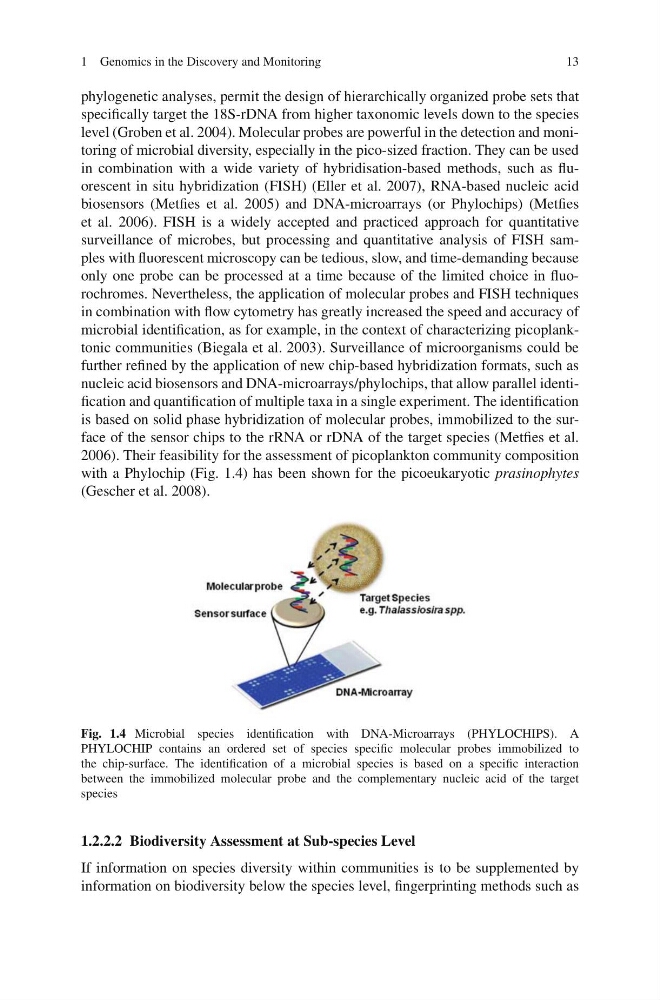
nucleic acid biosensors and DNA-microarrays/phylochips, that allow parallel identification and quantification of multiple taxa in a single experiment. The identification
is based on solid phase hybridization of molecular probes, immobilized to the surface of the sensor chips to the rRNA or rDNA of the target species (Metfies et al.
2006). Their feasibility for the assessment of picoplankton community composition
with a Phylochip (Fig. 1.4) has been shown for the picoeukaryotic prasinophytes
(Gescher et al. 2008).
Fig. 1.4 Microbial species identification with DNA-Microarrays (PHYLOCHIPS). A
PHYLOCHIP contains an ordered set of species specific molecular probes immobilized to
the chip-surface. The identification of a microbial species is based on a specific interaction
between the immobilized molecular probe and the complementary nucleic acid of the target
species
1.2.2.2 Biodiversity Assessment at Sub-species Level
If information on species diversity within communities is to be supplemented by
information on biodiversity below the species level, fingerprinting methods such as
13
phylogenetic analyses, permit the design of hierarchically organized probe sets that
specifically target the 18S-rDNA from higher taxonomic levels down to the species
level (Groben et al. 2004). Molecular probes are powerful in the detection and monitoring of microbial diversity, especially in the pico-sized fraction. They can be used
in combination with a wide variety of hybridisation-based methods, such as fluorescent in situ hybridization (FISH) (Eller et al. 2007), RNA-based nucleic acid
biosensors (Metfies et al. 2005) and DNA-microarrays (or Phylochips) (Metfies
et al. 2006). FISH is a widely accepted and practiced approach for quantitative
surveillance of microbes, but processing and quantitative analysis of FISH samples with fluorescent microscopy can be tedious, slow, and time-demanding because
only one probe can be processed at a time because of the limited choice in fluorochromes. Nevertheless, the application of molecular probes and FISH techniques
in combination with flow cytometry has greatly increased the speed and accuracy of
microbial identification, as for example, in the context of characterizing picoplanktonic communities (Biegala et al. 2003). Surveillance of microorganisms could be
further refined by the application of new chip-based hybridization formats, such as
nucleic acid biosensors and DNA-microarrays/phylochips, that allow parallel identification and quantification of multiple taxa in a single experiment. The identification
is based on solid phase hybridization of molecular probes, immobilized to the surface of the sensor chips to the rRNA or rDNA of the target species (Metfies et al.
2006). Their feasibility for the assessment of picoplankton community composition
with a Phylochip (Fig. 1.4) has been shown for the picoeukaryotic prasinophytes
(Gescher et al. 2008).
Fig. 1.4 Microbial species identification with DNA-Microarrays (PHYLOCHIPS). A
PHYLOCHIP contains an ordered set of species specific molecular probes immobilized to
the chip-surface. The identification of a microbial species is based on a specific interaction
between the immobilized molecular probe and the complementary nucleic acid of the target
species
1.2.2.2 Biodiversity Assessment at Sub-species Level
If information on species diversity within communities is to be supplemented by
information on biodiversity below the species level, fingerprinting methods such as