

240
M.L. Cancela et al.
of gene regulation that underlies certain biological functions associated with the
delivery of seafood, safe, with consistent quality and produced according to sound
sustainability standards.
7.6 Genomic Approaches in Host–Pathogen Interaction
7.6.1 Host–Parasite Interactions in Fish
In intensively cultured fish species like the European sea bass, the gilthead
seabream, the Atlantic salmon or the Senegal sole, infections are more likely to
occur and may cause significant economic losses, either directly through pathogen-induced mortality, or indirectly through the impossibility of selling infected
animals. Most teleost pathogens, classified in viral, bacterial and parasitical, are
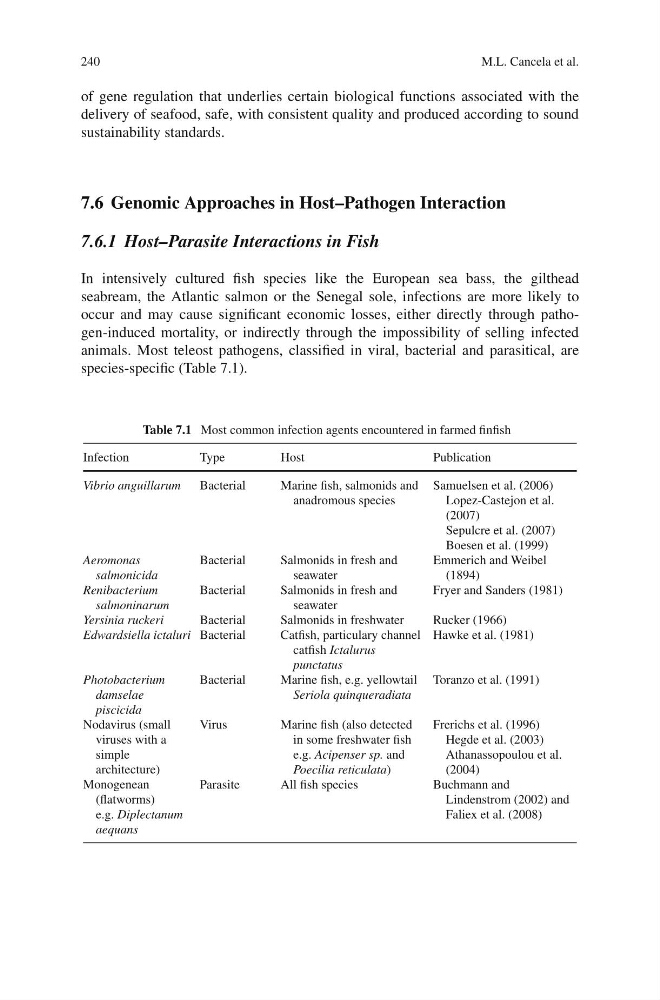
species-specific (Table 7.1).
Table 7.1 Most common infection agents encountered in farmed finfish
Infection
Type
Host
Publication
Vibrio anguillarum
Bacterial
Marine fish, salmonids and
anadromous species
Samuelsen et al. (2006)
Lopez-Castejon et al.
(2007)
Sepulcre et al. (2007)
Boesen et al. (1999)
Aeromonas
salmonicida
Bacterial
Salmonids in fresh and
seawater
Emmerich and Weibel
(1894)
Renibacterium
salmoninarum
Bacterial
Salmonids in fresh and
seawater
Fryer and Sanders (1981)
Yersinia ruckeri
Bacterial
Salmonids in freshwater
Rucker (1966)
Edwardsiella ictaluri Bacterial
Catfish, particulary channel
catfish Ictalurus
punctatus
Hawke et al. (1981)
Photobacterium
damselae
piscicida
Bacterial
Marine fish, e.g. yellowtail
Seriola quinqueradiata
Toranzo et al. (1991)
Nodavirus (small
viruses with a
simple
architecture)
Virus
Marine fish (also detected
in some freshwater fish
e.g. Acipenser sp. and
Poecilia reticulata)
Frerichs et al. (1996)
Hegde et al. (2003)
Athanassopoulou et al.
(2004)
Monogenean
(flatworms)
e.g. Diplectanum
aequans
Parasite
All fish species
Buchmann and
Lindenstrom (2002) and
Faliex et al. (2008)
M.L. Cancela et al.
of gene regulation that underlies certain biological functions associated with the
delivery of seafood, safe, with consistent quality and produced according to sound
sustainability standards.
7.6 Genomic Approaches in Host–Pathogen Interaction
7.6.1 Host–Parasite Interactions in Fish
In intensively cultured fish species like the European sea bass, the gilthead
seabream, the Atlantic salmon or the Senegal sole, infections are more likely to
occur and may cause significant economic losses, either directly through pathogen-induced mortality, or indirectly through the impossibility of selling infected
animals. Most teleost pathogens, classified in viral, bacterial and parasitical, are
species-specific (Table 7.1).
Table 7.1 Most common infection agents encountered in farmed finfish
Infection
Type
Host
Publication
Vibrio anguillarum
Bacterial
Marine fish, salmonids and
anadromous species
Samuelsen et al. (2006)
Lopez-Castejon et al.
(2007)
Sepulcre et al. (2007)
Boesen et al. (1999)
Aeromonas
salmonicida
Bacterial
Salmonids in fresh and
seawater
Emmerich and Weibel
(1894)
Renibacterium
salmoninarum
Bacterial
Salmonids in fresh and
seawater
Fryer and Sanders (1981)
Yersinia ruckeri
Bacterial
Salmonids in freshwater
Rucker (1966)
Edwardsiella ictaluri Bacterial
Catfish, particulary channel
catfish Ictalurus
punctatus
Hawke et al. (1981)
Photobacterium
damselae
piscicida
Bacterial
Marine fish, e.g. yellowtail
Seriola quinqueradiata
Toranzo et al. (1991)
Nodavirus (small
viruses with a
simple
architecture)
Virus
Marine fish (also detected
in some freshwater fish
e.g. Acipenser sp. and
Poecilia reticulata)
Frerichs et al. (1996)
Hegde et al. (2003)
Athanassopoulou et al.
(2004)
Monogenean
(flatworms)
e.g. Diplectanum
aequans
Parasite
All fish species
Buchmann and
Lindenstrom (2002) and
Faliex et al. (2008)