

6 Genomics of Marine Algae
181
genomic approaches has led to surprising and exciting new insights into algal biology. The following sections will look at several domains of algal research in detail
and will discuss the impact that genomic approaches have had in these areas.
6.3 Endosymbiosis and the Origins of the Algae
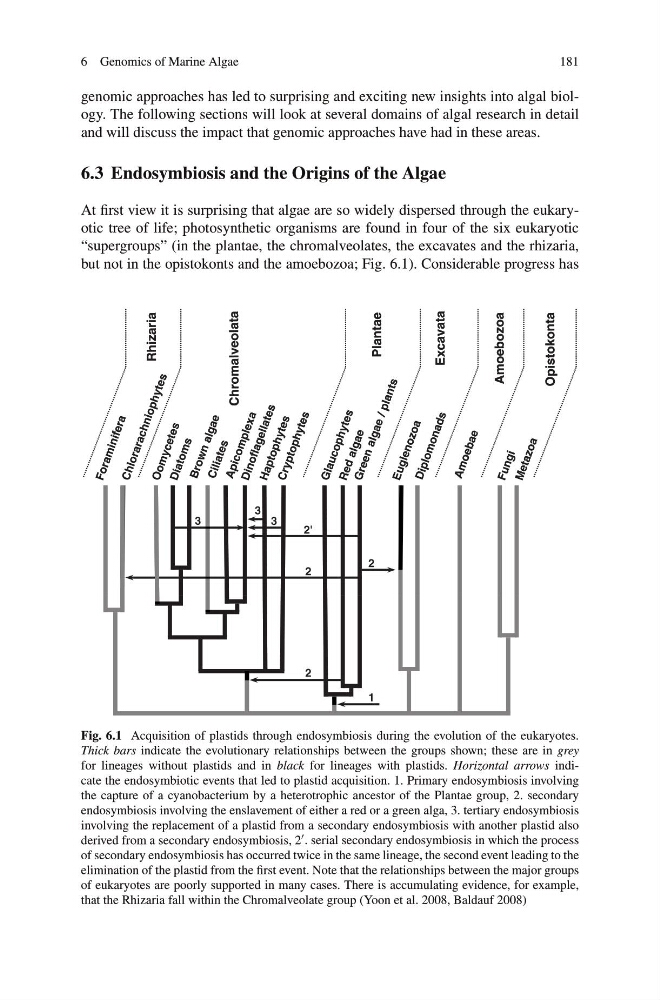
At first view it is surprising that algae are so widely dispersed through the eukaryotic tree of life; photosynthetic organisms are found in four of the six eukaryotic
“supergroups” (in the plantae, the chromalveolates, the excavates and the rhizaria,
but not in the opistokonts and the amoebozoa; Fig. 6.1). Considerable progress has
2
2
3
3
3
2'
1
2
Fig. 6.1 Acquisition of plastids through endosymbiosis during the evolution of the eukaryotes.
Thick bars indicate the evolutionary relationships between the groups shown; these are in grey
for lineages without plastids and in black for lineages with plastids. Horizontal arrows indicate the endosymbiotic events that led to plastid acquisition. 1. Primary endosymbiosis involving
the capture of a cyanobacterium by a heterotrophic ancestor of the Plantae group, 2. secondary
endosymbiosis involving the enslavement of either a red or a green alga, 3. tertiary endosymbiosis
involving the replacement of a plastid from a secondary endosymbiosis with another plastid also
derived from a secondary endosymbiosis, 2 . serial secondary endosymbiosis in which the process
of secondary endosymbiosis has occurred twice in the same lineage, the second event leading to the
elimination of the plastid from the first event. Note that the relationships between the major groups
of eukaryotes are poorly supported in many cases. There is accumulating evidence, for example,
that the Rhizaria fall within the Chromalveolate group (Yoon et al. 2008, Baldauf 2008)
181
genomic approaches has led to surprising and exciting new insights into algal biology. The following sections will look at several domains of algal research in detail
and will discuss the impact that genomic approaches have had in these areas.
6.3 Endosymbiosis and the Origins of the Algae
At first view it is surprising that algae are so widely dispersed through the eukaryotic tree of life; photosynthetic organisms are found in four of the six eukaryotic
“supergroups” (in the plantae, the chromalveolates, the excavates and the rhizaria,
but not in the opistokonts and the amoebozoa; Fig. 6.1). Considerable progress has
2
2
3
3
3
2'
1
2
Fig. 6.1 Acquisition of plastids through endosymbiosis during the evolution of the eukaryotes.
Thick bars indicate the evolutionary relationships between the groups shown; these are in grey
for lineages without plastids and in black for lineages with plastids. Horizontal arrows indicate the endosymbiotic events that led to plastid acquisition. 1. Primary endosymbiosis involving
the capture of a cyanobacterium by a heterotrophic ancestor of the Plantae group, 2. secondary
endosymbiosis involving the enslavement of either a red or a green alga, 3. tertiary endosymbiosis
involving the replacement of a plastid from a secondary endosymbiosis with another plastid also
derived from a secondary endosymbiosis, 2 . serial secondary endosymbiosis in which the process
of secondary endosymbiosis has occurred twice in the same lineage, the second event leading to the
elimination of the plastid from the first event. Note that the relationships between the major groups
of eukaryotes are poorly supported in many cases. There is accumulating evidence, for example,
that the Rhizaria fall within the Chromalveolate group (Yoon et al. 2008, Baldauf 2008)