

4
G.R. Carvalho et al.
Fourth, there is increasingly compelling evidence that sustainable ecosystem services depend upon diverse biota (reviewed by Palumbi et al. 2008a). For example,
using several independent indicators of ecosystem functioning and efficiency, a
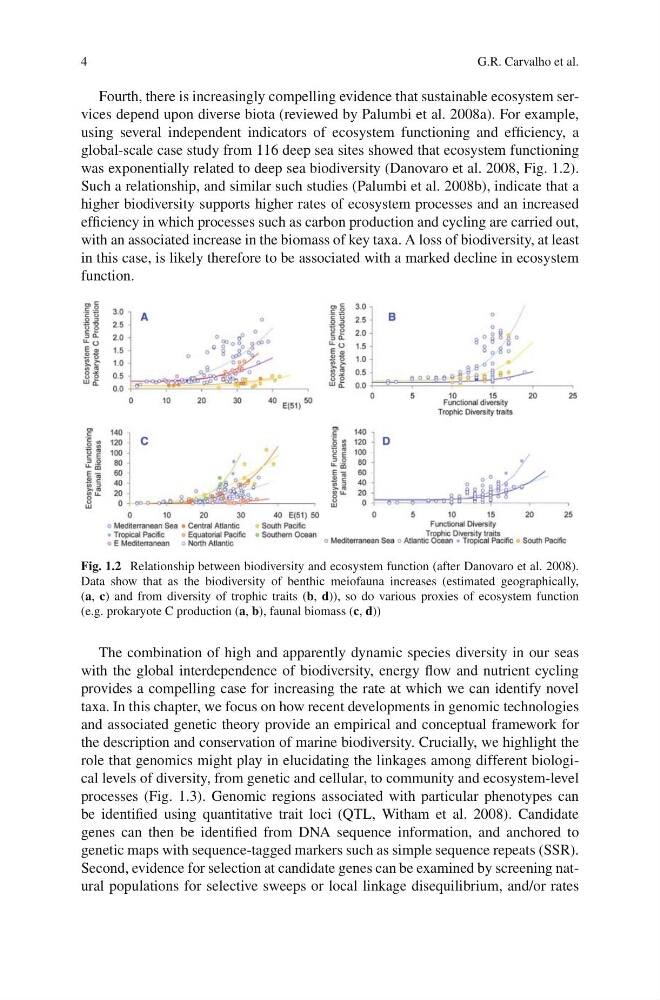
global-scale case study from 116 deep sea sites showed that ecosystem functioning
was exponentially related to deep sea biodiversity (Danovaro et al. 2008, Fig. 1.2).
Such a relationship, and similar such studies (Palumbi et al. 2008b), indicate that a
higher biodiversity supports higher rates of ecosystem processes and an increased
efficiency in which processes such as carbon production and cycling are carried out,
with an associated increase in the biomass of key taxa. A loss of biodiversity, at least
in this case, is likely therefore to be associated with a marked decline in ecosystem
function.
Fig. 1.2 Relationship between biodiversity and ecosystem function (after Danovaro et al. 2008).
Data show that as the biodiversity of benthic meiofauna increases (estimated geographically,
(a, c) and from diversity of trophic traits (b, d)), so do various proxies of ecosystem function
(e.g. prokaryote C production (a, b), faunal biomass (c, d))
The combination of high and apparently dynamic species diversity in our seas
with the global interdependence of biodiversity, energy flow and nutrient cycling
provides a compelling case for increasing the rate at which we can identify novel
taxa. In this chapter, we focus on how recent developments in genomic technologies
and associated genetic theory provide an empirical and conceptual framework for
the description and conservation of marine biodiversity. Crucially, we highlight the
role that genomics might play in elucidating the linkages among different biological levels of diversity, from genetic and cellular, to community and ecosystem-level
processes (Fig. 1.3). Genomic regions associated with particular phenotypes can
be identified using quantitative trait loci (QTL, Witham et al. 2008). Candidate
genes can then be identified from DNA sequence information, and anchored to
genetic maps with sequence-tagged markers such as simple sequence repeats (SSR).
Second, evidence for selection at candidate genes can be examined by screening natural populations for selective sweeps or local linkage disequilibrium, and/or rates
G.R. Carvalho et al.
Fourth, there is increasingly compelling evidence that sustainable ecosystem services depend upon diverse biota (reviewed by Palumbi et al. 2008a). For example,
using several independent indicators of ecosystem functioning and efficiency, a
global-scale case study from 116 deep sea sites showed that ecosystem functioning
was exponentially related to deep sea biodiversity (Danovaro et al. 2008, Fig. 1.2).
Such a relationship, and similar such studies (Palumbi et al. 2008b), indicate that a
higher biodiversity supports higher rates of ecosystem processes and an increased
efficiency in which processes such as carbon production and cycling are carried out,
with an associated increase in the biomass of key taxa. A loss of biodiversity, at least
in this case, is likely therefore to be associated with a marked decline in ecosystem
function.
Fig. 1.2 Relationship between biodiversity and ecosystem function (after Danovaro et al. 2008).
Data show that as the biodiversity of benthic meiofauna increases (estimated geographically,
(a, c) and from diversity of trophic traits (b, d)), so do various proxies of ecosystem function
(e.g. prokaryote C production (a, b), faunal biomass (c, d))
The combination of high and apparently dynamic species diversity in our seas
with the global interdependence of biodiversity, energy flow and nutrient cycling
provides a compelling case for increasing the rate at which we can identify novel
taxa. In this chapter, we focus on how recent developments in genomic technologies
and associated genetic theory provide an empirical and conceptual framework for
the description and conservation of marine biodiversity. Crucially, we highlight the
role that genomics might play in elucidating the linkages among different biological levels of diversity, from genetic and cellular, to community and ecosystem-level
processes (Fig. 1.3). Genomic regions associated with particular phenotypes can
be identified using quantitative trait loci (QTL, Witham et al. 2008). Candidate
genes can then be identified from DNA sequence information, and anchored to
genetic maps with sequence-tagged markers such as simple sequence repeats (SSR).
Second, evidence for selection at candidate genes can be examined by screening natural populations for selective sweeps or local linkage disequilibrium, and/or rates