

164
F. Raible and P.R.H. Steinmetz
selected BAC sequences, with additional efforts directed towards the generation of
a comprehensive EST dataset and a finished whole-genome sequence by the end of
2010. Moreover, Platynereis has a long history as an experimental model system,
and gene delivery and gene interference tools are currently being established, adding
to the available techniques for high-resolution gene expression studies (Jekely and
Arendt 2007, Tessmar-Raible et al. 2005).
Based on the available EST and BAC sequences, a subset of the Platynereis transcriptome and genome has recently been used for a first systematic assessment of its
gene structure and the evolution of its proteome. This study found a remarkable similarity between Platynereis and human genes, both with respect to their exon/intron
organisation and concerning the speed with which the encoded proteins are evolving
(Raible et al. 2005). These data provided for the first time evidence for the ancestrality of a large share of human introns, a notion that has since also been confirmed
by the genomic analyses in the cnidarian Nematostella (Putnam et al. 2007). One
illustrative example for this phenomenon and possible impacts on the evolution of
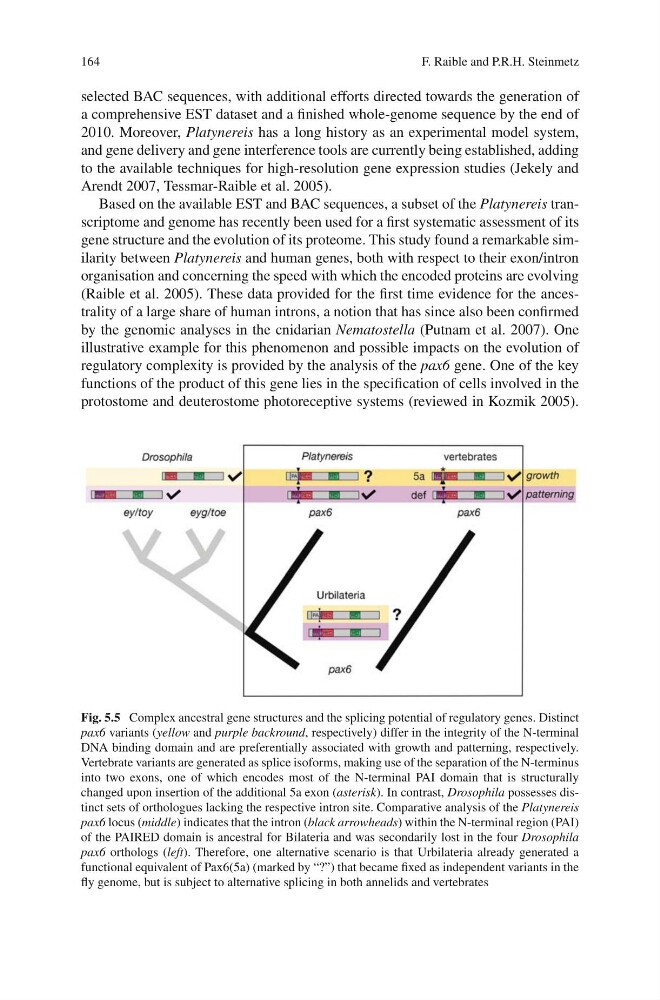
regulatory complexity is provided by the analysis of the pax6 gene. One of the key
functions of the product of this gene lies in the specification of cells involved in the
protostome and deuterostome photoreceptive systems (reviewed in Kozmik 2005).
Fig. 5.5 Complex ancestral gene structures and the splicing potential of regulatory genes. Distinct
pax6 variants (yellow and purple backround, respectively) differ in the integrity of the N-terminal
DNA binding domain and are preferentially associated with growth and patterning, respectively.
Vertebrate variants are generated as splice isoforms, making use of the separation of the N-terminus
into two exons, one of which encodes most of the N-terminal PAI domain that is structurally
changed upon insertion of the additional 5a exon (asterisk). In contrast, Drosophila possesses distinct sets of orthologues lacking the respective intron site. Comparative analysis of the Platynereis
pax6 locus (middle) indicates that the intron (black arrowheads) within the N-terminal region (PAI)
of the PAIRED domain is ancestral for Bilateria and was secondarily lost in the four Drosophila
pax6 orthologs (left). Therefore, one alternative scenario is that Urbilateria already generated a
functional equivalent of Pax6(5a) (marked by “?”) that became fixed as independent variants in the
fly genome, but is subject to alternative splicing in both annelids and vertebrates
F. Raible and P.R.H. Steinmetz
selected BAC sequences, with additional efforts directed towards the generation of
a comprehensive EST dataset and a finished whole-genome sequence by the end of
2010. Moreover, Platynereis has a long history as an experimental model system,
and gene delivery and gene interference tools are currently being established, adding
to the available techniques for high-resolution gene expression studies (Jekely and
Arendt 2007, Tessmar-Raible et al. 2005).
Based on the available EST and BAC sequences, a subset of the Platynereis transcriptome and genome has recently been used for a first systematic assessment of its
gene structure and the evolution of its proteome. This study found a remarkable similarity between Platynereis and human genes, both with respect to their exon/intron
organisation and concerning the speed with which the encoded proteins are evolving
(Raible et al. 2005). These data provided for the first time evidence for the ancestrality of a large share of human introns, a notion that has since also been confirmed
by the genomic analyses in the cnidarian Nematostella (Putnam et al. 2007). One
illustrative example for this phenomenon and possible impacts on the evolution of
regulatory complexity is provided by the analysis of the pax6 gene. One of the key
functions of the product of this gene lies in the specification of cells involved in the
protostome and deuterostome photoreceptive systems (reviewed in Kozmik 2005).
Fig. 5.5 Complex ancestral gene structures and the splicing potential of regulatory genes. Distinct
pax6 variants (yellow and purple backround, respectively) differ in the integrity of the N-terminal
DNA binding domain and are preferentially associated with growth and patterning, respectively.
Vertebrate variants are generated as splice isoforms, making use of the separation of the N-terminus
into two exons, one of which encodes most of the N-terminal PAI domain that is structurally
changed upon insertion of the additional 5a exon (asterisk). In contrast, Drosophila possesses distinct sets of orthologues lacking the respective intron site. Comparative analysis of the Platynereis
pax6 locus (middle) indicates that the intron (black arrowheads) within the N-terminal region (PAI)
of the PAIRED domain is ancestral for Bilateria and was secondarily lost in the four Drosophila
pax6 orthologs (left). Therefore, one alternative scenario is that Urbilateria already generated a
functional equivalent of Pax6(5a) (marked by “?”) that became fixed as independent variants in the
fly genome, but is subject to alternative splicing in both annelids and vertebrates