

158
F. Raible and P.R.H. Steinmetz
which is expressed in the Nematostella oral endoderm on both ends of the directive
axis (Matus et al. 2006a), or orthologues of the anterior marker otx, which are
expressed radially along the entire oral-aboral axis, allow for the same conclusion
(de Jong et al. 2006, Mazza et al. 2007). The reason why no axis can be directly
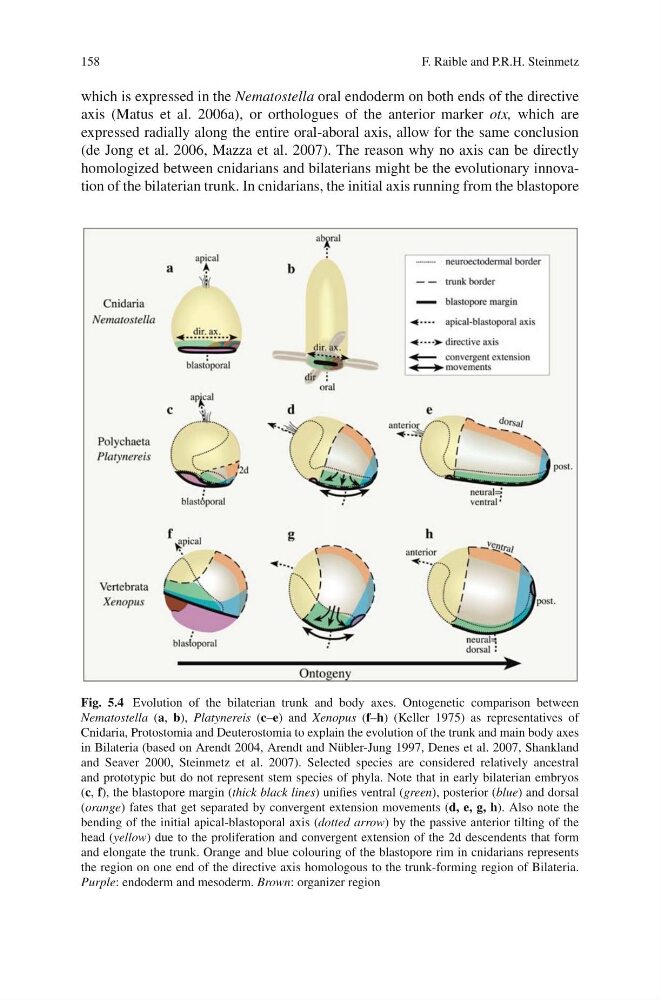
homologized between cnidarians and bilaterians might be the evolutionary innovation of the bilaterian trunk. In cnidarians, the initial axis running from the blastopore
Fig. 5.4 Evolution of the bilaterian trunk and body axes. Ontogenetic comparison between
Nematostella (a, b), Platynereis (c–e) and Xenopus (f–h) (Keller 1975) as representatives of
Cnidaria, Protostomia and Deuterostomia to explain the evolution of the trunk and main body axes
in Bilateria (based on Arendt 2004, Arendt and Nübler-Jung 1997, Denes et al. 2007, Shankland
and Seaver 2000, Steinmetz et al. 2007). Selected species are considered relatively ancestral
and prototypic but do not represent stem species of phyla. Note that in early bilaterian embryos
(c, f), the blastopore margin (thick black lines) unifies ventral (green), posterior (blue) and dorsal
(orange) fates that get separated by convergent extension movements (d, e, g, h). Also note the
bending of the initial apical-blastoporal axis (dotted arrow) by the passive anterior tilting of the
head (yellow) due to the proliferation and convergent extension of the 2d descendents that form
and elongate the trunk. Orange and blue colouring of the blastopore rim in cnidarians represents
the region on one end of the directive axis homologous to the trunk-forming region of Bilateria.
Purple: endoderm and mesoderm. Brown: organizer region
F. Raible and P.R.H. Steinmetz
which is expressed in the Nematostella oral endoderm on both ends of the directive
axis (Matus et al. 2006a), or orthologues of the anterior marker otx, which are
expressed radially along the entire oral-aboral axis, allow for the same conclusion
(de Jong et al. 2006, Mazza et al. 2007). The reason why no axis can be directly
homologized between cnidarians and bilaterians might be the evolutionary innovation of the bilaterian trunk. In cnidarians, the initial axis running from the blastopore
Fig. 5.4 Evolution of the bilaterian trunk and body axes. Ontogenetic comparison between
Nematostella (a, b), Platynereis (c–e) and Xenopus (f–h) (Keller 1975) as representatives of
Cnidaria, Protostomia and Deuterostomia to explain the evolution of the trunk and main body axes
in Bilateria (based on Arendt 2004, Arendt and Nübler-Jung 1997, Denes et al. 2007, Shankland
and Seaver 2000, Steinmetz et al. 2007). Selected species are considered relatively ancestral
and prototypic but do not represent stem species of phyla. Note that in early bilaterian embryos
(c, f), the blastopore margin (thick black lines) unifies ventral (green), posterior (blue) and dorsal
(orange) fates that get separated by convergent extension movements (d, e, g, h). Also note the
bending of the initial apical-blastoporal axis (dotted arrow) by the passive anterior tilting of the
head (yellow) due to the proliferation and convergent extension of the 2d descendents that form
and elongate the trunk. Orange and blue colouring of the blastopore rim in cnidarians represents
the region on one end of the directive axis homologous to the trunk-forming region of Bilateria.
Purple: endoderm and mesoderm. Brown: organizer region