

5 Metazoan Complexity
151
(see Chapter 4 and below for a discussion on the position of Trichoplax) and the
first animals with embryonic and larval development. Comparison of cell adhesion
and ECM-interacting proteins of different sponge groups with choanoflagellates
and eumetazoans has helped to identify crucial events during the evolution of
animal multicellularity. In addition, comparative study of developmentally relevant
transcription factors and signalling molecules has provided a deeper understanding
of the early evolution of embryonic and larval development including germ layer
separation, axis specification and embryonic differentiation.
As described in the introduction, animal complexity is often correlated with
cell type diversity. As cell types are specified by characteristic combinations of
transcription factors (the “molecular fingerprint”) (Arendt 2005), the expansion of
transcription factor families might be a proxy for cell type diversification (Vogel and
Chothia 2006). This hypothesis is being tested by determining the repertoire of transcription factor subclasses in extant sponges cnidarians and bilaterians to reconstruct
their emergence during animal evolution. Already in the demosponge reference
species Amphimedon all major metazoan transcription factor classes are present.
Phylogenetic analyses have explored in detail the relationship of the Amphimedon
bHLH, Fox, Sox, T-box, Paired-like, Antennapedia, NK, TALE, Six, POU and
LIM homeodomain proteins with their correlates in other animals (Adell et al.
2003, Adell and Müller 2004, 2005, Jager et al. 2005, Larroux et al. 2007, 2006,
2008, Manuel and Le Parco 2000, Manuel et al. 2004, Simionato et al. 2007).
This approach has proved useful to date the extent of gene families at the base of
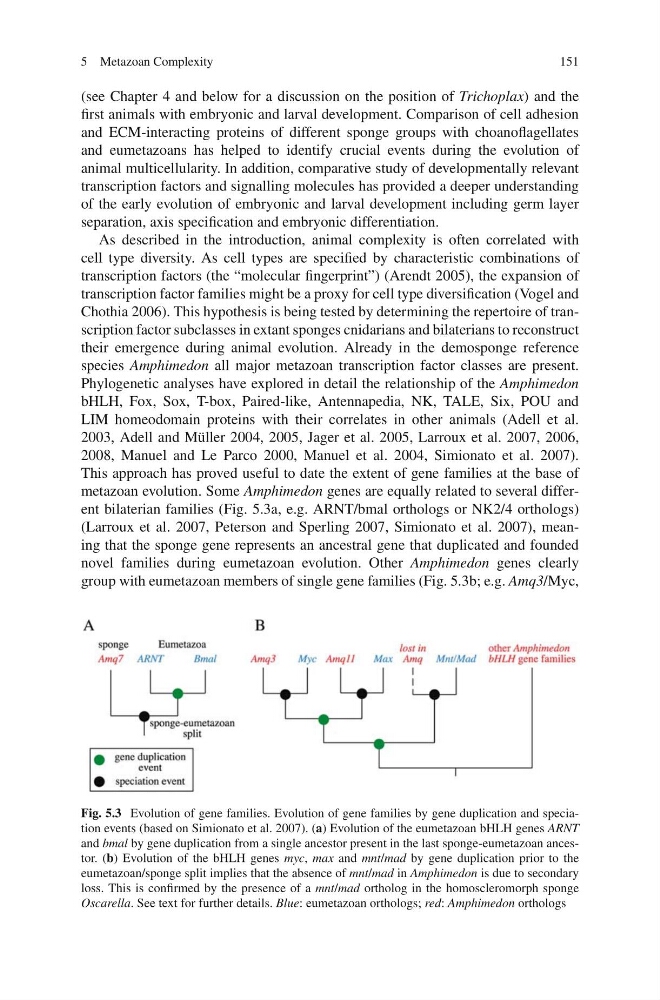
metazoan evolution. Some Amphimedon genes are equally related to several different bilaterian families (Fig. 5.3a, e.g. ARNT/bmal orthologs or NK2/4 orthologs)
(Larroux et al. 2007, Peterson and Sperling 2007, Simionato et al. 2007), meaning that the sponge gene represents an ancestral gene that duplicated and founded
novel families during eumetazoan evolution. Other Amphimedon genes clearly
group with eumetazoan members of single gene families (Fig. 5.3b; e.g. Amq3/Myc,
Fig. 5.3 Evolution of gene families. Evolution of gene families by gene duplication and speciation events (based on Simionato et al. 2007). (a) Evolution of the eumetazoan bHLH genes ARNT
and bmal by gene duplication from a single ancestor present in the last sponge-eumetazoan ancestor. (b) Evolution of the bHLH genes myc, max and mnt/mad by gene duplication prior to the
eumetazoan/sponge split implies that the absence of mnt/mad in Amphimedon is due to secondary
loss. This is confirmed by the presence of a mnt/mad ortholog in the homoscleromorph sponge
Oscarella. See text for further details. Blue: eumetazoan orthologs; red: Amphimedon orthologs
151
(see Chapter 4 and below for a discussion on the position of Trichoplax) and the
first animals with embryonic and larval development. Comparison of cell adhesion
and ECM-interacting proteins of different sponge groups with choanoflagellates
and eumetazoans has helped to identify crucial events during the evolution of
animal multicellularity. In addition, comparative study of developmentally relevant
transcription factors and signalling molecules has provided a deeper understanding
of the early evolution of embryonic and larval development including germ layer
separation, axis specification and embryonic differentiation.
As described in the introduction, animal complexity is often correlated with
cell type diversity. As cell types are specified by characteristic combinations of
transcription factors (the “molecular fingerprint”) (Arendt 2005), the expansion of
transcription factor families might be a proxy for cell type diversification (Vogel and
Chothia 2006). This hypothesis is being tested by determining the repertoire of transcription factor subclasses in extant sponges cnidarians and bilaterians to reconstruct
their emergence during animal evolution. Already in the demosponge reference
species Amphimedon all major metazoan transcription factor classes are present.
Phylogenetic analyses have explored in detail the relationship of the Amphimedon
bHLH, Fox, Sox, T-box, Paired-like, Antennapedia, NK, TALE, Six, POU and
LIM homeodomain proteins with their correlates in other animals (Adell et al.
2003, Adell and Müller 2004, 2005, Jager et al. 2005, Larroux et al. 2007, 2006,
2008, Manuel and Le Parco 2000, Manuel et al. 2004, Simionato et al. 2007).
This approach has proved useful to date the extent of gene families at the base of
metazoan evolution. Some Amphimedon genes are equally related to several different bilaterian families (Fig. 5.3a, e.g. ARNT/bmal orthologs or NK2/4 orthologs)
(Larroux et al. 2007, Peterson and Sperling 2007, Simionato et al. 2007), meaning that the sponge gene represents an ancestral gene that duplicated and founded
novel families during eumetazoan evolution. Other Amphimedon genes clearly
group with eumetazoan members of single gene families (Fig. 5.3b; e.g. Amq3/Myc,
Fig. 5.3 Evolution of gene families. Evolution of gene families by gene duplication and speciation events (based on Simionato et al. 2007). (a) Evolution of the eumetazoan bHLH genes ARNT
and bmal by gene duplication from a single ancestor present in the last sponge-eumetazoan ancestor. (b) Evolution of the bHLH genes myc, max and mnt/mad by gene duplication prior to the
eumetazoan/sponge split implies that the absence of mnt/mad in Amphimedon is due to secondary
loss. This is confirmed by the presence of a mnt/mad ortholog in the homoscleromorph sponge
Oscarella. See text for further details. Blue: eumetazoan orthologs; red: Amphimedon orthologs